My Cart
Your Cart 0

    Your cart is empty.

  • Total (Amount) ₹0.00
Previous year question hub

Reynolds Transport Theorem and Conservation Laws - Integral Analysis for a Control Volume - Engineering Sciences Previous Year Questions

Practice Reynolds Transport Theorem and Conservation Laws - Integral Analysis for a Control Volume - Engineering Sciences previous year questions organised from real papers, with year-wise coverage and clear topic navigation.

13Papers
13Years
25Questions
1Topics

Reynolds Transport Theorem and Conservation Laws question pattern

Every graph below is calculated only from this selection.

Questions by year

Year-wise coverage for Reynolds Transport Theorem and Conservation Laws. Each bar uses a separate theme-derived color.

Difficulty distribution

How the classified questions are distributed by difficulty.

Medium 18 72%
Easy 7 28%

Question type distribution

MCQ, numerical, multiple-select and other formats found in these papers.

MCQ 12 48%
Numerical Answer Type (NAT) 12 48%
MSQ 1 4%

Subject weightage

Top subjects by unique question coverage.

Engineering Sciences
25 Qs

Most asked topics

Top topics across the included previous year papers.

Integral Analysis for a Control Volume
25 Qs

Subtopic coverage

Top subtopics inside this exact selection.

Reynolds Transport Theorem and Conservation Laws
25 Qs

Paper coverage

Question coverage for the most populated papers. Every active PYP paper remains listed below.

Engineering Sciences (XE) 2026
1 Qs
Engineering Sciences (XE) 2025
2 Qs
Engineering Sciences (XE) 2024
4 Qs
Engineering Sciences (XE) 2022
2 Qs
Engineering Sciences (XE) 2021
3 Qs
Engineering Sciences (XE) 2020
1 Qs
Engineering Sciences (XE) 2019
2 Qs
Engineering Sciences (XE) 2014
1 Qs
Engineering Sciences (XE) 2013
2 Qs
Engineering Sciences (XE) 2012
2 Qs
Engineering Sciences (XE) 2011
1 Qs
Engineering Sciences (XE) 2008
2 Qs
Engineering Sciences (XE) 2007
2 Qs

Included previous year papers

Newest papers appear first. Sort by year, question coverage or name.

PaperYear / sessionQuestions in this viewOpen
Engineering Sciences (XE) 202620261View paper
Engineering Sciences (XE) 202520252View paper
Engineering Sciences (XE) 202420244View paper
Engineering Sciences (XE) 202220222View paper
Engineering Sciences (XE) 202120213View paper
Engineering Sciences (XE) 202020201View paper
Engineering Sciences (XE) 201920192View paper
Engineering Sciences (XE) 201420141View paper
Engineering Sciences (XE) 201320132View paper
Engineering Sciences (XE) 201220122View paper
Engineering Sciences (XE) 201120111View paper
Engineering Sciences (XE) 200820082View paper
Engineering Sciences (XE) 200720072View paper

All Reynolds Transport Theorem and Conservation Laws previous year questions

Practice every matching question in batches of 20, with every available option.

1
2007 · Engineering Sciences · Integral Analysis for a Control Volume · Reynolds Transport Theorem and Conservation Laws
Engineering Sciences (XE) 2007

The power utilized for propelling the boat is

Open complete paper
2
2007 · Engineering Sciences · Integral Analysis for a Control Volume · Reynolds Transport Theorem and Conservation Laws
Engineering Sciences (XE) 2007
Water enters a pipe of cross-sectional area \(A_1\) that branches out into sections of equal areas \(A_2\) and \(A_3\), as shown in the figure below. At one instant, the flow velocities are \(V_1 = 2\) m/s, \(V_2 = 3\) m/s and \(V_3 = 5\) m/s. At another instant, \(V_1 = 3\) m/s and \(V_2 = 4\) m/s. What is the value of \(V_3\) at this instant?
Open complete paper
3
2008 · Engineering Sciences · Integral Analysis for a Control Volume · Reynolds Transport Theorem and Conservation Laws
Engineering Sciences (XE) 2008
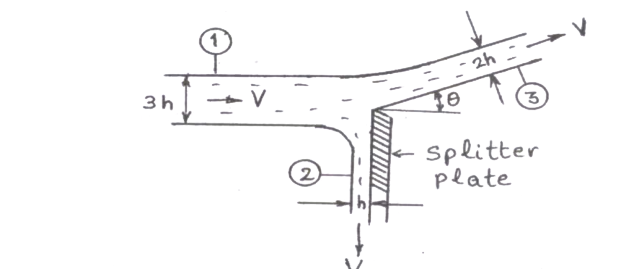
A two-dimensional water jet hits a splitter plate as shown. The velocities at sections ①, ② and ③ may be taken as uniform and equal to V. The weight of the water and the friction along the plate may be neglected. For the data shown what is θ?

Question diagram

Open complete paper
4
2008 · Engineering Sciences · Integral Analysis for a Control Volume · Reynolds Transport Theorem and Conservation Laws
Engineering Sciences (XE) 2008
A single engine jet aircraft is in a steady level flight at speed \(V_a\) with respect to ground. Assume that the engine intake area (\(A_{in}\)) is much larger than the engine exhaust area (\(A_e\)). If the density of the exhaust gas is \(\rho_e\) and the exhaust velocity relative to the aircraft is \(V_e\), the thrust generated by the engine is
Open complete paper
5
2011 · Engineering Sciences · Integral Analysis for a Control Volume · Reynolds Transport Theorem and Conservation Laws
Engineering Sciences (XE) 2011
After splitting, the velocity of the upward half-jet along the plate is
Open complete paper
6
2012 · Engineering Sciences · Integral Analysis for a Control Volume · Reynolds Transport Theorem and Conservation Laws
Engineering Sciences (XE) 2012
The total kinetic energy imparted to the water per second (in kW) by the pump is
Open complete paper
7
2012 · Engineering Sciences · Integral Analysis for a Control Volume · Reynolds Transport Theorem and Conservation Laws
Engineering Sciences (XE) 2012
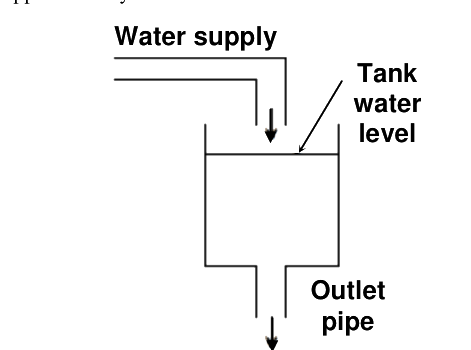
Water is supplied to a tank at the rate of \(0.02\text{ m}^3/\text{s}\), as shown in the figure below. The cross-sectional area of the tank is \(1\text{ m}^2\) and the inner diameter of the outlet pipe is \(60\text{ mm}\). At a time when the water level in the tank is increasing at the rate of \(5\text{ mm/s}\), the average velocity (in m/s) of water in the outlet pipe is approximately

Question diagram

Open complete paper
8
2013 · Engineering Sciences · Integral Analysis for a Control Volume · Reynolds Transport Theorem and Conservation Laws
Engineering Sciences (XE) 2013

The magnitude of the force, in kN, required to hold the pipe in place, is

Open complete paper
9
2013 · Engineering Sciences · Integral Analysis for a Control Volume · Reynolds Transport Theorem and Conservation Laws
Engineering Sciences (XE) 2013
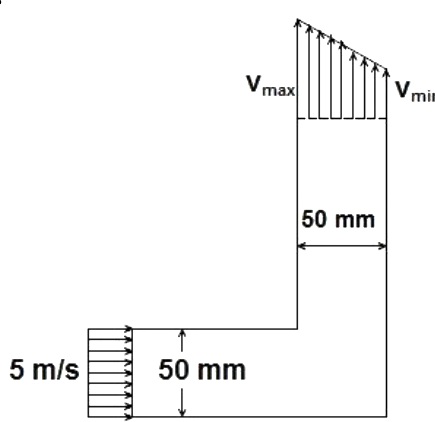
An incompressible fluid at a pressure of 150 kPa (absolute) flows steadily through a two-dimensional channel with a velocity of 5 m/s as shown in the Figure. The channel has a 90° bend. The fluid leaves the channel with a pressure of 100 kPa (absolute) and linearly-varying velocity profile. \(v_{max}\) is four times \(v_{min}\). The density of the fluid is 914.3 kg/m³. The velocity \(v_{min}\), in m/s, is

Question diagram

Open complete paper
10
2014 · Engineering Sciences · Integral Analysis for a Control Volume · Reynolds Transport Theorem and Conservation Laws
Engineering Sciences (XE) 2014
A reducing elbow is used to deflect water upward by \(30^{\circ}\) as shown in the figure. The mass flow rate at the inlet is 14 kg/s. Water is entering at a gauge pressure of 200 kPa and exits to the atmosphere. The cross-sectional area is \(113 \text{ cm}^2\) at the inlet and \(7 \text{ cm}^2\) at the exit. Density of water and acceleration due to gravity are 1000 kg/m³ and 10 m/s², respectively. Magnitude of \(x\)-component of the water force on the elbow is ____ N.
Open complete paper
11
2019 · Engineering Sciences · Integral Analysis for a Control Volume · Reynolds Transport Theorem and Conservation Laws
Engineering Sciences (XE) 2019
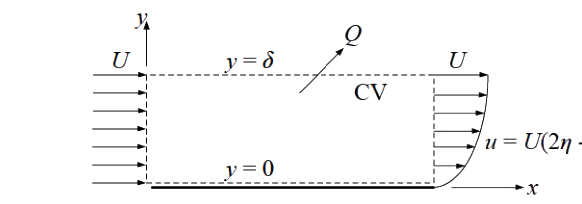
An incompressible fluid flows past a flat plate as shown in the figure below with a uniform inlet velocity profile u = U and a parabolic exit velocity profile u = U(2η - η²), where u is the component of velocity parallel to the wall, y is the normal distance from the plate and η = y/δ. If the volume flow rate across the top surface of the control volume (CV) is Q = pUδ per unit width (perpendicular to the x-y plane) of the plate, the value of p (rounded off to 2 decimal places) is ______

Question diagram

Open complete paper
12
2019 · Engineering Sciences · Integral Analysis for a Control Volume · Reynolds Transport Theorem and Conservation Laws
Engineering Sciences (XE) 2019
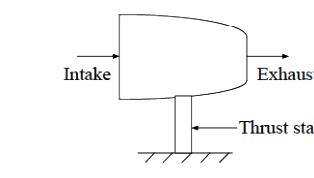
A jet engine is to be tested on a thrust stand as shown in the figure below. The conditions prevailing in a typical test are as follows: Axial intake air velocity = 100 m/s; axial exhaust gas velocity = 250 m/s; intake cross-sectional area = 1 m\(^2\); intake static pressure = –22 kPa (gauge); exhaust static pressure = 0 kPa (gauge); mass flow rate through the engine = 100 kg/s. The anchoring force (in kN) in axial direction on the thrust stand is ______

Question diagram

Open complete paper
13
2020 · Engineering Sciences · Integral Analysis for a Control Volume · Reynolds Transport Theorem and Conservation Laws
Engineering Sciences (XE) 2020
A liquid flow through a horizontal smooth pipe of diameter 5 cm and discharges into a collection tank of dimension 50 cm x 50 cm x 50 cm. Time taken for a 10 cm rise of liquid level in the collection tank is 40 s.

The flow velocity in the pipe is -------- m/s (rounded off to two decimal places).
Open complete paper
14
2021 · Engineering Sciences · Integral Analysis for a Control Volume · Reynolds Transport Theorem and Conservation Laws
Engineering Sciences (XE) 2021
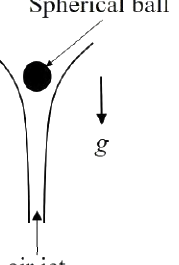
A spherical ball is steadily supported against gravity by an upward air jet as shown in the figure. Take acceleration due to gravity to be \( g = 10\, \text{m/s}^2 \). The mass flow rate of air, reaching the ball, is 0.01 kg/s and the air reaches the ball at an upward velocity of 3 m/s. Neglecting the buoyancy force, and using the principle of integral momentum balance, the mass (in grams, up to one decimal place) of the ball is ____.

Question diagram

Open complete paper
15
2021 · Engineering Sciences · Integral Analysis for a Control Volume · Reynolds Transport Theorem and Conservation Laws
Engineering Sciences (XE) 2021
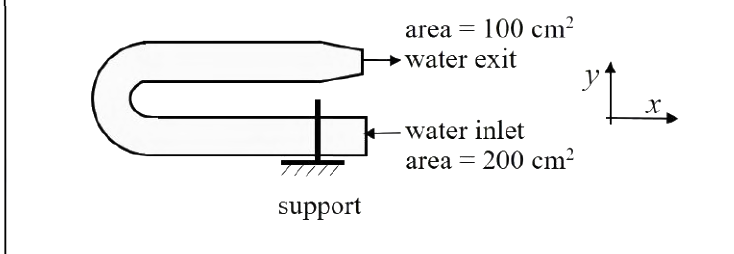
Water (density = 10^3 kg/m^3) enters steadily into a horizontal pipe bend, which is part of a larger piping system, as shown in the figure. The volumetric flow rate of water is 0.1 m^3/s. The gage pressure at the inlet is 500 kPa, while the exit is open to atmosphere. The x-component of the force on the support is F. The absolute value of F (in kN, up to one decimal place) is ____.

Question diagram

Open complete paper
16
2021 · Engineering Sciences · Integral Analysis for a Control Volume · Reynolds Transport Theorem and Conservation Laws
Engineering Sciences (XE) 2021
Air (of density 0.5 kg/m^3) enters horizontally into a jet engine at a steady speed of 200 m/s through an inlet area of 1.0 m^2. Upon entering the engine, the air passes through the combustion chamber and the exhaust gas exits the jet engine horizontally at a constant speed of 700 m/s. The fuel mass flow rate added in the combustion chamber is negligible compared to the air mass flow rate. Also neglect the pressure difference between the inlet air and the exhaust gas. The absolute value of the horizontal force (in kN, up to one decimal place) on the jet engine is ____.
Open complete paper
17
2022 · Engineering Sciences · Integral Analysis for a Control Volume · Reynolds Transport Theorem and Conservation Laws
Engineering Sciences (XE) 2022
A 10 kg mass placed on an infinitely long horizontal massless flat platform is to be supported by a steady vertical water jet as shown in the figure. The diameter of the jet is 5 cm. What minimum average velocity is required to hold the mass in place?
Assume \(\rho_{water} = 1000 \text{ kg/m}^3\), \(g = 10 \frac{\text{m}}{\text{s}^2}\) and \(\pi = 3.14\). Neglect friction.

(Round off to two decimal places)
Open complete paper
18
2022 · Engineering Sciences · Integral Analysis for a Control Volume · Reynolds Transport Theorem and Conservation Laws
Engineering Sciences (XE) 2022
Consider a lawn sprinkler with horizontal arms of radius, \(a = 10 \text{ cm}\) which has water introduced vertically through the centre, as shown in the figure. The exit area of the jet is \(25 \text{ cm}^2\) and the jet velocity is \(1 \text{ m/s}\). The water is ejected orthogonal to the sprinkler arm and the jet makes an angle of \(60^\circ\) with the horizontal plane. Find the torque (in N-m) required to hold the sprinkler stationary.
Consider water density \(1000 \text{ kg/m}^3\). Neglect the effects of friction and gravity.

(Round off to two decimal places)
Open complete paper
19
2024 · Engineering Sciences · Integral Analysis for a Control Volume · Reynolds Transport Theorem and Conservation Laws
Engineering Sciences (XE) 2024
Let \( \vec{r}, \vec{V}, \) and \( m \) be position vector, velocity vector, and mass, respectively in a control mass system. Which one of the following properties is considered as conserved extensive property in Reynolds Transport Theorem to obtain the angular momentum equation?
Open complete paper
20
2024 · Engineering Sciences · Integral Analysis for a Control Volume · Reynolds Transport Theorem and Conservation Laws
Engineering Sciences (XE) 2024
A circular water jet of diameter 50 mm impinges with a velocity of 18 m/s normal to a plate. The density of water is 1000 kg/m³ and gravity force is neglected. The magnitude of net force (in N, rounded off to two decimal places) imparted by the jet on the stationary plate is ______.
Open complete paper

Showing 20 of 25 questions