My Cart
Your Cart 0

    Your cart is empty.

  • Total (Amount) ₹0.00
Previous year question hub

Microbial Growth - Food Microbiology - Engineering Sciences Previous Year Questions

Practice Microbial Growth - Food Microbiology - Engineering Sciences previous year questions organised from real papers, with year-wise coverage and clear topic navigation.

13Papers
13Years
19Questions
1Topics

Microbial Growth question pattern

Every graph below is calculated only from this selection.

Questions by year

Year-wise coverage for Microbial Growth. Each bar uses a separate theme-derived color.

Difficulty distribution

How the classified questions are distributed by difficulty.

Easy 11 57.9%
Medium 8 42.1%

Question type distribution

MCQ, numerical, multiple-select and other formats found in these papers.

MCQ 13 68.4%
Numerical Answer Type (NAT) 6 31.6%

Subject weightage

Top subjects by unique question coverage.

Engineering Sciences
19 Qs

Most asked topics

Top topics across the included previous year papers.

Food Microbiology
19 Qs

Subtopic coverage

Top subtopics inside this exact selection.

Microbial Growth
19 Qs

Paper coverage

Question coverage for the most populated papers. Every active PYP paper remains listed below.

Engineering Sciences (XE) 2024
1 Qs
Engineering Sciences (XE) 2023
1 Qs
Engineering Sciences (XE) 2022
1 Qs
Engineering Sciences (XE) 2021
1 Qs
Engineering Sciences (XE) 2020
2 Qs
Engineering Sciences (XE) 2018
1 Qs
Engineering Sciences (XE) 2017
2 Qs
Engineering Sciences (XE) 2014
1 Qs
Engineering Sciences (XE) 2012
1 Qs
Engineering Sciences (XE) 2011
2 Qs
Engineering Sciences (XE) 2010
2 Qs
Engineering Sciences (XE) 2009
1 Qs
Engineering Sciences (XE) 2008
3 Qs

Included previous year papers

Newest papers appear first. Sort by year, question coverage or name.

PaperYear / sessionQuestions in this viewOpen
Engineering Sciences (XE) 202420241View paper
Engineering Sciences (XE) 202320231View paper
Engineering Sciences (XE) 202220221View paper
Engineering Sciences (XE) 202120211View paper
Engineering Sciences (XE) 202020202View paper
Engineering Sciences (XE) 201820181View paper
Engineering Sciences (XE) 201720172View paper
Engineering Sciences (XE) 201420141View paper
Engineering Sciences (XE) 201220121View paper
Engineering Sciences (XE) 201120112View paper
Engineering Sciences (XE) 201020102View paper
Engineering Sciences (XE) 200920091View paper
Engineering Sciences (XE) 200820083View paper

All Microbial Growth previous year questions

Practice every matching question in batches of 20, with every available option.

1
2008 · Engineering Sciences · Food Microbiology · Microbial Growth
Engineering Sciences (XE) 2008

Which of the following is an intrinsic factor influencing microbial growth in food?

Open complete paper
2
2008 · Engineering Sciences · Food Microbiology · Microbial Growth
Engineering Sciences (XE) 2008
The specific growth rate of Bacillus cereus in a food sample is 0.4 h⁻¹. Doubling time of the cell is
Open complete paper
3
2008 · Engineering Sciences · Food Microbiology · Microbial Growth
Engineering Sciences (XE) 2008
Five grams of cheese was mixed with 45 ml of sterile diluent. Two successive dilutions of 1:100 each were made and one-tenth milliliter from the last dilution was plated onto each of two plates containing plate count agar (PCA) medium. Following incubation, 56 colonies were counted on one plate and 54 on the other. The average number of colony forming units (CFUs) per gram of cheese is
Open complete paper
4
2009 · Engineering Sciences · Food Microbiology · Microbial Growth
Engineering Sciences (XE) 2009
The z-value (°C) of the microorganism is
Open complete paper
5
2010 · Engineering Sciences · Food Microbiology · Microbial Growth
Engineering Sciences (XE) 2010
A bacterial strain isolated from meat is inoculated in a growth medium at a cell density of 2 × 10⁶ cells/ml. Then, 0.2 ml of the culture broth is withdrawn immediately and mixed with 0.8 ml of sterile saline. This sample is diluted by mixing 0.1 ml of it with 99.9 ml sterile water. Then 0.1 ml of this diluted solution is spread on appropriate nutrient agar plate. The number of colonies expected on the agar plate is
Open complete paper
6
2010 · Engineering Sciences · Food Microbiology · Microbial Growth
Engineering Sciences (XE) 2010
D0 value of a bacterium is determined by using two thin walled glass capillary tubes filled with same bacterial suspension in distilled water. The sealed capillaries are dipped in an oil bath maintained at 121°C and kept for 60 s and 135 s, respectively. These capillaries are cooled immediately in ice water. Number of survivors remained in the respective tubes are 2000 and 300.
D0 value (in minutes) of the bacterium is
Open complete paper
7
2011 · Engineering Sciences · Food Microbiology · Microbial Growth
Engineering Sciences (XE) 2011
In an actively growing (exponential phase) yeast culture, the cell concentration increased from 103 cells per ml to 105 cells per ml in 4 h. The doubling time of the yeast is
Open complete paper
8
2011 · Engineering Sciences · Food Microbiology · Microbial Growth
Engineering Sciences (XE) 2011
The Do value of the organism will be
Open complete paper
9
2012 · Engineering Sciences · Food Microbiology · Microbial Growth
Engineering Sciences (XE) 2012
Thermal destruction of microorganisms follows a kinetics of
Open complete paper
10
2014 · Engineering Sciences · Food Microbiology · Microbial Growth
Engineering Sciences (XE) 2014
Saccharomyces cerevisiae (mean doubling time 3.2 h) is grown in a batch fermenter with an operating volume of 12 m\(^3\). A 2% (v/v) inoculum, which contains 5 kg cells per 100 m\(^3\) is mixed with the substrate. The residence time in the fermenter is 24 h and the density of broth is 1010 kg m\(^{-3}\). The mass of S. cerevisiae obtained from the fermenter, in kg, is ______________
Open complete paper
11
2017 · Engineering Sciences · Food Microbiology · Microbial Growth
Engineering Sciences (XE) 2017
A pure strain with generation time of 60 min is used in a fermentation process. Following inoculation (0 h), the strain takes 2 h for adaptation, 10 h to achieve maximum growth and 12 h to arrive at the point where the death rate is higher than the growth rate. If the inoculation load is 100 cells, the total population at the end of 10 h will be ______.
Open complete paper
12
2017 · Engineering Sciences · Food Microbiology · Microbial Growth
Engineering Sciences (XE) 2017
A suspension containing 2 × 10⁴ spores of organism A having a D₁₂₁.₁°C value of 1.5 min and 8 × 10⁵ spores of organism B having a D₁₂₁.₁°C value of 0.8 min is heated at a constant temperature of 121.1 °C. The heating time needed to obtain a probability of spoilage ‘1 in 1000’ is ______ min.
Open complete paper
13
2018 · Engineering Sciences · Food Microbiology · Microbial Growth
Engineering Sciences (XE) 2018
A microbial sample taken at 10 AM contained 1x10⁵ CFU/mL. The count reached to 1x10¹⁰ CFU/mL at 8 PM of the same day. The growth rate (h⁻¹) of the microorganism would be ______. (up to two decimal points)
Open complete paper
14
2020 · Engineering Sciences · Food Microbiology · Microbial Growth
Engineering Sciences (XE) 2020
The initial population of a bacterial strain increases from 1×10⁴ cells per mL to 1×10⁶ cells per mL in 120 minutes. The generation time for this strain (round off to 2 decimal places) is ______ minutes.
Open complete paper
15
2020 · Engineering Sciences · Food Microbiology · Microbial Growth
Engineering Sciences (XE) 2020
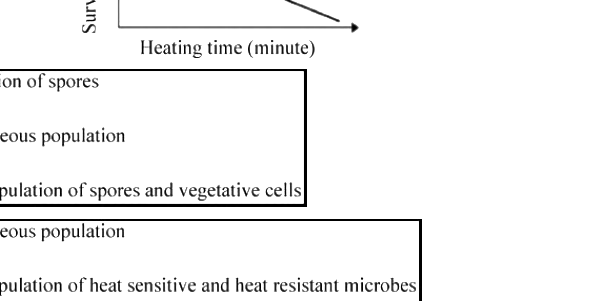
Which among the given options correctly explains the nature of the microbial culture represented by curves 1, 2 and 3 in the following figure?

Question diagram

Open complete paper
16
2021 · Engineering Sciences · Food Microbiology · Microbial Growth
Engineering Sciences (XE) 2021
In a typical bacterial growth curve, the first order kinetics for growth rate is observed in
Open complete paper
17
2022 · Engineering Sciences · Food Microbiology · Microbial Growth
Engineering Sciences (XE) 2022
The lowest water activity (aw) supporting the growth of Staphylococcus aureus in food under aerobic condition is
Open complete paper
18
2023 · Engineering Sciences · Food Microbiology · Microbial Growth
Engineering Sciences (XE) 2023

The time required for stipulated destruction of a microbial population at a given temperature is

Open complete paper
19
2024 · Engineering Sciences · Food Microbiology · Microbial Growth
Engineering Sciences (XE) 2024
Thermal resistance constant (z-value) is defined as the change in temperature required to reduce the decimal reduction time of a microorganism by __________ percent (Answer in integer).
Open complete paper