My Cart
Your Cart 0

    Your cart is empty.

  • Total (Amount) ₹0.00
Previous year question hub

Thermal operations - Food Engineering - Engineering Sciences Previous Year Questions

Practice Thermal operations - Food Engineering - Engineering Sciences previous year questions organised from real papers, with year-wise coverage and clear topic navigation.

11Papers
11Years
19Questions
1Topics

Thermal operations question pattern

Every graph below is calculated only from this selection.

Questions by year

Year-wise coverage for Thermal operations. Each bar uses a separate theme-derived color.

Difficulty distribution

How the classified questions are distributed by difficulty.

Easy 11 57.9%
Medium 8 42.1%

Question type distribution

MCQ, numerical, multiple-select and other formats found in these papers.

MCQ 11 57.9%
Numerical Answer Type (NAT) 6 31.6%
MSQ 2 10.5%

Subject weightage

Top subjects by unique question coverage.

Engineering Sciences
19 Qs

Most asked topics

Top topics across the included previous year papers.

Food Engineering
19 Qs

Subtopic coverage

Top subtopics inside this exact selection.

Thermal operations
19 Qs

Paper coverage

Question coverage for the most populated papers. Every active PYP paper remains listed below.

Engineering Sciences (XE) 2025
2 Qs
Engineering Sciences (XE) 2023
2 Qs
Engineering Sciences (XE) 2022
4 Qs
Engineering Sciences (XE) 2020
2 Qs
Engineering Sciences (XE) 2019
1 Qs
Engineering Sciences (XE) 2018
1 Qs
Engineering Sciences (XE) 2016
2 Qs
Engineering Sciences (XE) 2015
2 Qs
Engineering Sciences (XE) 2013
1 Qs
Engineering Sciences (XE) 2012
1 Qs
Engineering Sciences (XE) 2010
1 Qs

Included previous year papers

Newest papers appear first. Sort by year, question coverage or name.

PaperYear / sessionQuestions in this viewOpen
Engineering Sciences (XE) 202520252View paper
Engineering Sciences (XE) 202320232View paper
Engineering Sciences (XE) 202220224View paper
Engineering Sciences (XE) 202020202View paper
Engineering Sciences (XE) 201920191View paper
Engineering Sciences (XE) 201820181View paper
Engineering Sciences (XE) 201620162View paper
Engineering Sciences (XE) 201520152View paper
Engineering Sciences (XE) 201320131View paper
Engineering Sciences (XE) 201220121View paper
Engineering Sciences (XE) 201020101View paper

All Thermal operations previous year questions

Practice every matching question in batches of 20, with every available option.

1
2010 · Engineering Sciences · Food Engineering · Thermal operations
Engineering Sciences (XE) 2010
D0 value of a bacterium is determined by using two thin walled glass capillary tubes filled with same bacterial suspension in distilled water. The sealed capillaries are dipped in an oil bath maintained at 121°C and kept for 60 s and 135 s, respectively. These capillaries are cooled immediately in ice water. Number of survivors remained in the respective tubes are 2000 and 300.
The processing time (in minutes) to kill 99.999% of the bacteria in any food at 121°C will be
Open complete paper
2
2012 · Engineering Sciences · Food Engineering · Thermal operations
Engineering Sciences (XE) 2012
Thermal death time (TDT) of Clostridium botulinum at 121 °C is 2.78 min with a z-value of 10 °C. The TDT of the microorganism at 116 °C (in min) is
Open complete paper
3
2013 · Engineering Sciences · Food Engineering · Thermal operations
Engineering Sciences (XE) 2013
Thermal death of viable spores of Bacillus subtilis in a food sample follows a first order kinetics with a specific death rate constant of 0.23 min-1 at 100 °C. The time (in minutes) required to kill 99% of spores in the food sample at 100 °C will be
Open complete paper
4
2015 · Engineering Sciences · Food Engineering · Thermal operations
Engineering Sciences (XE) 2015
Multiple effect evaporation leads to
Open complete paper
5
2015 · Engineering Sciences · Food Engineering · Thermal operations
Engineering Sciences (XE) 2015
Which one of the following is NOT a component of an evaporator?
Open complete paper
6
2016 · Engineering Sciences · Food Engineering · Thermal operations
Engineering Sciences (XE) 2016
The D121 and Z values for C. botulinum spores in canned food are 0.2 min and 10 °C respectively. Total time required in min, to reduce the spores from 10⁵ to 10³ at 111 °C is _____.
Open complete paper
7
2016 · Engineering Sciences · Food Engineering · Thermal operations
Engineering Sciences (XE) 2016
A fruit juice with a negligible boiling point rise is being evaporated using saturated steam at 121.1 °C in a triple effect evaporator having equal area in each effect. The pressure of the vapor in the last effect is 25.6 kPa absolute and the corresponding saturation temperature is 65.7 °C. The heat transfer coefficients are U1 = 2760, U2 = 1875 and U3 = 1350 W m-2 K-1. The boiling point (°C) in the first effect is __.
Open complete paper
8
2018 · Engineering Sciences · Food Engineering · Thermal operations
Engineering Sciences (XE) 2018
Apple juice of 10% total solids (TS) is being concentrated in a single effect evaporator working with a surface condenser to 40% TS under a vacuum of 20 kPa. After some time the vacuum pump stops but the evaporation process continued. Choose the combination of possible implications from the following.
(P) Product quality is affected
(Q) Substantial increase in thermal energy requirement
(R) Decrease in the rate of evaporation
Open complete paper
9
2019 · Engineering Sciences · Food Engineering · Thermal operations
Engineering Sciences (XE) 2019
Sticking of powder to wall of the chamber during spray drying of fruit juice is due to ____.
Open complete paper
10
2020 · Engineering Sciences · Food Engineering · Thermal operations
Engineering Sciences (XE) 2020
During extrusion cooking, food materials are generally subjected to a combination of
Open complete paper
11
2020 · Engineering Sciences · Food Engineering · Thermal operations
Engineering Sciences (XE) 2020
During spray drying of a milk sample, inlet and outlet temperatures are maintained at 132 °C and 80 °C, respectively. If the ambient temperature is 29 °C, the thermal efficiency (round off to 2 decimal places) of the dryer will be ______%.
Open complete paper
12
2022 · Engineering Sciences · Food Engineering · Thermal operations
Engineering Sciences (XE) 2022
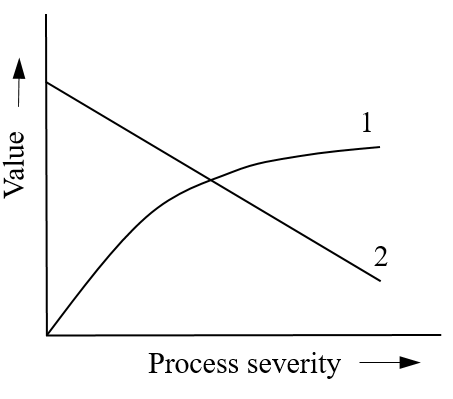
Which among the given options truly depict the lines 1 and 2 in the figure below with respect to the effect of heat processing on food?
Open complete paper
13
2022 · Engineering Sciences · Food Engineering · Thermal operations
Engineering Sciences (XE) 2022

In a dairy plant, spray drying technology is used to produce whey powder. The rate of spray drying depends on

Open complete paper
14
2022 · Engineering Sciences · Food Engineering · Thermal operations
Engineering Sciences (XE) 2022

Most commonly used refrigerant in direct immersion freezing of food is

Open complete paper
15
2022 · Engineering Sciences · Food Engineering · Thermal operations
Engineering Sciences (XE) 2022
In a canning industry, the total process time (F₀) was calculated as 3 min. If each can contains 20 spores having decimal reduction time of 1.6 min, the probability of spoilage would be __________ in 100 cans (round off to the nearest integer).
Open complete paper
16
2023 · Engineering Sciences · Food Engineering · Thermal operations
Engineering Sciences (XE) 2023

Extrusion cooking is accomplished in four different stages, which are indicated as I, II, III and IV in the figure given below. Choose the correct option representing the name of each stage.

Open complete paper
17
2023 · Engineering Sciences · Food Engineering · Thermal operations
Engineering Sciences (XE) 2023
If D10 for Salmonella in egg yolk is 0.75 kGy, calculate the radiation dose in kGy (rounded off to 2 decimal places) required for reducing the Salmonella count in egg yolk by 8 log cycles.
Open complete paper
18
2025 · Engineering Sciences · Food Engineering · Thermal operations
Engineering Sciences (XE) 2025
In canning and retorting of foods, which of the following is the correct expression of Ball process time (B)?
Assume: tp = processor's process time; tc = come-up time
Open complete paper
19
2025 · Engineering Sciences · Food Engineering · Thermal operations
Engineering Sciences (XE) 2025
The F121 value of a known microorganism with Z value of 11 °C is 2.4 min for 99.9999% inactivation. For a 12D inactivation of the said microorganism at 143 °C, the F value (in min) is ____. (rounded off to 3 decimal places)
Open complete paper