My Cart
Your Cart 0

    Your cart is empty.

  • Total (Amount) ₹0.00
Previous year question hub

Boundary Layers, Separation, Lift and Drag - External Flows - Engineering Sciences Previous Year Questions

Practice Boundary Layers, Separation, Lift and Drag - External Flows - Engineering Sciences previous year questions organised from real papers, with year-wise coverage and clear topic navigation.

19Papers
19Years
52Questions
1Topics

Boundary Layers, Separation, Lift and Drag question pattern

Every graph below is calculated only from this selection.

Questions by year

Year-wise coverage for Boundary Layers, Separation, Lift and Drag. Each bar uses a separate theme-derived color.

Difficulty distribution

How the classified questions are distributed by difficulty.

Medium 30 57.7%
Easy 22 42.3%

Question type distribution

MCQ, numerical, multiple-select and other formats found in these papers.

MCQ 41 78.8%
Numerical Answer Type (NAT) 9 17.3%
MSQ 2 3.8%

Subject weightage

Top subjects by unique question coverage.

Engineering Sciences
52 Qs

Most asked topics

Top topics across the included previous year papers.

External Flows
52 Qs

Subtopic coverage

Top subtopics inside this exact selection.

Boundary Layers, Separation, Lift and Drag
52 Qs

Paper coverage

Question coverage for the most populated papers. Every active PYP paper remains listed below.

Engineering Sciences (XE) 2026
4 Qs
Engineering Sciences (XE) 2025
3 Qs
Engineering Sciences (XE) 2024
2 Qs
Engineering Sciences (XE) 2023
3 Qs
Engineering Sciences (XE) 2022
4 Qs
Engineering Sciences (XE) 2021
3 Qs
Engineering Sciences (XE) 2019
2 Qs
Engineering Sciences (XE) 2018
2 Qs
Engineering Sciences (XE) 2017
2 Qs
Engineering Sciences (XE) 2016
2 Qs
Engineering Sciences (XE) 2015
3 Qs
Engineering Sciences (XE) 2014
2 Qs
Engineering Sciences (XE) 2013
2 Qs
Engineering Sciences (XE) 2012
1 Qs
Engineering Sciences (XE) 2011
2 Qs
Engineering Sciences (XE) 2010
4 Qs
Engineering Sciences (XE) 2009
4 Qs
Engineering Sciences (XE) 2008
3 Qs
Engineering Sciences (XE) 2007
4 Qs

Included previous year papers

Newest papers appear first. Sort by year, question coverage or name.

PaperYear / sessionQuestions in this viewOpen
Engineering Sciences (XE) 202620264View paper
Engineering Sciences (XE) 202520253View paper
Engineering Sciences (XE) 202420242View paper
Engineering Sciences (XE) 202320233View paper
Engineering Sciences (XE) 202220224View paper
Engineering Sciences (XE) 202120213View paper
Engineering Sciences (XE) 201920192View paper
Engineering Sciences (XE) 201820182View paper
Engineering Sciences (XE) 201720172View paper
Engineering Sciences (XE) 201620162View paper
Engineering Sciences (XE) 201520153View paper
Engineering Sciences (XE) 201420142View paper
Engineering Sciences (XE) 201320132View paper
Engineering Sciences (XE) 201220121View paper
Engineering Sciences (XE) 201120112View paper
Engineering Sciences (XE) 201020104View paper
Engineering Sciences (XE) 200920094View paper
Engineering Sciences (XE) 200820083View paper
Engineering Sciences (XE) 200720074View paper

All Boundary Layers, Separation, Lift and Drag previous year questions

Practice every matching question in batches of 20, with every available option.

1
2007 · Engineering Sciences · External Flows · Boundary Layers, Separation, Lift and Drag
Engineering Sciences (XE) 2007

Flow-separation from a solid surface may take place if the flow is

Open complete paper
2
2007 · Engineering Sciences · External Flows · Boundary Layers, Separation, Lift and Drag
Engineering Sciences (XE) 2007

For a laminar boundary layer with constant freestream velocity (i.e. dp/dx = 0), the variation of ∂u/∂y with distance from the wall is given by

Open complete paper
3
2007 · Engineering Sciences · External Flows · Boundary Layers, Separation, Lift and Drag
Engineering Sciences (XE) 2007
The total drag on the boat is

Question diagram

Open complete paper
4
2007 · Engineering Sciences · External Flows · Boundary Layers, Separation, Lift and Drag
Engineering Sciences (XE) 2007
Consider the steady flow of a uniform stream past a circular cylinder, for a viscous fluid. The following two cases are compared: (I) cylinder is rotating at a slow rate about its axis (II) cylinder is not rotating. Consider the statements P: The lift force in case I is zero Q: The lift force in case II is zero R: The drag force in case I is non-zero S: The drag force in case II is zero Which one of the following combinations is TRUE?
Open complete paper
5
2008 · Engineering Sciences · External Flows · Boundary Layers, Separation, Lift and Drag
Engineering Sciences (XE) 2008

Air flowing over a smooth cylinder of diameter 30 cm in a wind tunnel produces a two-dimensional laminar boundary layer that separates from the surface of the cylinder. The surface of the cylinder is then roughened with sand paper so that the boundary layer turns turbulent. The location of the point of separation will

Open complete paper
6
2008 · Engineering Sciences · External Flows · Boundary Layers, Separation, Lift and Drag
Engineering Sciences (XE) 2008
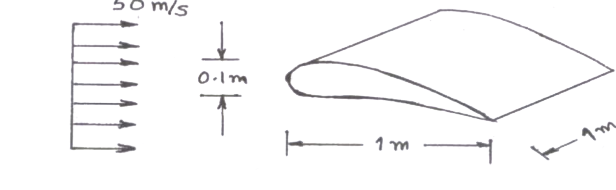
Consider the aerofoil of the dimensions shown. The lift coefficient \(C_L\) is measured to be 1.4 (based on the largest projected area). If air of density 1.2 kg/m³ flows over the aerofoil at 50 m/s the lift force is:

Question diagram

Open complete paper
7
2008 · Engineering Sciences · External Flows · Boundary Layers, Separation, Lift and Drag
Engineering Sciences (XE) 2008
Air with free stream velocity 10 m/s flows over three different bluff bodies P, Q and R as shown below, with a hemisphere of radius 1 m forming the nose. Comparing the total drag force \(F\) on the three bodies, state which of the following is true.
Open complete paper
8
2009 · Engineering Sciences · External Flows · Boundary Layers, Separation, Lift and Drag
Engineering Sciences (XE) 2009
Dimples are made on golf balls for which of the following reasons ?
P : to make the ball travel a longer distance
Q : to make the flow over the ball turbulent
R : to make the flow over the ball laminar
S : to create a separated boundary layer flow over the ball
Open complete paper
9
2009 · Engineering Sciences · External Flows · Boundary Layers, Separation, Lift and Drag
Engineering Sciences (XE) 2009
In a 2-D boundary layer flow, x and y are the streamwise and wall-normal coordinates, respectively. If u denotes the velocity along the x direction, which one of the following represents the condition at the point of flow separation ?
Open complete paper
10
2009 · Engineering Sciences · External Flows · Boundary Layers, Separation, Lift and Drag
Engineering Sciences (XE) 2009
Which one among the following boundary layer flows is the LEAST susceptible to flow separation ?
Open complete paper
11
2009 · Engineering Sciences · External Flows · Boundary Layers, Separation, Lift and Drag
Engineering Sciences (XE) 2009

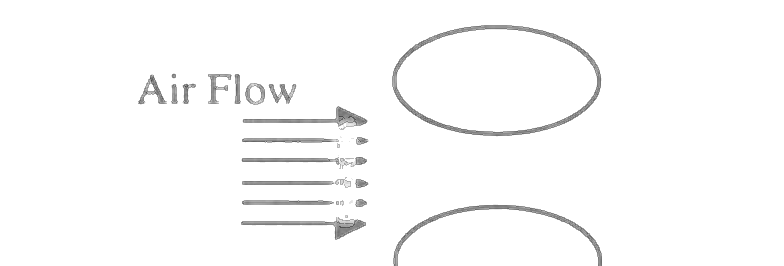
Air from the blower of a hairdryer flows between two identical elliptical cylinders suspended freely, for two cases shown in the figure. The cylinders would move

Open complete paper
12
2010 · Engineering Sciences · External Flows · Boundary Layers, Separation, Lift and Drag
Engineering Sciences (XE) 2010
In the context of boundary layers, which one of the following statements is FALSE ?

Question diagram

Open complete paper
13
2010 · Engineering Sciences · External Flows · Boundary Layers, Separation, Lift and Drag
Engineering Sciences (XE) 2010
Two models \( M_1 \) and \( M_2 \) have equal volumes and are made of steel. Model \( M_1 \) is an aerofoil (a streamlined body) and model \( M_2 \) a sphere (a bluff body). Both models are dropped in two identical short jars filled with honey simultaneously. Which of the following statements is TRUE?
Open complete paper
14
2010 · Engineering Sciences · External Flows · Boundary Layers, Separation, Lift and Drag
Engineering Sciences (XE) 2010

A cricket ball comprises of a seam running along its central section, which is essentially stitching of two hemi-spheres. The seam creates additional roughness. The bowler releases the ball with seam orientation as shown in the figure below. This would result in an out swinger with side forces on the cricket ball. These side forces on the ball are attributed to
Open complete paper
15
2010 · Engineering Sciences · External Flows · Boundary Layers, Separation, Lift and Drag
Engineering Sciences (XE) 2010
The most acceptable boundary conditions are
Open complete paper
16
2011 · Engineering Sciences · External Flows · Boundary Layers, Separation, Lift and Drag
Engineering Sciences (XE) 2011
For a boundary layer on a flat plate ________ forces and ________ forces are of the same order of magnitude.
Open complete paper
17
2011 · Engineering Sciences · External Flows · Boundary Layers, Separation, Lift and Drag
Engineering Sciences (XE) 2011
Separation is said to occur at a wall when ________ at the wall becomes zero.
Open complete paper
18
2012 · Engineering Sciences · External Flows · Boundary Layers, Separation, Lift and Drag
Engineering Sciences (XE) 2012
The dimensionless velocity profile is

Question diagram

Open complete paper
19
2013 · Engineering Sciences · External Flows · Boundary Layers, Separation, Lift and Drag
Engineering Sciences (XE) 2013
Let \( \delta \), \( \delta_1 \) and \( \delta_2 \) denote respectively the boundary-layer thickness, displacement thickness and the momentum thickness for laminar boundary layer flow of an incompressible fluid over a flat plate. The correct relation among these quantities is
Open complete paper
20
2013 · Engineering Sciences · External Flows · Boundary Layers, Separation, Lift and Drag
Engineering Sciences (XE) 2013

Bodies with various cross-sectional shapes subjected to cross-flow of air are shown in the following figures. The characteristic dimension of all the shapes is the same. The cross-sectional shape with the largest coefficient of drag (i.e. sum of the pressure and skin-friction drags), at any moderately large Reynolds number, is

Open complete paper

Showing 20 of 52 questions