My Cart
Your Cart 0

    Your cart is empty.

  • Total (Amount) ₹0.00
Previous year question hub

Navier-Stokes Solutions - Differential Analysis - Engineering Sciences Previous Year Questions

Practice Navier-Stokes Solutions - Differential Analysis - Engineering Sciences previous year questions organised from real papers, with year-wise coverage and clear topic navigation.

3Papers
3Years
4Questions
1Topics

Navier-Stokes Solutions question pattern

Every graph below is calculated only from this selection.

Questions by year

Year-wise coverage for Navier-Stokes Solutions. Each bar uses a separate theme-derived color.

Difficulty distribution

How the classified questions are distributed by difficulty.

Medium 4 100%

Question type distribution

MCQ, numerical, multiple-select and other formats found in these papers.

MCQ 4 100%

Subject weightage

Top subjects by unique question coverage.

Engineering Sciences
4 Qs

Most asked topics

Top topics across the included previous year papers.

Differential Analysis
4 Qs

Subtopic coverage

Top subtopics inside this exact selection.

Navier-Stokes Solutions
4 Qs

Paper coverage

Question coverage for the most populated papers. Every active PYP paper remains listed below.

Engineering Sciences (XE) 2023
2 Qs
Engineering Sciences (XE) 2021
1 Qs
Engineering Sciences (XE) 2018
1 Qs

Included previous year papers

Newest papers appear first. Sort by year, question coverage or name.

PaperYear / sessionQuestions in this viewOpen
Engineering Sciences (XE) 202320232View paper
Engineering Sciences (XE) 202120211View paper
Engineering Sciences (XE) 201820181View paper

All Navier-Stokes Solutions previous year questions

Practice every matching question in batches of 20, with every available option.
1
2018 · Engineering Sciences · Differential Analysis · Navier-Stokes Solutions
Engineering Sciences (XE) 2018
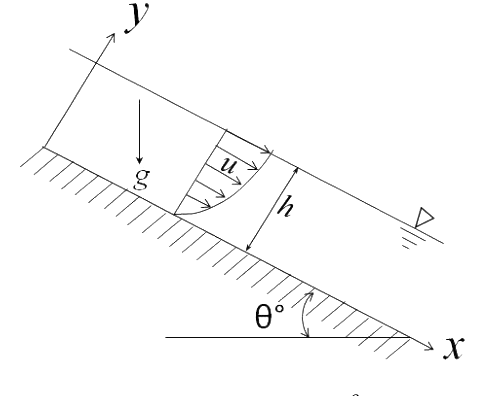
A two-dimensional laminar viscous liquid film of constant thickness (h) steadily flows down an incline as shown in figure. Acceleration due to gravity is g. If the velocity profile in the liquid film is given as, \(u = ky(2h - y); v = 0\), the value of constant k is

Question diagram

Open complete paper
2
2021 · Engineering Sciences · Differential Analysis · Navier-Stokes Solutions
Engineering Sciences (XE) 2021
In a Cartesian coordinate system, a steady, incompressible velocity field of a Newtonian fluid is given by
\(V = u_0(1-ay^2)\mathbf{i}\)
Here, V is the velocity vector in m/s, i is the unit vector in the x-direction, \(u_0\) is a positive, real constant (in m/s), and a is a positive, real constant (in m-2). The viscosity of the fluid is μ (in Pa·s). The absolute value of the pressure gradient (in Pa/m) is
Open complete paper
3
2023 · Engineering Sciences · Differential Analysis · Navier-Stokes Solutions
Engineering Sciences (XE) 2023
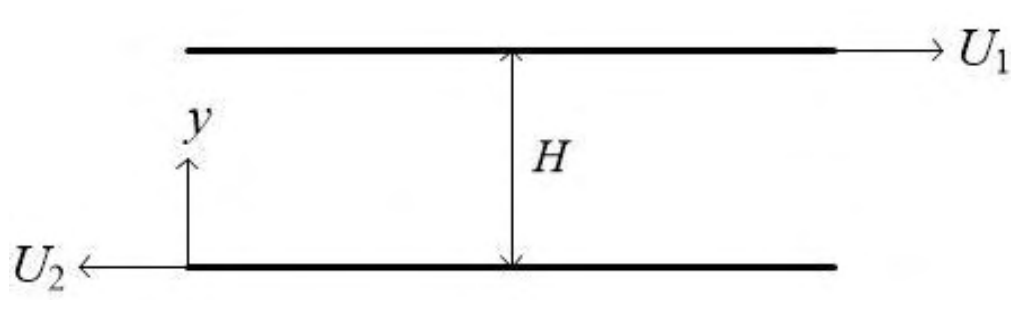
Consider steady fully-developed incompressible flow of a Newtonian fluid between two infinite parallel flat plates. The plates move in the opposite directions, as shown in the figure. In the absence of body force and pressure gradient, the ratio of shear stress at the top surface \(y = H\) to that at the bottom surface \(y = 0\) is

Source question diagram

Open complete paper
4
2023 · Engineering Sciences · Differential Analysis · Navier-Stokes Solutions
Engineering Sciences (XE) 2023
A two-dimensional incompressible flow field is defined as,
\(\vec{V}(x, y) = (Axy)\hat{i} + (By^2)\hat{j}\)
where, \(A\) and \(B\) are constants. The dynamic viscosity of the Newtonian fluid is \(\mu\). In the absence of body force, which among the following expressions represents the pressure gradient at the location (5, 0) in the concerned flow field?
Open complete paper