My Cart
Your Cart 0

    Your cart is empty.

  • Total (Amount) ₹0.00
Previous year question hub

Continuity, Euler and Bernoulli Equations - Differential Analysis - Engineering Sciences Previous Year Questions

Practice Continuity, Euler and Bernoulli Equations - Differential Analysis - Engineering Sciences previous year questions organised from real papers, with year-wise coverage and clear topic navigation.

19Papers
19Years
28Questions
1Topics

Continuity, Euler and Bernoulli Equations question pattern

Every graph below is calculated only from this selection.

Questions by year

Year-wise coverage for Continuity, Euler and Bernoulli Equations. Each bar uses a separate theme-derived color.

Difficulty distribution

How the classified questions are distributed by difficulty.

Medium 15 53.6%
Easy 13 46.4%

Question type distribution

MCQ, numerical, multiple-select and other formats found in these papers.

MCQ 20 71.4%
Numerical Answer Type (NAT) 7 25%
MSQ 1 3.6%

Subject weightage

Top subjects by unique question coverage.

Engineering Sciences
28 Qs

Most asked topics

Top topics across the included previous year papers.

Differential Analysis
28 Qs

Subtopic coverage

Top subtopics inside this exact selection.

Continuity, Euler and Bernoulli Equations
28 Qs

Paper coverage

Question coverage for the most populated papers. Every active PYP paper remains listed below.

Engineering Sciences (XE) 2026
1 Qs
Engineering Sciences (XE) 2025
1 Qs
Engineering Sciences (XE) 2024
1 Qs
Engineering Sciences (XE) 2022
2 Qs
Engineering Sciences (XE) 2021
1 Qs
Engineering Sciences (XE) 2020
2 Qs
Engineering Sciences (XE) 2019
1 Qs
Engineering Sciences (XE) 2018
2 Qs
Engineering Sciences (XE) 2017
1 Qs
Engineering Sciences (XE) 2016
2 Qs
Engineering Sciences (XE) 2015
1 Qs
Engineering Sciences (XE) 2014
1 Qs
Engineering Sciences (XE) 2013
1 Qs
Engineering Sciences (XE) 2012
2 Qs
Engineering Sciences (XE) 2011
2 Qs
Engineering Sciences (XE) 2010
1 Qs
Engineering Sciences (XE) 2009
2 Qs
Engineering Sciences (XE) 2008
3 Qs
Engineering Sciences (XE) 2007
1 Qs

Included previous year papers

Newest papers appear first. Sort by year, question coverage or name.

PaperYear / sessionQuestions in this viewOpen
Engineering Sciences (XE) 202620261View paper
Engineering Sciences (XE) 202520251View paper
Engineering Sciences (XE) 202420241View paper
Engineering Sciences (XE) 202220222View paper
Engineering Sciences (XE) 202120211View paper
Engineering Sciences (XE) 202020202View paper
Engineering Sciences (XE) 201920191View paper
Engineering Sciences (XE) 201820182View paper
Engineering Sciences (XE) 201720171View paper
Engineering Sciences (XE) 201620162View paper
Engineering Sciences (XE) 201520151View paper
Engineering Sciences (XE) 201420141View paper
Engineering Sciences (XE) 201320131View paper
Engineering Sciences (XE) 201220122View paper
Engineering Sciences (XE) 201120112View paper
Engineering Sciences (XE) 201020101View paper
Engineering Sciences (XE) 200920092View paper
Engineering Sciences (XE) 200820083View paper
Engineering Sciences (XE) 200720071View paper

All Continuity, Euler and Bernoulli Equations previous year questions

Practice every matching question in batches of 20, with every available option.

1
2007 · Engineering Sciences · Differential Analysis · Continuity, Euler and Bernoulli Equations
Engineering Sciences (XE) 2007
The velocity of an airstream (ρ = 1.0 kg/m³) is to be measured using a pitot-static tube. The level difference between the two arms of the manometer is 2 cm of water. The velocity is
Open complete paper
2
2008 · Engineering Sciences · Differential Analysis · Continuity, Euler and Bernoulli Equations
Engineering Sciences (XE) 2008
The momentum equation (Euler),
\[ \frac{\partial u}{\partial t}+u\frac{\partial u}{\partial x}+v\frac{\partial u}{\partial y}+w\frac{\partial u}{\partial z}=-\frac{1}{\rho}\frac{\partial p}{\partial x}, \]
is valid if and only if the flow is
Open complete paper
3
2008 · Engineering Sciences · Differential Analysis · Continuity, Euler and Bernoulli Equations
Engineering Sciences (XE) 2008
The velocity in a wind tunnel is being measured using a Pitot-static tube connected to a vertical U-tube manometer. The density of air is 1.2 kg/m³ and the deflection of the manometer is 24 mm. The manometric fluid is water. The velocity measured by the Pitot-static tube is:
Open complete paper
4
2008 · Engineering Sciences · Differential Analysis · Continuity, Euler and Bernoulli Equations
Engineering Sciences (XE) 2008
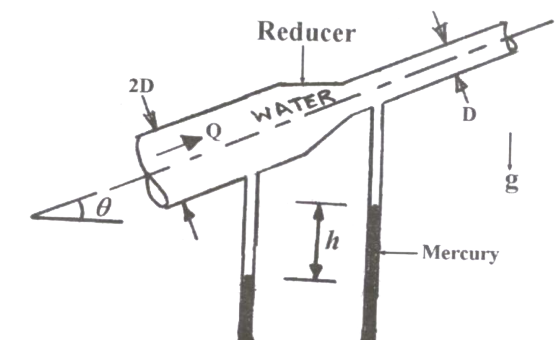
Water is flowing with volume flow rate Q through a pipe whose diameter reduces to half across a reducer. If the flow is frictionless, compare the manometer reading \( h_1 \), \( h_2 \) and \( h_3 \) corresponding to the three different inclinations of the pipe \( \theta_1 = 30^0 \), \( \theta_2 = 0^0 \) and \( \theta_3 = -30^0 \). Note that only the pipe tilts, while the manometer always stays vertical.

Question diagram

Open complete paper
5
2009 · Engineering Sciences · Differential Analysis · Continuity, Euler and Bernoulli Equations
Engineering Sciences (XE) 2009
A nozzle has inlet and outlet diameters of 10 cm and 5 cm, respectively. If it discharges air at a steady rate of 0.1 m³/s into the atmosphere, the gauge pressure (static) at the nozzle inlet will be
Open complete paper
6
2009 · Engineering Sciences · Differential Analysis · Continuity, Euler and Bernoulli Equations
Engineering Sciences (XE) 2009
Under what conditions is the equation Δ•ρV⃗ = 0 valid ?
P : Steady incompressible flow
Q : Unsteady incompressible flow
R : Steady compressible flow
S : Unsteady compressible flow
Open complete paper
7
2010 · Engineering Sciences · Differential Analysis · Continuity, Euler and Bernoulli Equations
Engineering Sciences (XE) 2010

Expressions for P, Q and R are

Open complete paper
8
2011 · Engineering Sciences · Differential Analysis · Continuity, Euler and Bernoulli Equations
Engineering Sciences (XE) 2011
A pitot-static probe is inserted in an air flow. A manometer connected to this probe having Hg as the manometric fluid shows a difference of 30 mm. Assume a probe factor of 1. Assuming ρ_air = 1.23 kg/m³, ρ_Hg = 13600 kg/m³ and g = 10 m/s², the speed of the air flow is approximately
Open complete paper
9
2011 · Engineering Sciences · Differential Analysis · Continuity, Euler and Bernoulli Equations
Engineering Sciences (XE) 2011
In an inviscid incompressible flow, the velocity field is given by \(\vec{V} = x\hat{i} + y\hat{j}\) m/s and the body force per unit mass is given by \(\vec{g} = -10\hat{k}\) m/s². The pressure at the point (0, 0, 0) is 101 Pa. Assuming that the density of the fluid is 1 kg/m³, the pressure at the point (1, 1, 1) for this flow is
Open complete paper
10
2012 · Engineering Sciences · Differential Analysis · Continuity, Euler and Bernoulli Equations
Engineering Sciences (XE) 2012
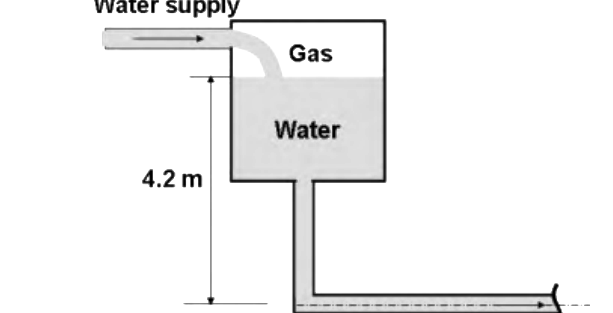
The water level in a gas-pressurized tank with a large cross-sectional area is maintained constant as shown in the figure below. The water level in the tank is 4.2 m above the pipe centerline as indicated in the figure. The gas pressure is 130 kPa. The atmospheric pressure, gravitational acceleration and density of water may be taken as 100 kPa, 10 m/s² and 1000 kg/m³, respectively. Neglecting losses, the maximum velocity (in m/s) of water at any location in the horizontal portion of the delivery pipe for the pressure NOT to drop below atmospheric pressure, is

Question diagram

Open complete paper
11
2012 · Engineering Sciences · Differential Analysis · Continuity, Euler and Bernoulli Equations
Engineering Sciences (XE) 2012
The velocity of an air stream is 20 m/s. The densities of mercury and air are 13600 kg/m³ and 1.2 kg/m³, respectively. The gravitational acceleration may be taken as 10 m/s². When a Pitot-static tube is placed in the stream, assuming the flow to be incompressible and frictionless, the difference between the stagnation and static pressure in the flow field (in mm Hg) would approximately be
Open complete paper
12
2013 · Engineering Sciences · Differential Analysis · Continuity, Euler and Bernoulli Equations
Engineering Sciences (XE) 2013

Bernoulli’s equation is valid for the following type of flow:

Open complete paper
13
2014 · Engineering Sciences · Differential Analysis · Continuity, Euler and Bernoulli Equations
Engineering Sciences (XE) 2014
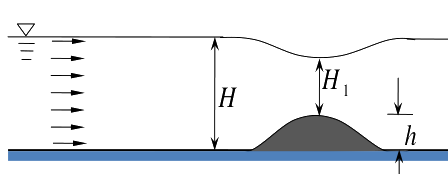
The gravity driven flow over a hump of height \( h \) in a canal is shown in the figure. The height of the free surface from the canal bed at upstream of the hump is \( H \). The free surface height reduces to \( H_1 \) above the hump.
Assuming the canal bed to be horizontal, the discharge per unit width is given by

Question diagram

Open complete paper
14
2015 · Engineering Sciences · Differential Analysis · Continuity, Euler and Bernoulli Equations
Engineering Sciences (XE) 2015
A steady, two-dimensional, inviscid and incompressible flow field is described in rectangular Cartesian coordinates as \(u = ax\) and \(v = -ay\), where \(u\) and \(v\) are the components of the velocity vector in the \(x\) and \(y\) directions, respectively. Gravity acts along the negative \(y\)-direction. The pressure distribution, with the reference pressure taken as zero at the origin, with usual notation, is given by
Open complete paper
15
2016 · Engineering Sciences · Differential Analysis · Continuity, Euler and Bernoulli Equations
Engineering Sciences (XE) 2016
Consider a fully developed, steady, incompressible, 2-D, viscous channel flow with uniform suction and blowing velocity \(v_0\), as shown in the figure given below. The centerline velocity of the channel is 10 m/s along the x-direction. If the value of \(v_0\) at both the walls is 1 m/s, the value of the y-component of velocity inside the flow field is ________ m/s.

Question diagram

Open complete paper
16
2016 · Engineering Sciences · Differential Analysis · Continuity, Euler and Bernoulli Equations
Engineering Sciences (XE) 2016
Exhaust from a kitchen goes into the atmosphere through a tapered chimney as shown. The area of cross-section of chimney at location-1 is twice of that at location-2. The flow can be assumed to be inviscid with constant exhaust density of 1 kg/m³ and acceleration due to gravity, \(g = 9.8\) m/s². If the steady, uniform exhaust velocity at location-1 is \(U = 1\) m/s, the pressure drop across the chimney is ________ Pa.

Question diagram

Open complete paper
17
2017 · Engineering Sciences · Differential Analysis · Continuity, Euler and Bernoulli Equations
Engineering Sciences (XE) 2017
An inviscid incompressible fluid of density 1000 kg/m³ is flowing in a horizontal pipe of tapered cross-section with a flow rate of 4000 cm³/s. The area of cross-section at two different locations ‘A’ and ‘B’ are 10 cm² and 20 cm², respectively. The velocity of the fluid at the location ‘A’ is 4 m/s and pressure is 5 N/m². The pressure (N/m²) at location ‘B’ would be ______
Open complete paper
18
2018 · Engineering Sciences · Differential Analysis · Continuity, Euler and Bernoulli Equations
Engineering Sciences (XE) 2018
The velocity field and the surface normal vector are given by, V̅ = u î + v ĵ + w k̂ and n̅ = n₁ î + n₂ ĵ + n₃ k̂, respectively. If Euler equations are to be solved, the boundary condition that must be satisfied at the wall is,
Open complete paper
19
2018 · Engineering Sciences · Differential Analysis · Continuity, Euler and Bernoulli Equations
Engineering Sciences (XE) 2018
A pitot-static tube is used to measure air velocity in a duct by neglecting losses. The density of air is \(1.2\) kg/m\(^3\). If the difference between the total and static pressures is \(1\) kPa, the velocity of air at the measuring location, in m/s, is ______.
Open complete paper
20
2019 · Engineering Sciences · Differential Analysis · Continuity, Euler and Bernoulli Equations
Engineering Sciences (XE) 2019
The velocity field in Cartesian coordinates in a two-dimensional steady incompressible flow of a fluid with density ρ is V = x̂ − ŷ. Assuming no body and line forces, the magnitude of pressure gradient ∇p at point (1,1) is
Open complete paper

Showing 20 of 28 questions