My Cart
Your Cart 0

    Your cart is empty.

  • Total (Amount) ₹0.00
Previous year question hub

Degradation of Materials - Engineering Sciences Previous Year Questions

Practice Degradation of Materials - Engineering Sciences previous year questions organised from real papers, with year-wise coverage and clear topic navigation.

9Papers
9Years
11Questions
1Topics

Degradation of Materials question pattern

Every graph below is calculated only from this selection.

Questions by year

Year-wise coverage for Degradation of Materials. Each bar uses a separate theme-derived color.

Difficulty distribution

How the classified questions are distributed by difficulty.

Medium 6 54.5%
Easy 4 36.4%
Hard 1 9.1%
Question type distribution

MCQ, numerical, multiple-select and other formats found in these papers.

Numerical Answer Type (NAT) 5 45.5%
MCQ 4 36.4%
MSQ 2 18.2%

Subject weightage

Top subjects by unique question coverage.

Engineering Sciences
11 Qs

Most asked topics

Top topics across the included previous year papers.

Degradation of Materials
11 Qs

Subtopic coverage

Top subtopics inside this exact selection.

Metal Corrosion and Prevention
9 Qs
Polymer Degradation
2 Qs

Paper coverage

Question coverage for the most populated papers. Every active PYP paper remains listed below.

Engineering Sciences (XE) 2026
2 Qs
Engineering Sciences (XE) 2025
1 Qs
Engineering Sciences (XE) 2024
1 Qs
Engineering Sciences (XE) 2021
1 Qs
Engineering Sciences (XE) 2020
1 Qs
Engineering Sciences (XE) 2019
2 Qs
Engineering Sciences (XE) 2015
1 Qs
Engineering Sciences (XE) 2013
1 Qs
Engineering Sciences (XE) 2012
1 Qs

Browse by subtopics

Open a focused page built from the same verified paper data.

Included previous year papers

Newest papers appear first. Sort by year, question coverage or name.

PaperYear / sessionQuestions in this viewOpen
Engineering Sciences (XE) 202620262View paper
Engineering Sciences (XE) 202520251View paper
Engineering Sciences (XE) 202420241View paper
Engineering Sciences (XE) 202120211View paper
Engineering Sciences (XE) 202020201View paper
Engineering Sciences (XE) 201920192View paper
Engineering Sciences (XE) 201520151View paper
Engineering Sciences (XE) 201320131View paper
Engineering Sciences (XE) 201220121View paper

Sample previous year questions

A varied preview from the papers represented in this selection, with every available option.

1
2012 · Engineering Sciences · Degradation of Materials · Metal Corrosion and Prevention
Engineering Sciences (XE) 2012

The Pilling-Bedworth ratio is defined as the ratio of

Open complete paper
2
2013 · Engineering Sciences · Degradation of Materials · Metal Corrosion and Prevention
Engineering Sciences (XE) 2013

Which one of the following metals is commonly alloyed with iron to improve its corrosion resistance?

Open complete paper
3
2015 · Engineering Sciences · Degradation of Materials · Metal Corrosion and Prevention
Engineering Sciences (XE) 2015

A 1 kg sacrificial anode of Mg (atomic weight: 24.31 amu) is attached to the base of a ship. If the anode lasts for 60 days, what is the average corrosion current (in Amperes) during that period?

Open complete paper
4
2019 · Engineering Sciences · Degradation of Materials · Metal Corrosion and Prevention
Engineering Sciences (XE) 2019

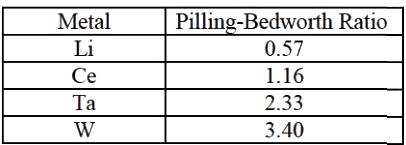
Pilling-Bedworth ratios for oxides of some metals are given in the table.

MetalPilling-Bedworth Ratio
Li0.57
Ce1.16
Ta2.33
W3.40
Based on the criterion of Pilling-Bedworth ratio alone, which one of the following metals will be most protected from high temperature oxidation?

Question diagram

Open complete paper
5
2020 · Engineering Sciences · Degradation of Materials · Metal Corrosion and Prevention
Engineering Sciences (XE) 2020
Isothermal weight gain per unit area (ΔW/A, where ΔW is the weight gain (in mg) and A is the area (in cm²)) during oxidation of a metal at 600 °C follows parabolic rate law, where, ΔW/A = 1.0 mg.cm⁻² after 100 min of oxidation. The ΔW/A after 500 min at 600 °C will be ______ mg.cm⁻² (round-off to two decimal places).

Question diagram

Open complete paper
6
2021 · Engineering Sciences · Degradation of Materials · Metal Corrosion and Prevention
Engineering Sciences (XE) 2021
When a metal (M) is immersed in de-aerated acid electrolyte, it polarizes anodically by 0.4 V. The M/Mⁿ⁺ exchange current density is \(10^{-5} \; \mathrm{A \; m^{-2}}\) and Tafel slope is 0.1 V/decade for the anodic reaction. Assume that corrosion is uniform, and anodic and cathodic reactions are under activation control. The rate of metal dissolution in \(\mathrm{A \; m^{-2}}\) is __________ (round off to 1 decimal place)
Open complete paper
