My Cart
Your Cart 0

    Your cart is empty.

  • Total (Amount) ₹0.00
Previous year question hub

Fluid Properties and Flow Regimes - Classification of Flows - Engineering Sciences Previous Year Questions

Practice Fluid Properties and Flow Regimes - Classification of Flows - Engineering Sciences previous year questions organised from real papers, with year-wise coverage and clear topic navigation.

15Papers
15Years
24Questions
1Topics

Fluid Properties and Flow Regimes question pattern

Every graph below is calculated only from this selection.

Questions by year

Year-wise coverage for Fluid Properties and Flow Regimes. Each bar uses a separate theme-derived color.

Difficulty distribution

How the classified questions are distributed by difficulty.

Easy 22 91.7%
Medium 2 8.3%

Question type distribution

MCQ, numerical, multiple-select and other formats found in these papers.

MCQ 15 62.5%
Numerical Answer Type (NAT) 6 25%
MSQ 3 12.5%

Subject weightage

Top subjects by unique question coverage.

Engineering Sciences
24 Qs

Most asked topics

Top topics across the included previous year papers.

Classification of Flows
24 Qs

Subtopic coverage

Top subtopics inside this exact selection.

Fluid Properties and Flow Regimes
24 Qs

Paper coverage

Question coverage for the most populated papers. Every active PYP paper remains listed below.

Engineering Sciences (XE) 2026
3 Qs
Engineering Sciences (XE) 2024
1 Qs
Engineering Sciences (XE) 2023
1 Qs
Engineering Sciences (XE) 2022
1 Qs
Engineering Sciences (XE) 2021
2 Qs
Engineering Sciences (XE) 2020
2 Qs
Engineering Sciences (XE) 2018
3 Qs
Engineering Sciences (XE) 2017
2 Qs
Engineering Sciences (XE) 2015
1 Qs
Engineering Sciences (XE) 2014
1 Qs
Engineering Sciences (XE) 2011
1 Qs
Engineering Sciences (XE) 2010
1 Qs
Engineering Sciences (XE) 2009
2 Qs
Engineering Sciences (XE) 2008
1 Qs
Engineering Sciences (XE) 2007
2 Qs

Included previous year papers

Newest papers appear first. Sort by year, question coverage or name.

PaperYear / sessionQuestions in this viewOpen
Engineering Sciences (XE) 202620263View paper
Engineering Sciences (XE) 202420241View paper
Engineering Sciences (XE) 202320231View paper
Engineering Sciences (XE) 202220221View paper
Engineering Sciences (XE) 202120212View paper
Engineering Sciences (XE) 202020202View paper
Engineering Sciences (XE) 201820183View paper
Engineering Sciences (XE) 201720172View paper
Engineering Sciences (XE) 201520151View paper
Engineering Sciences (XE) 201420141View paper
Engineering Sciences (XE) 201120111View paper
Engineering Sciences (XE) 201020101View paper
Engineering Sciences (XE) 200920092View paper
Engineering Sciences (XE) 200820081View paper
Engineering Sciences (XE) 200720072View paper

All Fluid Properties and Flow Regimes previous year questions

Practice every matching question in batches of 20, with every available option.

1
2007 · Engineering Sciences · Classification of Flows · Fluid Properties and Flow Regimes
Engineering Sciences (XE) 2007
For a two-dimensional turbulent boundary layer, the wall shear stress can be expressed as \(\tau_w = \mu \left.\frac{\partial u}{\partial y}\right|_{wall}\) where \(u\) is the velocity parallel to the wall and \(y\) is the coordinate perpendicular to the wall. In the above expression, \(\mu\) denotes
Open complete paper
2
2007 · Engineering Sciences · Classification of Flows · Fluid Properties and Flow Regimes
Engineering Sciences (XE) 2007
Consider a constant pressure boundary layer over a flat plate of length L = 3 m. The freestream velocity is U = 60 m/s and the density and viscosity of the fluid respectively are ρ = 1.23 kg/m³ and μ = 1.79 × 10⁻⁵ Ns/m². Transition occurs at a distance x_cr = 0.1m from the leading edge. If the free stream velocity is changed to U = 120 m/s, x_cr becomes
Open complete paper
3
2008 · Engineering Sciences · Classification of Flows · Fluid Properties and Flow Regimes
Engineering Sciences (XE) 2008
A cubical block of melting ice (20 cm x 20 cm x 20 cm) rests on a smooth horizontal floor over a layer of water of 0.1 mm thickness. To pull the block at a speed of 1 m/s a force of 1 N is required. What is the force required to pull the block at a speed of 2 m/s?
Open complete paper
4
2009 · Engineering Sciences · Classification of Flows · Fluid Properties and Flow Regimes
Engineering Sciences (XE) 2009
An oil droplet (density = 800 kg/m³) is rising in still water at a constant velocity of 1 mm/s. Its radius is approximately
Open complete paper
5
2009 · Engineering Sciences · Classification of Flows · Fluid Properties and Flow Regimes
Engineering Sciences (XE) 2009
Which of the following statements are true ?
P : In Case 1, the velocity at section A is twice the velocity at section B
Q : In Case 1, the velocity at section A is half the velocity at section B
R : In Case 2, the flow rate at section A is twice that at section B
S : In Case 2, the flow rate at section A is half that at section B
Open complete paper
6
2010 · Engineering Sciences · Classification of Flows · Fluid Properties and Flow Regimes
Engineering Sciences (XE) 2010
Water at 20°C is pumped from a base tank to an elevated tank, 15 m above the base tank. Water flows at a rate of 5.0 × 10⁻³ m3 s-1 through a pipe having internal diameter of 0.1023 m. Frictional energy loss in the pipe is 6.837 J kg-1. The pump has an efficiency of 63%. Density and viscosity of water are 998.2 kg m-3 and 1.005 × 10⁻³ Pa s, respectively.
Reynolds number for water flowing through the pipe is
Open complete paper
7
2011 · Engineering Sciences · Classification of Flows · Fluid Properties and Flow Regimes
Engineering Sciences (XE) 2011
For a fully developed flow between two parallel flat plates, the velocity gradient at a point is found to be 1000 s⁻¹. If the density of the fluid is 880 kg/m³ and the kinematic viscosity of the fluid is 7.4 × 10⁻⁷ m²/s, the shear stress at the same point is approximately
Open complete paper
8
2014 · Engineering Sciences · Classification of Flows · Fluid Properties and Flow Regimes
Engineering Sciences (XE) 2014
A Bingham plastic fluid is flowing under gravity, down a vertical plate, as a film. Find the appropriate match for the fully developed velocity profile of the fluid in the film, from among those shown below.
Open complete paper
9
2015 · Engineering Sciences · Classification of Flows · Fluid Properties and Flow Regimes
Engineering Sciences (XE) 2015
Milk is flowing at 0.12 m³/min in a 2.5 cm diameter pipe. The temperature of the milk is 21 °C and the corresponding viscosity and density are 2.1 x 10⁻³ Pas and 1029 kg/m³, respectively. If the flow is found to be turbulent under the given conditions, the Reynolds number is __________
Open complete paper
10
2017 · Engineering Sciences · Classification of Flows · Fluid Properties and Flow Regimes
Engineering Sciences (XE) 2017
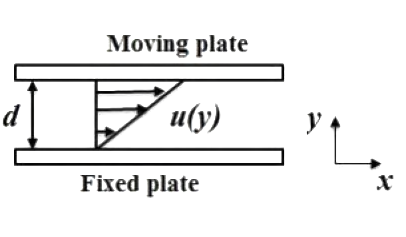
Two infinite parallel horizontal plates are separated by a small gap ($d = 20$ mm) as shown in figure. The bottom plate is fixed and the gap between the plates is filled with oil having density of 890 kg/m³ and kinematic viscosity of 0.00033 m²/s. A shear flow is induced by moving the upper plate with a velocity of 5 m/s. Assume, linear velocity profile between the plates and the oil to be a Newtonian fluid. The shear stress (N/m²) at the upper plate is __________

Question diagram

Open complete paper
11
2017 · Engineering Sciences · Classification of Flows · Fluid Properties and Flow Regimes
Engineering Sciences (XE) 2017
A 50% sucrose solution at 20 °C is flowing at a rate of 3.5 m³/h through a pipe with an inside diameter of 0.0475 m and length of 12 m. The viscosity and the density of the solution are 15.43 cp and 1232 kg/m³, respectively. The Reynolds number of the flow is ______.
Open complete paper
12
2018 · Engineering Sciences · Classification of Flows · Fluid Properties and Flow Regimes
Engineering Sciences (XE) 2018
Identify the correct statement related to the viscosity of Newtonian fluids from the following
Open complete paper
13
2018 · Engineering Sciences · Classification of Flows · Fluid Properties and Flow Regimes
Engineering Sciences (XE) 2018
On a flat plate, transition from laminar to turbulent boundary layer occurred at a critical Reynolds number (Recr). The empirical relations for the laminar and turbulent boundary layer thickness are given by \frac{\delta_{lam}}{x} = 5.48 Re_x^{-0.5} and \frac{\delta_{turb}}{x} = 0.37 Re_x^{-0.2}, respectively. The ratio of laminar to turbulent boundary layer thickness, at the location of transition, is 0.3. The value of Recr is ______.
Open complete paper
14
2018 · Engineering Sciences · Classification of Flows · Fluid Properties and Flow Regimes
Engineering Sciences (XE) 2018
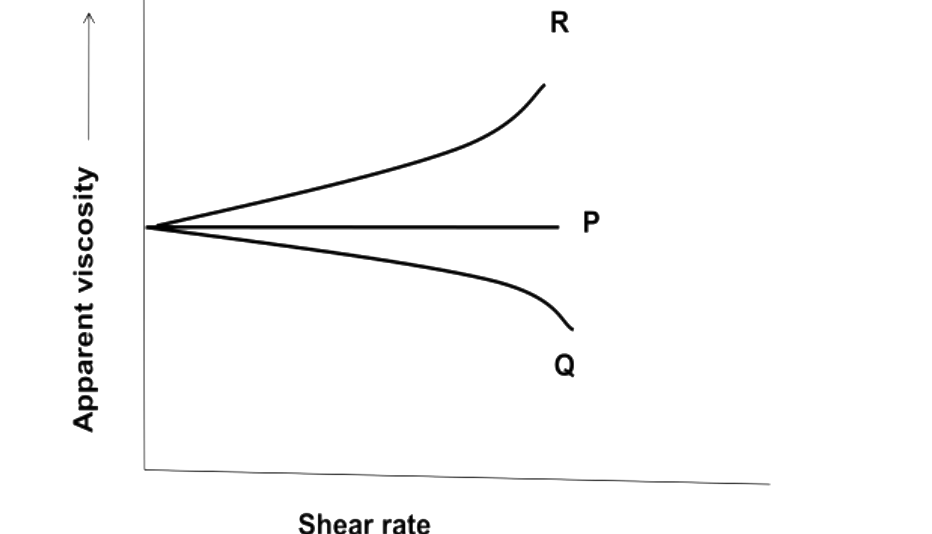
The plot shows apparent viscosity versus shear rate of Newtonian, Dilatant and Pseudoplastic fluids. Based on this plot and the fluid behaviour as mentioned below, find out the correct combination.

Question diagram

Open complete paper
15
2020 · Engineering Sciences · Classification of Flows · Fluid Properties and Flow Regimes
Engineering Sciences (XE) 2020
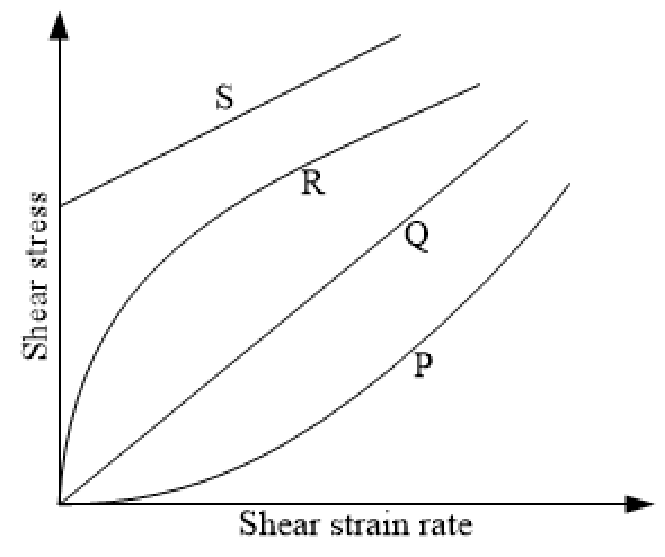
The variation of shear stress (τ) against strain rate (du/dy) is given in the Figure. Identify the line/curve among P, Q, R and S, that represents an ideal fluid.
Open complete paper
16
2020 · Engineering Sciences · Classification of Flows · Fluid Properties and Flow Regimes
Engineering Sciences (XE) 2020
The whole milk at 22 °C is pumped through a stainless steel pipe at a flow rate of 3 L s⁻¹. The length and inner diameter of the pipe are 40 m and 4 cm, respectively. If viscosity and density of the milk at the pumping temperature of 0.2 Pa s and 1032 kg m⁻³, respectively, the Reynolds number (rounded off to nearest integer) will be ______.
Open complete paper
17
2021 · Engineering Sciences · Classification of Flows · Fluid Properties and Flow Regimes
Engineering Sciences (XE) 2021

Which of the following expressions represent the Reynolds number of a fluid flowing through a uniform circular cross section pipe?

Open complete paper
18
2021 · Engineering Sciences · Classification of Flows · Fluid Properties and Flow Regimes
Engineering Sciences (XE) 2021
The general relationship between shear stress, $\tau$ , and the velocity gradient $\left(\frac{du}{dy}\right)$ for a fluid is given by $\tau = k \left(\frac{du}{dy}\right)^n$ , where $k$ is a constant with appropriate units. The fluid is Newtonian if
Open complete paper
19
2022 · Engineering Sciences · Classification of Flows · Fluid Properties and Flow Regimes
Engineering Sciences (XE) 2022

As temperature increases

Open complete paper
20
2023 · Engineering Sciences · Classification of Flows · Fluid Properties and Flow Regimes
Engineering Sciences (XE) 2023

Among the shear stress versus shear strain rate curves shown in the figure, which one corresponds to a shear thinning fluid?

Source question diagram

Open complete paper

Showing 20 of 24 questions