My Cart
Your Cart 0

    Your cart is empty.

  • Total (Amount) ₹0.00
Previous year question hub

Diffraction, Spectroscopy and Microscopy - Characterization and Measurements of Properties - Engineering Sciences Previous Year Questions

Practice Diffraction, Spectroscopy and Microscopy - Characterization and Measurements of Properties - Engineering Sciences previous year questions organised from real papers, with year-wise coverage and clear topic navigation.

17Papers
17Years
33Questions
1Topics

Diffraction, Spectroscopy and Microscopy question pattern

Every graph below is calculated only from this selection.

Questions by year

Year-wise coverage for Diffraction, Spectroscopy and Microscopy. Each bar uses a separate theme-derived color.

Difficulty distribution

How the classified questions are distributed by difficulty.

Easy 18 54.5%
Medium 14 42.4%
Hard 1 3%
Question type distribution

MCQ, numerical, multiple-select and other formats found in these papers.

MCQ 24 72.7%
Numerical Answer Type (NAT) 5 15.2%
MSQ 3 9.1%
Fill in the blanks 1 3%

Subject weightage

Top subjects by unique question coverage.

Engineering Sciences
33 Qs

Most asked topics

Top topics across the included previous year papers.

Characterization and Measurements of Properties
33 Qs

Subtopic coverage

Top subtopics inside this exact selection.

Diffraction, Spectroscopy and Microscopy
33 Qs

Paper coverage

Question coverage for the most populated papers. Every active PYP paper remains listed below.

Engineering Sciences (XE) 2026
1 Qs
Engineering Sciences (XE) 2025
2 Qs
Engineering Sciences (XE) 2024
1 Qs
Engineering Sciences (XE) 2023
2 Qs
Engineering Sciences (XE) 2022
1 Qs
Engineering Sciences (XE) 2021
5 Qs
Engineering Sciences (XE) 2020
3 Qs
Engineering Sciences (XE) 2019
1 Qs
Engineering Sciences (XE) 2017
1 Qs
Engineering Sciences (XE) 2016
3 Qs
Engineering Sciences (XE) 2014
1 Qs
Engineering Sciences (XE) 2013
2 Qs
Engineering Sciences (XE) 2012
3 Qs
Engineering Sciences (XE) 2011
2 Qs
Engineering Sciences (XE) 2009
2 Qs
Engineering Sciences (XE) 2008
2 Qs
Engineering Sciences (XE) 2007
1 Qs

Included previous year papers

Newest papers appear first. Sort by year, question coverage or name.

PaperYear / sessionQuestions in this viewOpen
Engineering Sciences (XE) 202620261View paper
Engineering Sciences (XE) 202520252View paper
Engineering Sciences (XE) 202420241View paper
Engineering Sciences (XE) 202320232View paper
Engineering Sciences (XE) 202220221View paper
Engineering Sciences (XE) 202120215View paper
Engineering Sciences (XE) 202020203View paper
Engineering Sciences (XE) 201920191View paper
Engineering Sciences (XE) 201720171View paper
Engineering Sciences (XE) 201620163View paper
Engineering Sciences (XE) 201420141View paper
Engineering Sciences (XE) 201320132View paper
Engineering Sciences (XE) 201220123View paper
Engineering Sciences (XE) 201120112View paper
Engineering Sciences (XE) 200920092View paper
Engineering Sciences (XE) 200820082View paper
Engineering Sciences (XE) 200720071View paper

All Diffraction, Spectroscopy and Microscopy previous year questions

Practice every matching question in batches of 20, with every available option.

1
2007 · Engineering Sciences · Characterization and Measurements of Properties · Diffraction, Spectroscopy and Microscopy
Engineering Sciences (XE) 2007
Match the experimental techniques in Group I with the applications in Group II and choose the correct matching from (A), (B), (C) and (D).
Group I (Technique)Group II (Application)
P  X-ray diffraction1. Resistivity determination
Q  Transmitted polarized light microscopy2. Measurement of crystallite size
R  Four probe technique3. Observation of inclusion
S  Zone refining4. Observation of spherulites
5. Purification of materials
Open complete paper
2
2008 · Engineering Sciences · Characterization and Measurements of Properties · Diffraction, Spectroscopy and Microscopy
Engineering Sciences (XE) 2008
If the full width at half maximum (FWHM) of the above peak is 0.4°, ignoring the instrumental broadening, the crystallite size of the material is
Open complete paper
3
2008 · Engineering Sciences · Characterization and Measurements of Properties · Diffraction, Spectroscopy and Microscopy
Engineering Sciences (XE) 2008
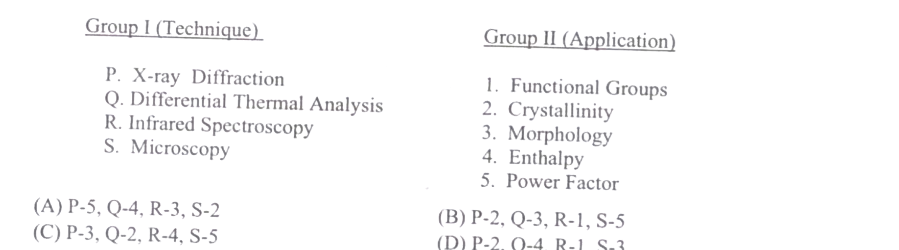
Match the characterization techniques listed in Group I with the applications listed in Group II and select the correct answer from (A), (B), (C) or (D)

Group I (Technique)
P. X-ray Diffraction
Q. Differential Thermal Analysis
R. Infrared Spectroscopy
S. Microscopy

Group II (Application)
1. Functional Groups
2. Crystallinity
3. Morphology
4. Enthalpy
5. Power Factor

Question diagram

Open complete paper
4
2009 · Engineering Sciences · Characterization and Measurements of Properties · Diffraction, Spectroscopy and Microscopy
Engineering Sciences (XE) 2009

Line broadening in X-ray diffraction pattern occurs on account of

Open complete paper
5
2009 · Engineering Sciences · Characterization and Measurements of Properties · Diffraction, Spectroscopy and Microscopy
Engineering Sciences (XE) 2009
Match the characterization technique with the most appropriate property
Characterization technique
P. infrared spectroscopy
Q. thermo-gravimetric analysis
R. transmission electron microscopy
S. differential scanning calorimetry
Property
1. melting point
2. functional group
3. degradation temperature
4. morphology
Open complete paper
6
2011 · Engineering Sciences · Characterization and Measurements of Properties · Diffraction, Spectroscopy and Microscopy
Engineering Sciences (XE) 2011

Match the techniques in Column-I with the descriptions in Column-II.

Column-IColumn-II
P. Differential scanning calorimetry1. Residual stress measurement
Q. Atomic force microscopy2. Surface morphology of a material
R. Scanning electron microscopy3. Incident beam passes through a thin sample
S. X-ray diffraction4. Thermal expansion measurement
5. Resolution less than 1 nm is possible
6. Measurement of enthalpy change
Open complete paper
7
2011 · Engineering Sciences · Characterization and Measurements of Properties · Diffraction, Spectroscopy and Microscopy
Engineering Sciences (XE) 2011
The full width at half maximum (FWHM) of the first peak is 0.35°. Ignoring micro-strain and instrumental broadening, the crystallite size of the sample (in nm) is
Open complete paper
8
2012 · Engineering Sciences · Characterization and Measurements of Properties · Diffraction, Spectroscopy and Microscopy
Engineering Sciences (XE) 2012

Which of the following signals is produced due to the elastic scattering of electrons by a material?

Open complete paper
9
2012 · Engineering Sciences · Characterization and Measurements of Properties · Diffraction, Spectroscopy and Microscopy
Engineering Sciences (XE) 2012

Microstrain can be measured by X-ray diffraction using peak

Open complete paper
10
2012 · Engineering Sciences · Characterization and Measurements of Properties · Diffraction, Spectroscopy and Microscopy
Engineering Sciences (XE) 2012
Find the first diffraction peak position (2θ) for Cu Kα radiation with a wavelength of 1.54 Å
Open complete paper
11
2013 · Engineering Sciences · Characterization and Measurements of Properties · Diffraction, Spectroscopy and Microscopy
Engineering Sciences (XE) 2013
Match the microscopes listed in Column I with their principle of operation listed in Column II
Open complete paper
12
2013 · Engineering Sciences · Characterization and Measurements of Properties · Diffraction, Spectroscopy and Microscopy
Engineering Sciences (XE) 2013
X-rays of unknown wavelength are diffracted by an FCC metal with a lattice parameter of 0.352 nm. The measured ‘2θ’ angle for the (200) peak is 61.08°. Calculate the wavelength of the X-ray used, in nm.
Open complete paper
13
2014 · Engineering Sciences · Characterization and Measurements of Properties · Diffraction, Spectroscopy and Microscopy
Engineering Sciences (XE) 2014
Quantitative measurement of the roughness of a polysilicon wafer can be performed with
Open complete paper
14
2016 · Engineering Sciences · Characterization and Measurements of Properties · Diffraction, Spectroscopy and Microscopy
Engineering Sciences (XE) 2016
Energy Dispersive Spectroscopy (EDS) in a typical scanning electron microscope enables elemental identification by collecting and examining which of the following:
Open complete paper
15
2016 · Engineering Sciences · Characterization and Measurements of Properties · Diffraction, Spectroscopy and Microscopy
Engineering Sciences (XE) 2016
In a diffraction experiment, monochromatic X-rays of wavelength 1.54 Å are used to examine a material with a BCC structure. If the lattice parameter is 4.1 Å, the angular position θ of the first diffraction peak is __________ degrees.
Open complete paper
16
2016 · Engineering Sciences · Characterization and Measurements of Properties · Diffraction, Spectroscopy and Microscopy
Engineering Sciences (XE) 2016
A batch of spherical titania nanoparticles, uniform in size, has a specific surface area of 125 m\(^2\) g\(^{-1}\). If the density of titania is 4.23 g cm\(^{-3}\), the diameter of the particles is __________ nm.
Open complete paper
17
2017 · Engineering Sciences · Characterization and Measurements of Properties · Diffraction, Spectroscopy and Microscopy
Engineering Sciences (XE) 2017
The contrast obtained in scanning electron microscope using back scattered electrons depends on
Open complete paper
18
2019 · Engineering Sciences · Characterization and Measurements of Properties · Diffraction, Spectroscopy and Microscopy
Engineering Sciences (XE) 2019
On decreasing the objective aperture size in an optical microscope
Open complete paper
19
2020 · Engineering Sciences · Characterization and Measurements of Properties · Diffraction, Spectroscopy and Microscopy
Engineering Sciences (XE) 2020
A Pb-Sn sample of eutectic composition, containing α- and β- phases, is examined in a scanning electron microscope. The α-phase contains ~97 wt% Pb (atomic number 82) while β-phase contains ~99 wt% Sn (atomic number 50). The ratio of number of backscattered electrons escaping from α-phase to that from β-phase would be:
Open complete paper
20
2020 · Engineering Sciences · Characterization and Measurements of Properties · Diffraction, Spectroscopy and Microscopy
Engineering Sciences (XE) 2020
Smallest or minimum feature size that can be theoretically resolved in an optical microscope does NOT depend on:
Open complete paper

Showing 20 of 33 questions