My Cart
Your Cart 0

    Your cart is empty.

  • Total (Amount) ₹0.00
Previous year question hub

Atmospheric Structure, Radiation and Thermodynamics - Atmospheric Science - Engineering Sciences Previous Year Questions

Practice Atmospheric Structure, Radiation and Thermodynamics - Atmospheric Science - Engineering Sciences previous year questions organised from real papers, with year-wise coverage and clear topic navigation.

11Papers
11Years
35Questions
1Topics

Atmospheric Structure, Radiation and Thermodynamics question pattern

Every graph below is calculated only from this selection.

Questions by year

Year-wise coverage for Atmospheric Structure, Radiation and Thermodynamics. Each bar uses a separate theme-derived color.

Difficulty distribution

How the classified questions are distributed by difficulty.

Easy 21 60%
Medium 14 40%

Question type distribution

MCQ, numerical, multiple-select and other formats found in these papers.

Numerical Answer Type (NAT) 21 60%
MCQ 12 34.3%
MSQ 2 5.7%

Subject weightage

Top subjects by unique question coverage.

Engineering Sciences
35 Qs

Most asked topics

Top topics across the included previous year papers.

Atmospheric Science
35 Qs

Subtopic coverage

Top subtopics inside this exact selection.

Atmospheric Structure, Radiation and Thermodynamics
35 Qs

Paper coverage

Question coverage for the most populated papers. Every active PYP paper remains listed below.

Engineering Sciences (XE) 2026
3 Qs
Engineering Sciences (XE) 2025
4 Qs
Engineering Sciences (XE) 2024
3 Qs
Engineering Sciences (XE) 2023
1 Qs
Engineering Sciences (XE) 2022
5 Qs
Engineering Sciences (XE) 2021
4 Qs
Engineering Sciences (XE) 2020
4 Qs
Engineering Sciences (XE) 2019
1 Qs
Engineering Sciences (XE) 2018
5 Qs
Engineering Sciences (XE) 2017
4 Qs
Engineering Sciences (XE) 2015
1 Qs

Included previous year papers

Newest papers appear first. Sort by year, question coverage or name.

PaperYear / sessionQuestions in this viewOpen
Engineering Sciences (XE) 202620263View paper
Engineering Sciences (XE) 202520254View paper
Engineering Sciences (XE) 202420243View paper
Engineering Sciences (XE) 202320231View paper
Engineering Sciences (XE) 202220225View paper
Engineering Sciences (XE) 202120214View paper
Engineering Sciences (XE) 202020204View paper
Engineering Sciences (XE) 201920191View paper
Engineering Sciences (XE) 201820185View paper
Engineering Sciences (XE) 201720174View paper
Engineering Sciences (XE) 201520151View paper

All Atmospheric Structure, Radiation and Thermodynamics previous year questions

Practice every matching question in batches of 20, with every available option.

1
2015 · Engineering Sciences · Atmospheric Science · Atmospheric Structure, Radiation and Thermodynamics
Engineering Sciences (XE) 2015

What is the percent relative humidity at which both the dry bulb and wet bulb thermometers would record equal temperatures?

Open complete paper
2
2017 · Engineering Sciences · Atmospheric Science · Atmospheric Structure, Radiation and Thermodynamics
Engineering Sciences (XE) 2017
The largest contributor to the atmospheric greenhouse effect is
Open complete paper
3
2017 · Engineering Sciences · Atmospheric Science · Atmospheric Structure, Radiation and Thermodynamics
Engineering Sciences (XE) 2017
Planets in the solar system are in radiative equilibrium. Let \( S_0 \), \( \alpha \), \( T_0 \) and \( R \) denote solar constant, albedo, average temperature and radius of a planet, respectively, and \( \sigma \) is Stefan's constant. Then the energy balance of this planet is given by the expression
Open complete paper
4
2017 · Engineering Sciences · Atmospheric Science · Atmospheric Structure, Radiation and Thermodynamics
Engineering Sciences (XE) 2017
Average surface temperatures of the Sun and the Earth are 6300 K and 285 K, respectively. The ratio of the wavelength of peak radiation of the Earth to that of the Sun is ______.
Open complete paper
5
2017 · Engineering Sciences · Atmospheric Science · Atmospheric Structure, Radiation and Thermodynamics
Engineering Sciences (XE) 2017
The thickness of an atmospheric layer between 600 hPa and 500 hPa is 1.5 km. If the layer is isothermal, then its temperature is __________ K.
[Gas constant of air: 287 J kg-1 K-1, g: 10 m s-2]
Open complete paper
6
2018 · Engineering Sciences · Atmospheric Science · Atmospheric Structure, Radiation and Thermodynamics
Engineering Sciences (XE) 2018
The most abundant gas in the atmosphere among inert gases is
Open complete paper
7
2018 · Engineering Sciences · Atmospheric Science · Atmospheric Structure, Radiation and Thermodynamics
Engineering Sciences (XE) 2018
The pair of variables that always exhibit monotonic decrease with height in the atmosphere is
Open complete paper
8
2018 · Engineering Sciences · Atmospheric Science · Atmospheric Structure, Radiation and Thermodynamics
Engineering Sciences (XE) 2018
On the summer solstice day, the maximum incident shortwave radiation at the top of the atmosphere over the equator (up to one decimal place) is __________ W m-2. (Take solar constant as 1368 W m-2).
Open complete paper
9
2018 · Engineering Sciences · Atmospheric Science · Atmospheric Structure, Radiation and Thermodynamics
Engineering Sciences (XE) 2018
In an isothermal atmosphere having a temperature of 15°C, the height at which pressure decreases to 1/10 of its value at the surface is __________ km. (Give the answer to two decimal places.) Take g = 9.8 m s-2, gas constant R = 287 J kg-1 K-1
Open complete paper
10
2018 · Engineering Sciences · Atmospheric Science · Atmospheric Structure, Radiation and Thermodynamics
Engineering Sciences (XE) 2018
A numerical model of the atmosphere uses sigma (σ) coordinate system in vertical. At locations P and Q, surface pressures are 1005 hPa and 500 hPa, respectively. Absolute difference in the heights of σ = 0.9 level between these locations is _________ meters. (Give the answer to one decimal place.) Layer mean temperatures at P and Q are 300 K and 270 K, respectively. (Take g = 9.8 m s-2, gas constant R = 287 J kg-1 K-1.)
Open complete paper
11
2019 · Engineering Sciences · Atmospheric Science · Atmospheric Structure, Radiation and Thermodynamics
Engineering Sciences (XE) 2019
Ideal gas equation for dry air is expressed as \( p = \rho R_d T \), where \( p \) is pressure, \( \rho \) is density, \( T \) is temperature and \( R_d \) is gas constant. If CO₂ concentration in Earth’s atmosphere quadruples due to fossil fuel burning, then the new gas constant is __________ J kg⁻¹ K⁻¹. (Round off to two decimal places.)
Take the universal gas constant (\( R^* \)) = 8.314 J K⁻¹ mole⁻¹, molecular weight of CO₂ = 44, and present value of \( R_d \) = 287 J kg⁻¹ K⁻¹, present concentration of CO₂ = 500 mg kg⁻¹.
Open complete paper
12
2020 · Engineering Sciences · Atmospheric Science · Atmospheric Structure, Radiation and Thermodynamics
Engineering Sciences (XE) 2020
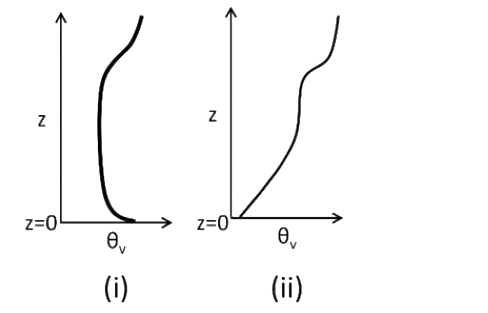
Consider the two atmospheric virtual temperature profiles observed in Delhi given in Figures (i) and (ii) below.

At what times of the day are you most likely to see such profiles?
(i) Midnight and (ii) noon
(i) 3 pm and (ii) 3 am
(i) Sunrise and (ii) sunset
(i) 3 am and (ii) 3 pm

Question diagram

Open complete paper
13
2020 · Engineering Sciences · Atmospheric Science · Atmospheric Structure, Radiation and Thermodynamics
Engineering Sciences (XE) 2020
The emissivity of polluted air that reflects and transmits 20% and 60% of the incoming solar radiation, respectively, at a given wavelength (correct up to 1 decimal place) is ________.
Open complete paper
14
2020 · Engineering Sciences · Atmospheric Science · Atmospheric Structure, Radiation and Thermodynamics
Engineering Sciences (XE) 2020
Assume that pressure varies exponentially with height: \( p(z) = p_0 e^{-z/H} \), where \( p(z) \) is the pressure at a height \( z \) above the surface, \( p_0 \) is the surface pressure, and the scale height \( H = 7.5 \) km. Under these conditions, one-fourth of the total mass of the atmosphere lies above a height (rounded off to 1 decimal place) of ________ km above the surface.
Open complete paper
15
2020 · Engineering Sciences · Atmospheric Science · Atmospheric Structure, Radiation and Thermodynamics
Engineering Sciences (XE) 2020
Consider an atmospheric column of depth 300 m at the Earth's surface with an average temperature of 300 K. If the temperature of the layer rises by \( \Delta T = 10 \) °C, the layer depth \( h \) will increase by \( \Delta h \). Assuming \( \Delta T/T = \Delta h/h \), air density remains unchanged at 1 kgm\(^{-3}\) and \( g = 10 \; \text{ms}^{-2} \), the change in surface pressure is ________ kgm\(^{-1}\)s\(^{-2}\).
Open complete paper
16
2021 · Engineering Sciences · Atmospheric Science · Atmospheric Structure, Radiation and Thermodynamics
Engineering Sciences (XE) 2021
The water vapour mixing ratio of an air parcel increases from 10 g kg-1 to 20 g kg-1 at a constant pressure of 1010 hPa and temperature of 300 K. The change in virtual temperature is ______ K (to one decimal place).
Open complete paper
17
2021 · Engineering Sciences · Atmospheric Science · Atmospheric Structure, Radiation and Thermodynamics
Engineering Sciences (XE) 2021
In an atmosphere, temperature (T) decreases linearly with height above the ground (z), i.e., T(z) = T₀ - γ z, where γ is a constant. Surface pressure is 900 hPa. If the atmosphere is at rest, then the value of z at which the pressure decreases to half of that at the surface is $\_\_\_\_$ m (round off to the nearest integer).
Take acceleration due to gravity g = 10 m s⁻², gas constant R = 300 J kg⁻¹ K⁻¹, T₀ = 300 K and γ = 1/30 K m⁻¹, and the atmosphere behaves as an ideal gas.
Open complete paper
18
2021 · Engineering Sciences · Atmospheric Science · Atmospheric Structure, Radiation and Thermodynamics
Engineering Sciences (XE) 2021
Suppose, because of the doubling of atmospheric CO₂ concentration, an ocean water column receives an additional net energy input of 4 Wm⁻². If the entire water column of depth 1 km heats up uniformly, the water temperature will increase by 1 K in $\_\_\_\_$ years (round off to the nearest integer).
Assume all the additional heat added is retained and not lost. Take density of seawater = 1000 kg m⁻³; specific heat capacity of seawater = 4200 J kg⁻¹ K⁻¹.
Open complete paper
19
2021 · Engineering Sciences · Atmospheric Science · Atmospheric Structure, Radiation and Thermodynamics
Engineering Sciences (XE) 2021
A spherical asteroid, revolving around the sun in a circular orbit, is in radiative balance. Suddenly, the asteroid enters the shadow of a planet and solar radiation is cut off. Assuming that the asteroid emits as a blackbody in the longwave regime, the time taken to reduce the average temperature of the asteroid by 0.5 K is ______ seconds (round off to the nearest integer). Ignore the temporal change in radiation emitted by the asteroid during this cooling period.
The physical properties of the asteroid are: diameter = 2 m, density = 3000 kg m-3, specific heat = 2000 J kg-1 K-1 and albedo = 0.8 in shortwave radiation. Take the solar constant = 500 W m-2, Stefan-Boltzmann constant = 5.67 x 10⁻⁸ W m-2 K-4.
Open complete paper
20
2022 · Engineering Sciences · Atmospheric Science · Atmospheric Structure, Radiation and Thermodynamics
Engineering Sciences (XE) 2022
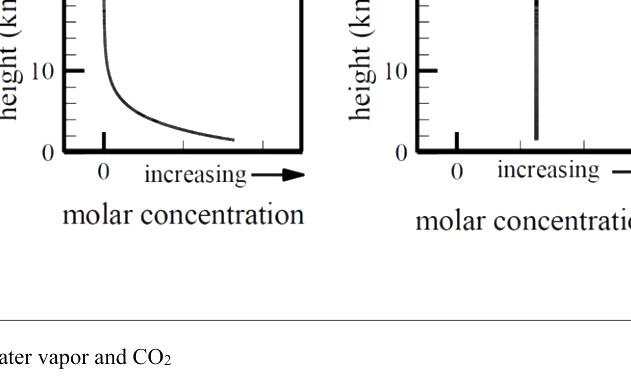
The figure shows a schematic of vertical profiles of concentrations of two gases P and Q in the atmosphere near a coastal station. The correct pair representing P and Q, respectively, is

Question diagram

Open complete paper

Showing 20 of 35 questions