My Cart
Your Cart 0

    Your cart is empty.

  • Total (Amount) ₹0.00
Previous year question hub

Vulcanization and Crosslinking - Additives, Compounding and Formulations - Engineering Sciences Previous Year Questions

Practice Vulcanization and Crosslinking - Additives, Compounding and Formulations - Engineering Sciences previous year questions organised from real papers, with year-wise coverage and clear topic navigation.

8Papers
8Years
10Questions
1Topics

Vulcanization and Crosslinking question pattern

Every graph below is calculated only from this selection.

Questions by year

Year-wise coverage for Vulcanization and Crosslinking. Each bar uses a separate theme-derived color.

Difficulty distribution

How the classified questions are distributed by difficulty.

Medium 7 70%
Easy 3 30%

Question type distribution

MCQ, numerical, multiple-select and other formats found in these papers.

MCQ 5 50%
Numerical Answer Type (NAT) 4 40%
MSQ 1 10%

Subject weightage

Top subjects by unique question coverage.

Engineering Sciences
10 Qs

Most asked topics

Top topics across the included previous year papers.

Additives, Compounding and Formulations
10 Qs

Subtopic coverage

Top subtopics inside this exact selection.

Vulcanization and Crosslinking
10 Qs

Paper coverage

Question coverage for the most populated papers. Every active PYP paper remains listed below.

Engineering Sciences (XE) 2025
1 Qs
Engineering Sciences (XE) 2023
1 Qs
Engineering Sciences (XE) 2021
1 Qs
Engineering Sciences (XE) 2020
2 Qs
Engineering Sciences (XE) 2016
2 Qs
Engineering Sciences (XE) 2015
1 Qs
Engineering Sciences (XE) 2013
1 Qs
Engineering Sciences (XE) 2008
1 Qs

Included previous year papers

Newest papers appear first. Sort by year, question coverage or name.

PaperYear / sessionQuestions in this viewOpen
Engineering Sciences (XE) 202520251View paper
Engineering Sciences (XE) 202320231View paper
Engineering Sciences (XE) 202120211View paper
Engineering Sciences (XE) 202020202View paper
Engineering Sciences (XE) 201620162View paper
Engineering Sciences (XE) 201520151View paper
Engineering Sciences (XE) 201320131View paper
Engineering Sciences (XE) 200820081View paper

All Vulcanization and Crosslinking previous year questions

Practice every matching question in batches of 20, with every available option.

1
2008 · Engineering Sciences · Additives, Compounding and Formulations · Vulcanization and Crosslinking
Engineering Sciences (XE) 2008

The amount of sulphur (S) required for 5% cross linking in 100 kg of Polyisoprene is (atomic masses of H, C, and S are 1, 12, and 32 amu, respectively)

Open complete paper
2
2013 · Engineering Sciences · Additives, Compounding and Formulations · Vulcanization and Crosslinking
Engineering Sciences (XE) 2013

Vulcanization is related to

Open complete paper
3
2015 · Engineering Sciences · Additives, Compounding and Formulations · Vulcanization and Crosslinking
Engineering Sciences (XE) 2015
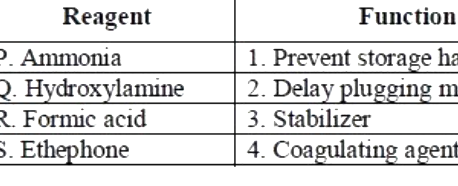
Match the following reagents to their function in natural rubber latex technology

Question diagram

Open complete paper
4
2016 · Engineering Sciences · Additives, Compounding and Formulations · Vulcanization and Crosslinking
Engineering Sciences (XE) 2016
In the vulcanization of 50 g of natural rubber, 10 g of sulfur is added. Assuming the mer to S ratio is 1:1, the maximum percentage of cross-linked sites that could be connected is __________ %.
(Given: atomic weight of S is 32 amu and molecular weight of a mer of natural rubber is 68 amu)
Open complete paper
5
2016 · Engineering Sciences · Additives, Compounding and Formulations · Vulcanization and Crosslinking
Engineering Sciences (XE) 2016
Match the elastomers listed below to the appropriate curing agent:
Open complete paper
6
2020 · Engineering Sciences · Additives, Compounding and Formulations · Vulcanization and Crosslinking
Engineering Sciences (XE) 2020
Dicumyl peroxide is a
Open complete paper
7
2020 · Engineering Sciences · Additives, Compounding and Formulations · Vulcanization and Crosslinking
Engineering Sciences (XE) 2020
Assume that each cross-link produced by vulcanization of polyisoprene contains an average of two sulphur atoms and that the sulphur is present only in the cross-links. If 40% of the isoprene units are cross-linked, the sulphur content in weight percentage is ____________________ (round off to 2 decimal places).
Open complete paper
8
2021 · Engineering Sciences · Additives, Compounding and Formulations · Vulcanization and Crosslinking
Engineering Sciences (XE) 2021
A sample of natural rubber (cis-1,4-polyisoprene) is vulcanized such that one of every 240 chain carbon atoms is cross-linked. The formula unit of the isoprene monomer is C5H8 (molecular weight = 68 g/mol). The average molecular weight (rounded off to the nearest integer) between cross-links is \_\_\_\_\_\_\_\_ g/mol.
Open complete paper
9
2023 · Engineering Sciences · Additives, Compounding and Formulations · Vulcanization and Crosslinking
Engineering Sciences (XE) 2023

Among the options given, which agents are used to vulcanize or cure rubbers?

Open complete paper
10
2025 · Engineering Sciences · Additives, Compounding and Formulations · Vulcanization and Crosslinking
Engineering Sciences (XE) 2025
A rubber contains 70 wt% butadiene (molar mass = 54 g/mol), 20 wt% isoprene (molar mass = 68 g/mol), 5 wt% sulfur and 5 wt% carbon black. Assume that all the sulfur is present in crosslinks.
If each sulfide crosslink contains an average of two sulfur atoms, the percentage of possible crosslinks that are joined by vulcanization is ______%. (Round off to one decimal place)
Open complete paper