Difficulty distribution
How the classified questions are distributed by difficulty.
Your cart is empty.
Practice Compounding Ingredients and Mixing - Additives, Compounding and Formulations - Engineering Sciences previous year questions organised from real papers, with year-wise coverage and clear topic navigation.
Every graph below is calculated only from this selection.
Year-wise coverage for Compounding Ingredients and Mixing. Each bar uses a separate theme-derived color.
How the classified questions are distributed by difficulty.
MCQ, numerical, multiple-select and other formats found in these papers.
Top subjects by unique question coverage.
Top topics across the included previous year papers.
Top subtopics inside this exact selection.
Question coverage for the most populated papers. Every active PYP paper remains listed below.
Newest papers appear first. Sort by year, question coverage or name.
| Paper | Year / session | Questions in this view | Open |
|---|---|---|---|
| Engineering Sciences (XE) 2026 | 2026 | 2 | View paper |
| Engineering Sciences (XE) 2025 | 2025 | 2 | View paper |
| Engineering Sciences (XE) 2024 | 2024 | 1 | View paper |
| Engineering Sciences (XE) 2023 | 2023 | 1 | View paper |
| Engineering Sciences (XE) 2022 | 2022 | 1 | View paper |
| Engineering Sciences (XE) 2021 | 2021 | 1 | View paper |
| Engineering Sciences (XE) 2020 | 2020 | 1 | View paper |
| Engineering Sciences (XE) 2019 | 2019 | 2 | View paper |
| Engineering Sciences (XE) 2018 | 2018 | 1 | View paper |
| Engineering Sciences (XE) 2017 | 2017 | 2 | View paper |
| Engineering Sciences (XE) 2016 | 2016 | 1 | View paper |
| Engineering Sciences (XE) 2015 | 2015 | 2 | View paper |
| Engineering Sciences (XE) 2014 | 2014 | 2 | View paper |
| Engineering Sciences (XE) 2013 | 2013 | 2 | View paper |
| Engineering Sciences (XE) 2012 | 2012 | 1 | View paper |
| Engineering Sciences (XE) 2011 | 2011 | 1 | View paper |
| Engineering Sciences (XE) 2010 | 2010 | 2 | View paper |
| Engineering Sciences (XE) 2009 | 2009 | 3 | View paper |
| Engineering Sciences (XE) 2008 | 2008 | 2 | View paper |
Practice every matching question in batches of 20, with every available option.
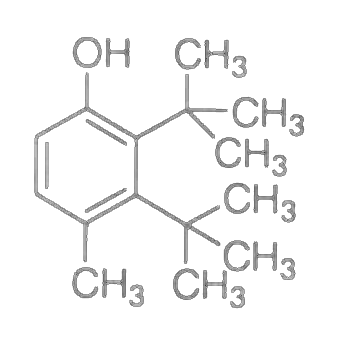
The correct structure of synthetic antioxidant BHT (butylated hydroxy toluene) is

Which one of the following reagents is used to prevent coagulation of natural rubber latex?
| Compounding ingredients | Functions |
|---|---|
| P. Tricresyl phosphate | 1. Filler |
| Q. Calcium carbonate | 2. UV stabilizer |
| R. Azodicarbonamide | 3. Plasticizer |
| S. o-Hydroxybenzophenone | 4. Blowing agent |
| Additive | Function |
|---|---|
| P. Ξ±-Cellulose | 1. Flame retarder |
| Q. Zinc chromate | 2. Plasticizer extender |
| R. Alumina trihydrate | 3. Organic fibrous filler |
| S. Chlorinated paraffin wax | 4. Colorant |
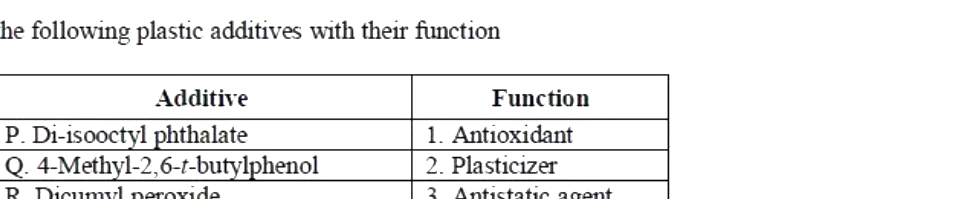
| Additive | Function |
|---|---|
| P. Di-isoocytl phthalate | 1. Antioxidant |
| Q. 4-Methyl-2,6-t-butylphenol | 2. Plasticizer |
| R. Dicumyl peroxide | 3. Antistatic agent |
| S. Quaternary ammonium compound | 4. Cross-linking agent |

| Additive | Function |
|---|---|
| P. Tetramethyl thiuram disulfide | 1. Peptizer |
| Q. Xylyl mercaptan | 2. Antiozonant |
| R. Sulfur | 3. Accelerator |
| S. Microcrystalline wax | 4. Cross-linking agent |
Showing 20 of 30 questions