My Cart
Your Cart 0

    Your cart is empty.

  • Total (Amount) ₹0.00
Previous year question hub

Random Processes - Communications - Electronics & Communication Engineering Previous Year Questions

Practice Random Processes - Communications - Electronics & Communication Engineering previous year questions organised from real papers, with year-wise coverage and clear topic navigation.

6Papers
6Years
6Questions
1Topics

Random Processes question pattern

Every graph below is calculated only from this selection.

Questions by year

Year-wise coverage for Random Processes. Each bar uses a separate theme-derived color.

Difficulty distribution

How the classified questions are distributed by difficulty.

Medium 6 100%

Question type distribution

MCQ, numerical, multiple-select and other formats found in these papers.

MCQ 3 50%
Numerical Answer Type (NAT) 2 33.3%
MSQ 1 16.7%

Subject weightage

Top subjects by unique question coverage.

Electronics & Communication Engineering
6 Qs

Most asked topics

Top topics across the included previous year papers.

Communications
6 Qs

Subtopic coverage

Top subtopics inside this exact selection.

Random Processes
6 Qs

Paper coverage

Question coverage for the most populated papers. Every active PYP paper remains listed below.

Electronics & Communication Engineering (EC) 2023
1 Qs
Electronics & Communication Engineering (EC) 2019
1 Qs
Electronics & Communication Engineering (EC) 2018
1 Qs
Electronics & Communication Engineering (EC) 2012
1 Qs
Electronics & Communication Engineering (EC) 2011
1 Qs
Electronics & Communication Engineering (EC) 2008
1 Qs

Included previous year papers

Newest papers appear first. Sort by year, question coverage or name.

PaperYear / sessionQuestions in this viewOpen
Electronics & Communication Engineering (EC) 202320231View paper
Electronics & Communication Engineering (EC) 201920191View paper
Electronics & Communication Engineering (EC) 201820181View paper
Electronics & Communication Engineering (EC) 201220121View paper
Electronics & Communication Engineering (EC) 201120111View paper
Electronics & Communication Engineering (EC) 200820081View paper

All Random Processes previous year questions

Practice every matching question in batches of 20, with every available option.

1
2008 · Electronics & Communication Engineering · Communications · Random Processes
Electronics & Communication Engineering (EC) 2008
Noise with double-sided power spectral density of K over all frequencies is passed through a RC low pass filter with 3 dB cut-off frequency of fc. The noise power at the filter output is

Question diagram

Open complete paper
2
2011 · Electronics & Communication Engineering · Communications · Random Processes
Electronics & Communication Engineering (EC) 2011
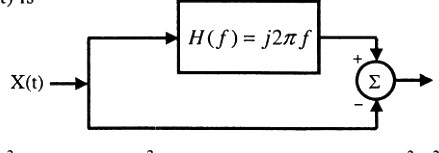
X(t) is a stationary random process with autocorrelation function $R_X(\tau) = \exp(-\pi\tau^2)$. This process is passed through the system shown below. The power spectral density of the output process Y(t) is

Question diagram

Open complete paper
3
2012 · Electronics & Communication Engineering · Communications · Random Processes
Electronics & Communication Engineering (EC) 2012
The power spectral density of a real process \(X(t)\) for positive frequencies is shown below. The values of \(E[X^2(t)]\) and \(|E[X(t)]|\), respectively, are

Question diagram

Open complete paper
4
2018 · Electronics & Communication Engineering · Communications · Random Processes
Electronics & Communication Engineering (EC) 2018
A random variable \(X\) takes values \(-0.5\) and \(0.5\) with probabilities \(\frac{1}{4}\) and \(\frac{3}{4}\), respectively. The noisy observation of \(X\) is \(Y = X + Z\), where \(Z\) has uniform probability density over the interval \((-1, 1)\). \(X\) and \(Z\) are independent. If the MAP rule based detector outputs \(\hat{X}\) as

\[ \hat{X} = \begin{cases} -0.5, & Y < \alpha \\ 0.5, & Y \ge \alpha, \end{cases} \]

then the value of \(\alpha\) (accurate to two decimal places) is ________.
Open complete paper
5
2019 · Electronics & Communication Engineering · Communications · Random Processes
Electronics & Communication Engineering (EC) 2019
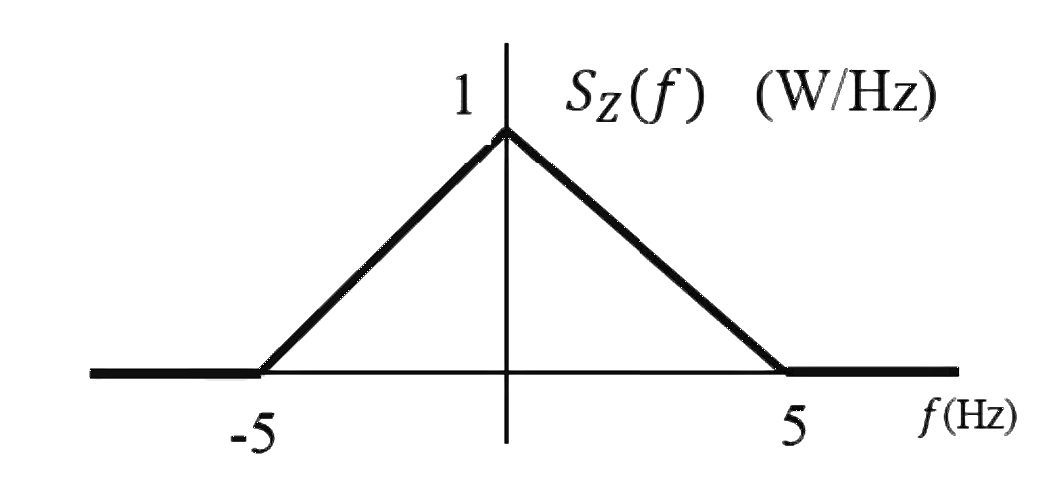
Let a random process Y(t) be described as Y(t) = h(t) * X(t) + Z(t), where X(t) is a white noise process with power spectral density S_X(f) = 5 W/Hz. The filter h(t) has a magnitude response given by |H(f)| = 0.5 for -5 ≤ f ≤ 5, and zero elsewhere. Z(t) is a stationary random process, uncorrelated with X(t), with power spectral density as shown in the figure. The power in Y(t), in watts, is equal to ___________ W (rounded off to two decimal places).
Open complete paper
6
2023 · Electronics & Communication Engineering · Communications · Random Processes
Electronics & Communication Engineering (EC) 2023

For a real signal, which of the following is/are valid power spectral density/densities?

Open complete paper