My Cart
Your Cart 0

    Your cart is empty.

  • Total (Amount) ₹0.00
Previous year question hub

Analog Communications - Communications - Electronics & Communication Engineering Previous Year Questions

Practice Analog Communications - Communications - Electronics & Communication Engineering previous year questions organised from real papers, with year-wise coverage and clear topic navigation.

17Papers
15Years
37Questions
1Topics

Analog Communications question pattern

Every graph below is calculated only from this selection.

Questions by year

Year-wise coverage for Analog Communications. Each bar uses a separate theme-derived color.

Difficulty distribution

How the classified questions are distributed by difficulty.

Medium 24 64.9%
Easy 11 29.7%
Hard 2 5.4%

Question type distribution

MCQ, numerical, multiple-select and other formats found in these papers.

MCQ 17 45.9%
Numerical Answer Type (NAT) 16 43.2%
Fill in the blanks 2 5.4%
MSQ 2 5.4%

Subject weightage

Top subjects by unique question coverage.

Electronics & Communication Engineering
37 Qs

Most asked topics

Top topics across the included previous year papers.

Communications
37 Qs

Subtopic coverage

Top subtopics inside this exact selection.

Analog Communications
37 Qs

Paper coverage

Question coverage for the most populated papers. Every active PYP paper remains listed below.

Electronics and Communication Engineering (EC) 2026
2 Qs
Electronics & Communication Engineering (EC) 2025
2 Qs
Electronics & Communication Engineering (EC) 2024
2 Qs
Electronics & Communication Engineering (EC) 2023
1 Qs
Electronics & Communication Engineering (EC) 2021
4 Qs
Electronics & Communication Engineering (EC) 2020
2 Qs
Electronics & Communication Engineering (EC) 2019
3 Qs
Electronics & Communication Engineering (EC) 2018
3 Qs
Electronics & Communication Engineering (EC) 2017
2 Qs
Electronics & Communication Engineering (EC) 2016 [Session 1]
5 Qs
Electronics & Communication Engineering (EC) 2016 [Session 3]
1 Qs
Electronics & Communication Engineering (EC) 2014 [Session 3]
1 Qs
Electronics & Communication Engineering (EC) 2014 [Session 4]
1 Qs
Electronics & Communication Engineering (EC) 2012
1 Qs
Electronics & Communication Engineering (EC) 2011
2 Qs
Electronics & Communication Engineering (EC) 2010
2 Qs
Electronics & Communication Engineering (EC) 2008
3 Qs

Included previous year papers

Newest papers appear first. Sort by year, question coverage or name.

PaperYear / sessionQuestions in this viewOpen
Electronics and Communication Engineering (EC) 202620262View paper
Electronics & Communication Engineering (EC) 202520252View paper
Electronics & Communication Engineering (EC) 202420242View paper
Electronics & Communication Engineering (EC) 202320231View paper
Electronics & Communication Engineering (EC) 202120214View paper
Electronics & Communication Engineering (EC) 202020202View paper
Electronics & Communication Engineering (EC) 201920193View paper
Electronics & Communication Engineering (EC) 201820183View paper
Electronics & Communication Engineering (EC) 201720172View paper
Electronics & Communication Engineering (EC) 2016 [Session 1]20165View paper
Electronics & Communication Engineering (EC) 2016 [Session 3]20161View paper
Electronics & Communication Engineering (EC) 2014 [Session 3]20141View paper
Electronics & Communication Engineering (EC) 2014 [Session 4]20141View paper
Electronics & Communication Engineering (EC) 201220121View paper
Electronics & Communication Engineering (EC) 201120112View paper
Electronics & Communication Engineering (EC) 201020102View paper
Electronics & Communication Engineering (EC) 200820083View paper

All Analog Communications previous year questions

Practice every matching question in batches of 20, with every available option.

1
2008 · Electronics & Communication Engineering · Communications · Analog Communications
Electronics & Communication Engineering (EC) 2008
Consider the amplitude modulated (AM) signal \(A_c \cos \omega_c t + 2\cos \omega_m t \cos \omega_c t\). For demodulating the signal using envelope detector, the minimum value of \(A_c\) should be
Open complete paper
2
2008 · Electronics & Communication Engineering · Communications · Analog Communications
Electronics & Communication Engineering (EC) 2008
Consider the frequency modulated signal 10 cos[2π × 105t + 5 sin(2π × 1500)t + 7.5 sin(2π × 1000)t] with carrier frequency of 105 Hz. The modulation index is

Question diagram

Open complete paper
3
2008 · Electronics & Communication Engineering · Communications · Analog Communications
Electronics & Communication Engineering (EC) 2008
The signal cos ωct + 0.5 cos ωmt sin ωct is

Question diagram

Open complete paper
4
2010 · Electronics & Communication Engineering · Communications · Analog Communications
Electronics & Communication Engineering (EC) 2010
Suppose that the modulating signal is \(m(t) = 2\cos(2π f_m t)\) and the carrier signal is \(x_c(t) = A_c \cos(2π f_c t)\). Which one of the following is a conventional AM signal without over-modulation?
Open complete paper
5
2010 · Electronics & Communication Engineering · Communications · Analog Communications
Electronics & Communication Engineering (EC) 2010
Consider an angle modulated signal \(x(t) = 6\cos[2π×10^6 t + 2\sin(8000π t) + 4\cos(8000π t)]\) V. The average power of x(t) is
Open complete paper
6
2011 · Electronics & Communication Engineering · Communications · Analog Communications
Electronics & Communication Engineering (EC) 2011

The Column-1 lists the attributes and the Column-2 lists the modulation systems. Match the attribute to the modulation system that best meets it.

Column-1Column-2
P. Power efficient transmission of signalsI. Conventional AM
Q. Most bandwidth efficient transmission of voice signalsII. FM
R. Simplest receiver structureIII. VSB
S. Bandwidth efficient transmission of signals with significant dc componentIV. SSB-SC
Open complete paper
7
2011 · Electronics & Communication Engineering · Communications · Analog Communications
Electronics & Communication Engineering (EC) 2011
A message signal \(m(t) = \cos 2000\pi t + 4\cos 4000\pi t\) modulates the carrier \(c(t) = \cos 2\pi f_c t\) where \(f_c = 1\) MHz to produce an AM signal. For demodulating the generated AM signal using an envelope detector, the time constant RC of the detector circuit should satisfy
Open complete paper
8
2012 · Electronics & Communication Engineering · Communications · Analog Communications
Electronics & Communication Engineering (EC) 2012
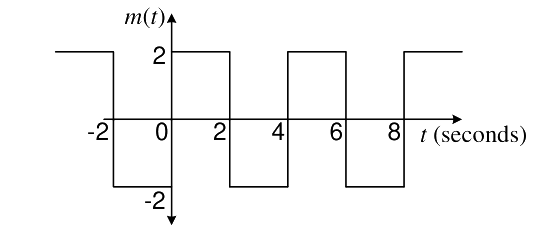
The signal \( m(t) \) as shown is applied both to a phase modulator (with \( k_p \) as the phase constant) and a frequency modulator (with \( k_f \) as the frequency constant) having the same carrier frequency. The ratio \( k_p / k_f \) (in rad/Hz) for the same maximum phase deviation is

Question diagram

Open complete paper
9
2014 · Electronics & Communication Engineering · Communications · Analog Communications
Electronics & Communication Engineering (EC) 2014 [Session 3]
The phase response of a passband waveform at the receiver is given by
\( \phi(f) = -2\pi\alpha(f - f_c) - 2\pi\beta f_c \)
where \( f_c \) is the centre frequency, and \( \alpha \) and \( \beta \) are positive constants. The actual signal propagation delay from the transmitter to receiver is
Open complete paper
10
2014 · Electronics & Communication Engineering · Communications · Analog Communications
Electronics & Communication Engineering (EC) 2014 [Session 4]
In a double side-band (DSB) full carrier AM transmission system, if the modulation index is doubled, then the ratio of total sideband power to the carrier power increases by a factor of ________.
Open complete paper
11
2016 · Electronics & Communication Engineering · Communications · Analog Communications
Electronics & Communication Engineering (EC) 2016 [Session 1]
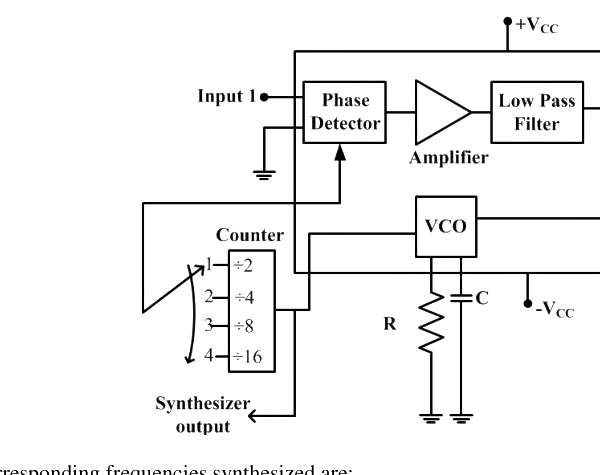
The block diagram of a frequency synthesizer consisting of a Phase Locked Loop (PLL) and a divide-by-\(N\) counter (comprising \( = 2, = 4, = 8, = 16 \) outputs) is sketched below. The synthesizer is excited with a 5 kHz signal (Input 1). The free-running frequency of the PLL is set to 20 kHz. Assume that the commutator switch makes contacts repeatedly in the order 1-2-3-4.
The corresponding frequencies synthesized are:

Question diagram

Open complete paper
12
2016 · Electronics & Communication Engineering · Communications · Analog Communications
Electronics & Communication Engineering (EC) 2016 [Session 1]
A superheterodyne receiver operates in the frequency range of 5 – 60 MHz. The intermediate frequency fIF and local oscillator frequency fLO are chosen such that fIFfLO. It is required that the image frequencies fall outside the 5 – 60 MHz band. The minimum required fIF (in MHz) is ______
Open complete paper
13
2016 · Electronics & Communication Engineering · Communications · Analog Communications
Electronics & Communication Engineering (EC) 2016 [Session 1]
The amplitude of a sinusoidal carrier is modulated by a single sinusoid to obtain the amplitude modulated signal s(t) = 5 cos 1600πt + 20 cos 1800πt + 5 cos 2000πt. The value of the modulation index is ______
Open complete paper
14
2016 · Electronics & Communication Engineering · Communications · Analog Communications
Electronics & Communication Engineering (EC) 2016 [Session 1]
An analog pulse s(t) is transmitted over an additive white Gaussian noise (AWGN) channel. The received signal is r(t) = s(t) + n(t), where n(t) is additive white Gaussian noise with power spectral density \( \frac{N_0}{2} \). The received signal is passed through a filter with impulse response h(t). Let \( E_s \) and \( E_h \) denote the energies of the pulse s(t) and the filter h(t), respectively. When the signal-to-noise ratio (SNR) is maximized at the output of the filter (SNRmax), which of the following holds?
Open complete paper
15
2016 · Electronics & Communication Engineering · Communications · Analog Communications
Electronics & Communication Engineering (EC) 2016 [Session 1]
An antenna pointing in a certain direction has a noise temperature of 50 K. The ambient temperature is 290 K. The antenna is connected to a pre-amplifier that has a noise figure of 2 dB and an available gain of 40 dB over an effective bandwidth of 12 MHz. The effective input noise temperature \( T_e \) for the amplifier and the noise power \( P_{ao} \) at the output of the preamplifier, respectively, are
Open complete paper
16
2016 · Electronics & Communication Engineering · Communications · Analog Communications
Electronics & Communication Engineering (EC) 2016 [Session 3]
For a superheterodyne receiver, the intermediate frequency is 15 MHz and the local oscillator frequency is 3.5 GHz. If the frequency of the received signal is greater than the local oscillator frequency, then the image frequency (in MHz) is _____________
Open complete paper
17
2017 · Electronics & Communication Engineering · Communications · Analog Communications
Electronics & Communication Engineering (EC) 2017

The unmodulated carrier power in an AM transmitter is 5 kW. This carrier is modulated by a sinusoidal modulating signal. The maximum percentage of modulation is 50%. If it is reduced to 40%, then the maximum unmodulated carrier power (in kW) that can be used without overloading the transmitter is ________

Open complete paper
18
2017 · Electronics & Communication Engineering · Communications · Analog Communications
Electronics & Communication Engineering (EC) 2017

A modulating signal given by x(t) = 5 sin(4π103t − 10π cos 2π103t) V is fed to a phase modulator with phase deviation constant kp = 5 rad/V. If the carrier frequency is 20 kHz, the instantaneous frequency (in kHz) at t = 0.5 ms is ________

Open complete paper
19
2018 · Electronics & Communication Engineering · Communications · Analog Communications
Electronics & Communication Engineering (EC) 2018
Consider the following amplitude modulated signal: \( s(t) = \cos(2000 \pi t) + 4 \cos(2400 \pi t) + \cos(2800 \pi t) \). The ratio (accurate to three decimal places) of the power of the message signal to the power of the carrier signal is __________.
Open complete paper
20
2018 · Electronics & Communication Engineering · Communications · Analog Communications
Electronics & Communication Engineering (EC) 2018
A binary source generates symbols \( X \in \{-1, 1\} \) which are transmitted over a noisy channel. The probability of transmitting \( X = 1 \) is 0.5. Input to the threshold detector is \( R = X + N \). The probability density function \( f_N(n) \) of the noise \( N \) is shown below. If the detection threshold is zero, then the probability of error (correct to two decimal places) is __________.
Open complete paper

Showing 20 of 37 questions