My Cart
Your Cart 0

    Your cart is empty.

  • Total (Amount) ₹0.00
Previous year question hub

Logic - General Aptitude - General Aptitude (GA) Previous Year Questions

Practice Logic - General Aptitude - General Aptitude (GA) previous year questions organised from real papers, with year-wise coverage and clear topic navigation.

4Papers
4Years
9Questions
1Topics

Logic question pattern

Every graph below is calculated only from this selection.

Questions by year

Year-wise coverage for Logic. Each bar uses a separate theme-derived color.

Difficulty distribution

How the classified questions are distributed by difficulty.

Easy 5 55.6%
Medium 4 44.4%

Question type distribution

MCQ, numerical, multiple-select and other formats found in these papers.

MCQ 9 100%

Subject weightage

Top subjects by unique question coverage.

General Aptitude (GA)
9 Qs

Most asked topics

Top topics across the included previous year papers.

General Aptitude
9 Qs

Subtopic coverage

Top subtopics inside this exact selection.

Logic
9 Qs

Paper coverage

Question coverage for the most populated papers. Every active PYP paper remains listed below.

Ecology and Evolution (EY) 2024
1 Qs
Ecology and Evolution (EY) 2022
1 Qs
Ecology and Evolution (EY) 2018
1 Qs
Ecology and Evolution (EY) 2015
6 Qs

Included previous year papers

Newest papers appear first. Sort by year, question coverage or name.

PaperYear / sessionQuestions in this viewOpen
Ecology and Evolution (EY) 202420241View paper
Ecology and Evolution (EY) 202220221View paper
Ecology and Evolution (EY) 201820181View paper
Ecology and Evolution (EY) 201520156View paper

All Logic previous year questions

Practice every matching question in batches of 20, with every available option.

1
2015 · General Aptitude (GA) · General Aptitude · Logic
Ecology and Evolution (EY) 2015

Which of the following processes captures the KEY DIFFERENCE between metapopulation versus single-population approaches to study population dynamics?

Open complete paper
2
2015 · General Aptitude (GA) · General Aptitude · Logic
Ecology and Evolution (EY) 2015
Many cranes are highly endangered and are often raised in captivity in zoos by having wild-collected eggs hatched in incubators. The hatchlings are then reared by the zoo keepers in the absence of adult cranes. In order to ensure successful reproduction of these zoo-reared cranes in the wild, which of the following should NOT occur?
Open complete paper
3
2015 · General Aptitude (GA) · General Aptitude · Logic
Ecology and Evolution (EY) 2015
Many agriculturally important insect pests belong to which of the following groups?
P) Coleoptera, Q) Odonata, R) Lepidoptera, S) Orthoptera, T) Chiroptera

Question diagram

Open complete paper
4
2015 · General Aptitude (GA) · General Aptitude · Logic
Ecology and Evolution (EY) 2015
From an original population P of a butterfly species, two experimental populations X and Y were established. In X, males and females were maintained in standard conditions, and females were allowed to mate and lay eggs. Only eggs from females laying small clutches, i.e., S eggs or fewer, were allowed to hatch and the rest were not utilized. In Y, males and females were maintained in standard conditions and females were allowed to mate and lay eggs. From each female, S eggs were randomly selected and allowed to hatch, and the rest were not utilized. After 20 generations of these experimental conditions, relative to the original population P, and assuming that clutch size is under genetic control, we expect clutch size to be ________ in X and ________ in Y.

(A) same, same
(B) reduced, same
(C) same, reduced
(D) reduced, reduced
Open complete paper
5
2015 · General Aptitude (GA) · General Aptitude · Logic
Ecology and Evolution (EY) 2015
Redox potential (Eh) indicates the capacity of atoms, ions, or molecules to donate or accept electrons (i.e., electric potential of energetic transformation during chemical reactions). For reactions involving the nitrogen cycle, Eh values are the following:
ReactionEh (volts)
NO3- to N2+0.75
NO3- to NO2-+0.42
NO2- to NH4++0.34
N2 to NH4+-0.28

A consequence of these differences is that:

(A) N-fixation is energetically unfavourable
(B) denitrification is energetically unfavourable
(C) both N-fixation and denitrification are energetically favourable
(D) both N-fixation and denitrification are energetically unfavourable

Question diagram

Open complete paper
6
2015 · General Aptitude (GA) · General Aptitude · Logic
Ecology and Evolution (EY) 2015
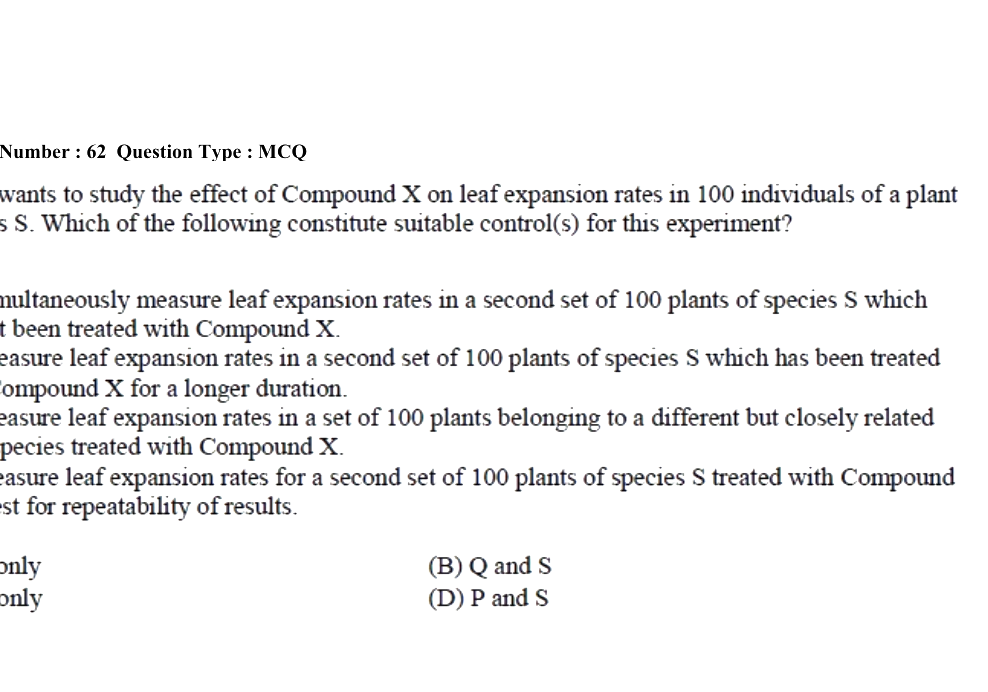
Anita wants to study the effect of Compound X on leaf expansion rates in 100 individuals of a plant species S. Which of the following constitute suitable control(s) for this experiment?
(P) Simultaneously measure leaf expansion rates in a second set of 100 plants of species S which has not been treated with Compound X.
(Q) Measure leaf expansion rates in a second set of 100 plants of species S which has been treated with Compound X for a longer duration.
(R) Measure leaf expansion rates in a set of 100 plants belonging to a different but closely related plant species treated with Compound X.
(S) Measure leaf expansion rates for a second set of 100 plants of species S treated with Compound X to test for repeatability of results.
Open complete paper
7
2018 · General Aptitude (GA) · General Aptitude · Logic
Ecology and Evolution (EY) 2018
Given that \(a\) and \(b\) are integers and \(a + a^2 b^3\) is odd, which one of the following statements is correct?
Open complete paper
8
2024 · General Aptitude (GA) · General Aptitude · Logic
Ecology and Evolution (EY) 2024
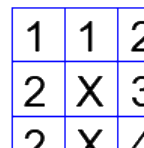
In the 4 × 4 array shown below, each cell of the first three columns has either a cross (X) or a number, as per the given rule.
112
2X3
2X4
12X

Rule: The number in a cell represents the count of crosses around its immediate neighboring cells (left, right, top, bottom, diagonals).
As per this rule, the maximum number of crosses possible in the empty column is

Question diagram

Open complete paper
9
2022 · General Aptitude (GA) · General Aptitude · Logic
Ecology and Evolution (EY) 2022
In the square grid shown on the left, a person standing at P2 position is required to move to P5 position.

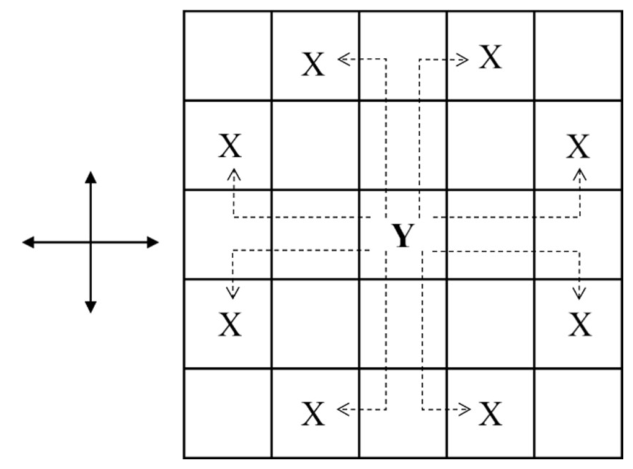
The only movement allowed for a step involves, “two moves along one direction followed by one move in a perpendicular direction”. The permissible directions for movement are shown as dotted arrows in the right.

For example, a person at a given position Y can move only to the positions marked X on the right.

Without occupying any of the shaded squares at the end of each step, the minimum number of steps required to go from P2 to P5 is

Question source image

Open complete paper