My Cart
Your Cart 0

    Your cart is empty.

  • Total (Amount) ₹0.00
Previous year question hub

Searching, Sorting and Divide-and-conquer - Programming, Data Structures and Algorithms - Data Science & Artificial Intelligence Previous Year Questions

Practice Searching, Sorting and Divide-and-conquer - Programming, Data Structures and Algorithms - Data Science & Artificial Intelligence previous year questions organised from real papers, with year-wise coverage and clear topic navigation.

3Papers
3Years
10Questions
1Topics

Searching, Sorting and Divide-and-conquer question pattern

Every graph below is calculated only from this selection.

Questions by year

Year-wise coverage for Searching, Sorting and Divide-and-conquer. Each bar uses a separate theme-derived color.

Difficulty distribution

How the classified questions are distributed by difficulty.

Easy 6 60%
Medium 4 40%

Question type distribution

MCQ, numerical, multiple-select and other formats found in these papers.

MCQ 6 60%
Numerical Answer Type (NAT) 2 20%
MSQ 2 20%

Subject weightage

Top subjects by unique question coverage.

Data Science & Artificial Intelligence
10 Qs

Most asked topics

Top topics across the included previous year papers.

Programming, Data Structures and Algorithms
10 Qs

Subtopic coverage

Top subtopics inside this exact selection.

Searching, Sorting and Divide-and-conquer
10 Qs

Paper coverage

Question coverage for the most populated papers. Every active PYP paper remains listed below.

Data Science and Artificial Intelligence (DA) 2026
3 Qs
Data Science & Artificial Intelligence (DA) 2025
3 Qs
Data Science & Artificial Intelligence (DA) 2024
4 Qs

Included previous year papers

Newest papers appear first. Sort by year, question coverage or name.

PaperYear / sessionQuestions in this viewOpen
Data Science and Artificial Intelligence (DA) 202620263View paper
Data Science & Artificial Intelligence (DA) 202520253View paper
Data Science & Artificial Intelligence (DA) 202420244View paper

All Searching, Sorting and Divide-and-conquer previous year questions

Practice every matching question in batches of 20, with every available option.

1
2024 · Data Science & Artificial Intelligence · Programming, Data Structures and Algorithms · Searching, Sorting and Divide-and-conquer
Data Science & Artificial Intelligence (DA) 2024
Consider performing uniform hashing on an open address hash table with load factor \(\alpha = \frac{n}{m} < 1\), where n elements are stored in the table with m slots. The expected number of probes in an unsuccessful search is at most \(\frac{1}{1-\alpha}\). Inserting an element in this hash table requires at most ______ probes, on average.
Open complete paper
2
2024 · Data Science & Artificial Intelligence · Programming, Data Structures and Algorithms · Searching, Sorting and Divide-and-conquer
Data Science & Artificial Intelligence (DA) 2024
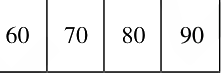
Consider sorting the following array of integers in ascending order using an in-place Quicksort algorithm that uses the last element as the pivot.
[60, 70, 80, 90, 100]
The minimum number of swaps performed during this Quicksort is ______.

Question diagram

Open complete paper
3
2024 · Data Science & Artificial Intelligence · Programming, Data Structures and Algorithms · Searching, Sorting and Divide-and-conquer
Data Science & Artificial Intelligence (DA) 2024
Let \(F(n)\) denote the maximum number of comparisons made while searching for an entry in a sorted array of size \(n\) using binary search.
Which ONE of the following options is TRUE?
Open complete paper
4
2024 · Data Science & Artificial Intelligence · Programming, Data Structures and Algorithms · Searching, Sorting and Divide-and-conquer
Data Science & Artificial Intelligence (DA) 2024
Consider the following sorting algorithms:
(i) Bubble sort
(ii) Insertion sort
(iii) Selection sort
Which ONE among the following choices of sorting algorithms sorts the numbers in the array \([4, 3, 2, 1, 5]\) in increasing order after exactly two passes over the array?
Open complete paper
5
2025 · Data Science & Artificial Intelligence · Programming, Data Structures and Algorithms · Searching, Sorting and Divide-and-conquer
Data Science & Artificial Intelligence (DA) 2025
Consider a hash table of size 10 with indices {0,1,…,9}, with the hash function
\(h(x) = 3x \ (\text{mod } 10)\),
where linear probing is used to handle collisions. The hash table is initially empty and then the following sequence of keys is inserted into the hash table: 1, 4, 5, 6, 14, 15. The indices where the keys 14 and 15 are stored are, respectively
Open complete paper
6
2025 · Data Science & Artificial Intelligence · Programming, Data Structures and Algorithms · Searching, Sorting and Divide-and-conquer
Data Science & Artificial Intelligence (DA) 2025
For which of the following inputs does binary search take time \(O(\log n)\) in the worst case?
Open complete paper
7
2025 · Data Science & Artificial Intelligence · Programming, Data Structures and Algorithms · Searching, Sorting and Divide-and-conquer
Data Science & Artificial Intelligence (DA) 2025
Suppose that insertion sort is applied to the array \([1, 3, 5, 7, 9, 11, x, 15, 13]\) and it takes exactly two swaps to sort the array. Select all possible values of \(x\).
Open complete paper
8
2026 · Data Science & Artificial Intelligence · Programming, Data Structures and Algorithms · Searching, Sorting and Divide-and-conquer
Data Science and Artificial Intelligence (DA) 2026
Consider that the quick sort algorithm is used to sort an array of \(n\) distinct randomly ordered elements. In every call, the pivot is chosen as the first element of the current subarray.
Let \(T(n)\) denote the expected time to sort the array. Assume that the time to partition is linear in the size of the current subarray.
Which of the following recurrence relations correctly represents \(T(n)\) in this scenario?
Open complete paper
9
2026 · Data Science & Artificial Intelligence · Programming, Data Structures and Algorithms · Searching, Sorting and Divide-and-conquer
Data Science and Artificial Intelligence (DA) 2026
Let A be a sorted array containing 1000 distinct integers. You perform a recursive binary search on A to find an element y. Suppose each comparison checks whether the middle element computed during the current recursive step is equal to, less than, or greater than y. The maximum number of comparisons that may have to be performed if y is not an element of A is ________. (Answer in integer)
Open complete paper
10
2026 · Data Science & Artificial Intelligence · Programming, Data Structures and Algorithms · Searching, Sorting and Divide-and-conquer
Data Science and Artificial Intelligence (DA) 2026
Consider the problem of sorting the given array in ascending order:
\( P = [1, 2, 3, 5, 4] \)
Consider two sorting algorithms Bubble Sort (BS) and Insertion Sort (IS).
Let N1 be the total number of comparisons done by BS on the elements of P and N2 be the total number of comparisons done by IS on the elements of P.
Which of the following options is/are correct?
Open complete paper