My Cart
Your Cart 0

    Your cart is empty.

  • Total (Amount) ₹0.00
Previous year question hub

Graphs, Traversals and Shortest Paths - Programming, Data Structures and Algorithms - Data Science & Artificial Intelligence Previous Year Questions

Practice Graphs, Traversals and Shortest Paths - Programming, Data Structures and Algorithms - Data Science & Artificial Intelligence previous year questions organised from real papers, with year-wise coverage and clear topic navigation.

3Papers
3Years
7Questions
1Topics

Graphs, Traversals and Shortest Paths question pattern

Every graph below is calculated only from this selection.

Questions by year

Year-wise coverage for Graphs, Traversals and Shortest Paths. Each bar uses a separate theme-derived color.

Difficulty distribution

How the classified questions are distributed by difficulty.

Medium 6 85.7%
Hard 1 14.3%

Question type distribution

MCQ, numerical, multiple-select and other formats found in these papers.

MSQ 4 57.1%
MCQ 2 28.6%
Numerical Answer Type (NAT) 1 14.3%

Subject weightage

Top subjects by unique question coverage.

Data Science & Artificial Intelligence
7 Qs

Most asked topics

Top topics across the included previous year papers.

Programming, Data Structures and Algorithms
7 Qs

Subtopic coverage

Top subtopics inside this exact selection.

Graphs, Traversals and Shortest Paths
7 Qs

Paper coverage

Question coverage for the most populated papers. Every active PYP paper remains listed below.

Data Science and Artificial Intelligence (DA) 2026
2 Qs
Data Science & Artificial Intelligence (DA) 2025
2 Qs
Data Science & Artificial Intelligence (DA) 2024
3 Qs

Included previous year papers

Newest papers appear first. Sort by year, question coverage or name.

PaperYear / sessionQuestions in this viewOpen
Data Science and Artificial Intelligence (DA) 202620262View paper
Data Science & Artificial Intelligence (DA) 202520252View paper
Data Science & Artificial Intelligence (DA) 202420243View paper

All Graphs, Traversals and Shortest Paths previous year questions

Practice every matching question in batches of 20, with every available option.

1
2024 · Data Science & Artificial Intelligence · Programming, Data Structures and Algorithms · Graphs, Traversals and Shortest Paths
Data Science & Artificial Intelligence (DA) 2024
Consider performing depth-first search (DFS) on an undirected and unweighted graph \( G \) starting at vertex \( s \). For any vertex \( u \) in \( G \), \( d[u] \) is the length of the shortest path from \( s \) to \( u \). Let \( (u, v) \) be an edge in \( G \) such that \( d[u] < d[v] \). If the edge \( (u, v) \) is explored first in the direction from \( u \) to \( v \) during the above DFS, then \( (u, v) \) becomes a ______ edge.
Open complete paper
2
2024 · Data Science & Artificial Intelligence · Programming, Data Structures and Algorithms · Graphs, Traversals and Shortest Paths
Data Science & Artificial Intelligence (DA) 2024
Consider the following tree traversals on a full binary tree:
(i) Preorder
(ii) Inorder
(iii) Postorder
Which of the following traversal options is/are sufficient to uniquely reconstruct the full binary tree?
Open complete paper
3
2024 · Data Science & Artificial Intelligence · Programming, Data Structures and Algorithms · Graphs, Traversals and Shortest Paths
Data Science & Artificial Intelligence (DA) 2024
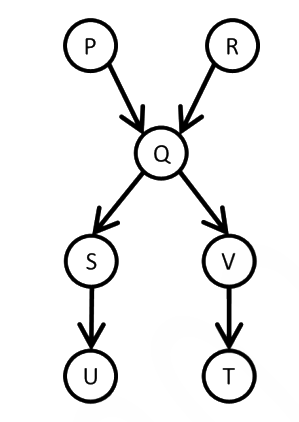
Consider the directed acyclic graph (DAG) below:
Which of the following is/are valid vertex orderings that can be obtained from a topological sort of the DAG?

Question diagram

Open complete paper
4
2025 · Data Science & Artificial Intelligence · Programming, Data Structures and Algorithms · Graphs, Traversals and Shortest Paths
Data Science & Artificial Intelligence (DA) 2025
Let \(G\) be a simple, unweighted, and undirected graph. A subset of the vertices and edges of \(G\) are shown below.
[Image]
It is given that \(a - b - c - d\) is a shortest path between \(a\) and \(d\); \(e - f - g - h\) is a shortest path between \(e\) and \(h\); \(a - f - c - h\) is a shortest path between \(a\) and \(h\). Which of the following is/are NOT the edges of \(G\)?

Question diagram

Open complete paper
5
2025 · Data Science & Artificial Intelligence · Programming, Data Structures and Algorithms · Graphs, Traversals and Shortest Paths
Data Science & Artificial Intelligence (DA) 2025
Consider a directed graph \(G = (V, E)\), where \(V = \{0, 1, 2, \dots, 100\}\) and \(E = \{(i, j) : 0 < j - i \le 2, \text{for all } i, j \in V\}\). Suppose the adjacency list of each vertex is in decreasing order of vertex number, and depth-first search (DFS) is performed at vertex 0. The number of vertices that will be discovered after vertex 50 is _________(Answer in integer)
Open complete paper
6
2026 · Data Science & Artificial Intelligence · Programming, Data Structures and Algorithms · Graphs, Traversals and Shortest Paths
Data Science and Artificial Intelligence (DA) 2026
You are given the following Pre-order and In-order traversals of a Binary Tree T with nodes E, F, G, P, Q, R, S.
Pre-order:    P    Q    S    E    R    F    G
In-order:     S    Q    E    P    F    R    G
Which of the following statements is/are true about the Binary Tree T?
Open complete paper
7
2026 · Data Science & Artificial Intelligence · Programming, Data Structures and Algorithms · Graphs, Traversals and Shortest Paths
Data Science and Artificial Intelligence (DA) 2026
Consider a directed graph G = (V, E), where V is the finite set of vertices and E is the set of directed edges between the vertices. G may contain cycles but there is no self-loop. Further, G may not be strongly connected.
Let GR be the graph obtained by reversing the directions of all the edges in G without changing the set of vertices.
Assume that Breadth First Search (BFS) or Depth First Search (DFS) from any given vertex v of a graph visits only the reachable vertices from v in that graph.
Which of the following statements must always be true, regardless of the structure of G?
Open complete paper