Supervised Learning - Machine Learning - Data Science & Artificial Intelligence Previous Year Questions
Practice Supervised Learning - Machine Learning - Data Science & Artificial Intelligence previous year questions organised from real papers, with year-wise coverage and clear topic navigation.
3Papers
3Years
17Questions
1Topics
Supervised Learning question pattern
Every graph below is calculated only from this selection.
Questions by year
Year-wise coverage for Supervised Learning. Each bar uses a separate theme-derived color.
Difficulty distribution
How the classified questions are distributed by difficulty.
17questions
Easy11
64.7%
Medium6
35.3%
Question type distribution
MCQ, numerical, multiple-select and other formats found in these papers.
17questions
Numerical Answer Type (NAT)7
41.2%
MCQ6
35.3%
MSQ4
23.5%
Subject weightage
Top subjects by unique question coverage.
Data Science & Artificial Intelligence
17 Qs
Most asked topics
Top topics across the included previous year papers.
Machine Learning
17 Qs
Subtopic coverage
Top subtopics inside this exact selection.
Supervised Learning
17 Qs
Paper coverage
Question coverage for the most populated papers. Every active PYP paper remains listed below.
Data Science and Artificial Intelligence (DA) 2026
6 Qs
Data Science & Artificial Intelligence (DA) 2025
5 Qs
Data Science & Artificial Intelligence (DA) 2024
6 Qs
Included previous year papers
Newest papers appear first. Sort by year, question coverage or name.
Paper
Year / session
Questions in this view
Open
Data Science and Artificial Intelligence (DA) 2026
Consider the dataset with six datapoints: \( \{(\mathbf{x}_1, y_1), (\mathbf{x}_2, y_2), \ldots, (\mathbf{x}_6, y_6)\} \), where \( \mathbf{x}_1 = \begin{bmatrix} 1 \\ 0 \end{bmatrix} \), \( \mathbf{x}_2 = \begin{bmatrix} 0 \\ 1 \end{bmatrix} \), \( \mathbf{x}_3 = \begin{bmatrix} 0 \\ -1 \end{bmatrix} \), \( \mathbf{x}_4 = \begin{bmatrix} -1 \\ 0 \end{bmatrix} \), \( \mathbf{x}_5 = \begin{bmatrix} 2 \\ 2 \end{bmatrix} \), \( \mathbf{x}_6 = \begin{bmatrix} -2 \\ -2 \end{bmatrix} \), and the labels are given by \( y_1 = y_2 = y_5 = 1 \), and \( y_3 = y_4 = y_6 = -1 \). A hard margin linear support vector machine is trained on the above dataset. Which ONE of the following sets is a possible set of support vectors?
Given a dataset with K binary-valued attributes (where K > 2) for a two-class classification task, the number of parameters to be estimated for learning a naive Bayes classifier is
For any binary classification dataset, let \(S_B \in \mathbb{R}^{d \times d}\) and \(S_W \in \mathbb{R}^{d \times d}\) be the between-class and within-class scatter (covariance) matrices, respectively. The Fisher linear discriminant is defined by \(u^* \in \mathbb{R}^d\) that maximizes \(J(u) = \frac{u^T S_B u}{u^T S_W u}\). If \(\lambda = J(u^*)\), \(S_W\) is non-singular and \(S_B \neq 0\), then \((u^*, \lambda)\) must satisfy which ONE of the following equations? Note: \(\mathbb{R}\) denotes the set of real numbers.
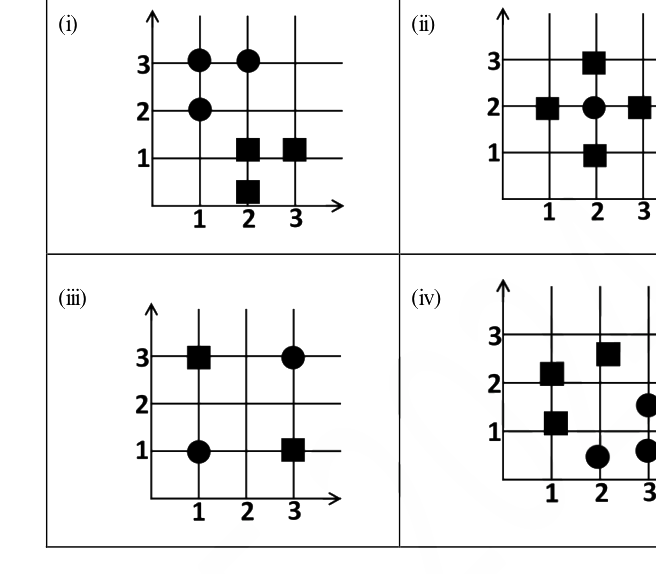
Consider the following figures representing datasets consisting of two-dimensional features with two classes denoted by circles and squares. Which of the following is/are TRUE?
Details of ten international cricket games between two teams “Green” and “Blue” are given in Table C. This table consists of matches played on different pitches, across formats along with their winners. The attribute Pitch can take one of two values: spin-friendly (represented as S) or pace-friendly (represented as F). The attribute Format can take one of two values: one day match (represented as O) or test match (represented as T). A cricket organization would like to use the information given in Table C to develop a decision-tree model to predict outcomes of future games between these two teams. To develop such a model, the computed InformationGain(C, Pitch) with respect to the Target is ______. (rounded off to two decimal places). Table C
Given the two-dimensional dataset consisting of 5 data points from two classes (circles and squares) and assume that the Euclidean distance is used to measure the distance between two points. The minimum odd value of \(k\) in \(k\)-nearest neighbor algorithm for which the diamond (◇) shaped data point is assigned the label square is ______.
Consider designing a linear classifier \[ y = \text{sign}(f(x; w, b)), \quad f(x; w, b) = w^\top x + b \] on a dataset \(D = \{(x_1, y_1), (x_2, y_2), \ldots, (x_N, y_N)\}\), \(x_i \in \mathbb{R}^d\), \(y_i \in \{+1, -1\}\), \(i = 1, 2, \ldots, N\). Recall that the sign function outputs +1 if the argument is positive, and -1 if the argument is non-positive. The parameters \(w\) and \(b\) are updated as per the following training algorithm: \[ w_{new} = w_{old} + y_n x_n, \quad b_{new} = b_{old} + y_n \] whenever \(\text{sign}(f(x_n; w_{old}, b_{old})) \ne y_n\). In other words, whenever the classifier wrongly predicts a sample \((x_n, y_n)\) from the dataset, \(w_{old}\) gets updated to \(w_{new}\) and likewise \(b_{old}\) gets updated to \(b_{new}\). Consider the case \((x_n, +1), f(x_n; w_{old}, b_{old}) < 0\). Then
Given data \(\{(-1, 1), (2, -5), (3, 5)\}\) of the form \((x_i, y_i)\), we fit a model \(y = wx\) using linear least-squares regression. The optimal value of \(w\) is ______________ (Round off to three decimal places)
The naive Bayes classifier is used to solve a two-class classification problem with class-labels \(y_1, y_2\). Suppose the prior probabilities are \(P(y_1) = \frac{1}{3}\) and \(P(y_2) = \frac{2}{3}\). Assuming a discrete feature space with \[P(x|y_1) = \frac{3}{4} \text{ and } P(x|y_2) = \frac{1}{4},\] for a specific feature vector \(x\). The probability of misclassifying \(x\) is ______________ (Round off to two decimal places)
Consider a two-class problem in \(\mathbb{R}^d\) with class labels red and green. Let \(\mu_{red}\) and \(\mu_{green}\) be the means of the two classes. Given test sample \(x \in \mathbb{R}^d\), a classifier calculates the squared Euclidean distance (denoted by \(\|\cdot\|^2\)) between \(x\) and the means of the two classes and assigns the class label that the sample \(x\) is closest to. That is, the classifier computes \(f(x) = \|\mu_{red} - x\|^2 - \|\mu_{green} - x\|^2\) and assigns the label red to \(x\) if \(f(x) < 0\), and green otherwise. Which of the following statements is/are correct?
Data Science and Artificial Intelligence (DA) 2026
Consider that you are training a classifier for a 10-class classification problem. Each input is represented as a 512-dimensional vector. There are 1000 samples, out of which first 100 will be used for testing. Let Leave-One-Out-Cross-Validation (LOOCV) be used for selection of the classifier model before testing. Which of the following options is the correct number of validation splits that will be generated?
Data Science and Artificial Intelligence (DA) 2026
Consider that for a supervised learning task, the objective function being minimized is $f_w(x) = wx$, where $x \in \mathbb{R}$ is the input and $w \in \mathbb{R}$ is the parameter.
Stochastic Gradient Descent with learning rate of 0.10 is used for parameter updates.
Suppose that at the end of iteration $t$, the value of $w$ becomes 10.00.
Let $x = 10.00$ be the input for iteration $(t+1)$.
The value of $w$ at the end of iteration $(t+1)$ is ________. (Rounded off to two decimal places)
Data Science and Artificial Intelligence (DA) 2026
Consider that 20 stories of Author X and 10 stories of Author Y were kept together without mentioning the names of the authors. A classifier was then asked to predict the author (X or Y) of each of these stories. Let, out of X’s stories, 6 were classified as that of Y. On the other hand, out of Y’s stories, 2 were classified as that of X. Considering X and Y as two classes, which of the following statements is/are true?
Data Science and Artificial Intelligence (DA) 2026
Consider that Linear Ridge Regression is being used to learn a prediction function \( y_{pred} = w^T x \), where \( w, x \in \mathbb{R}^2 \) and Mean Absolute Error (MAE) is used to measure the prediction error. A weight of 0.20 is associated with the regularizer. At an intermediate step of the training process, assume that the parameter \( w = [-3.00, 4.00]^T \). In the next step, for the input \( x = [1.00, 2.00]^T \), the predicted value of \( y \) is noted. Let the relation between \( x = [x_1, x_2]^T \) and the true value of \( y \) be \( y_{true} = x_1 + x_2 \). The value of the overall regularized loss function for this instance is ______. (Rounded off to two decimal places)
Data Science and Artificial Intelligence (DA) 2026
Consider a fully-connected feed-forward multi-layer perceptron. It has 30 neurons in the input layer, followed by two hidden layers and an output layer. The first hidden layer has 4 neurons and the second hidden layer has 3 neurons. The output layer has only one neuron. Assume that no bias parameters are used.
The number of learnable parameters in the multi-layer perceptron is __________ . (Answer in integer)