My Cart
Your Cart 0

    Your cart is empty.

  • Total (Amount) ₹0.00
Previous year question hub

Normalization, Storage and Indexing - Database Management and Warehousing - Data Science & Artificial Intelligence Previous Year Questions

Practice Normalization, Storage and Indexing - Database Management and Warehousing - Data Science & Artificial Intelligence previous year questions organised from real papers, with year-wise coverage and clear topic navigation.

3Papers
3Years
8Questions
1Topics

Normalization, Storage and Indexing question pattern

Every graph below is calculated only from this selection.

Questions by year

Year-wise coverage for Normalization, Storage and Indexing. Each bar uses a separate theme-derived color.

Difficulty distribution

How the classified questions are distributed by difficulty.

Medium 7 87.5%
Hard 1 12.5%

Question type distribution

MCQ, numerical, multiple-select and other formats found in these papers.

MSQ 3 37.5%
MCQ 3 37.5%
Numerical Answer Type (NAT) 2 25%

Subject weightage

Top subjects by unique question coverage.

Data Science & Artificial Intelligence
8 Qs

Most asked topics

Top topics across the included previous year papers.

Database Management and Warehousing
8 Qs

Subtopic coverage

Top subtopics inside this exact selection.

Normalization, Storage and Indexing
8 Qs

Paper coverage

Question coverage for the most populated papers. Every active PYP paper remains listed below.

Data Science and Artificial Intelligence (DA) 2026
4 Qs
Data Science & Artificial Intelligence (DA) 2025
2 Qs
Data Science & Artificial Intelligence (DA) 2024
2 Qs

Included previous year papers

Newest papers appear first. Sort by year, question coverage or name.

PaperYear / sessionQuestions in this viewOpen
Data Science and Artificial Intelligence (DA) 202620264View paper
Data Science & Artificial Intelligence (DA) 202520252View paper
Data Science & Artificial Intelligence (DA) 202420242View paper

All Normalization, Storage and Indexing previous year questions

Practice every matching question in batches of 20, with every available option.

1
2024 · Data Science & Artificial Intelligence · Database Management and Warehousing · Normalization, Storage and Indexing
Data Science & Artificial Intelligence (DA) 2024
Given the relational schema \( R = (U, V, W, X, Y, Z) \) and the set of functional dependencies:
\(\{U \rightarrow V, U \rightarrow W, WX \rightarrow Y, WX \rightarrow Z, V \rightarrow X\}\)
Which of the following functional dependencies can be derived from the above set?
Open complete paper
2
2024 · Data Science & Artificial Intelligence · Database Management and Warehousing · Normalization, Storage and Indexing
Data Science & Artificial Intelligence (DA) 2024
An OTT company is maintaining a large disk-based relational database of different movies with the following schema:
Movie(ID, CustomerRating)
Genre(ID, Name)
Movie_Genre(MovieID, GenreID)
Consider the following SQL query on the relation database above:
SELECT *
FROM Movie, Genre, Movie_Genre
WHERE
  Movie.CustomerRating > 3.4 AND
  Genre.Name = “Comedy” AND
  Movie_Genre.MovieID = Movie.ID AND
  Movie_Genre.GenreID = Genre.ID;
This SQL query can be sped up using which of the following indexing options?
Open complete paper
3
2025 · Data Science & Artificial Intelligence · Database Management and Warehousing · Normalization, Storage and Indexing
Data Science & Artificial Intelligence (DA) 2025
If a relational decomposition is not dependency-preserving, which one of the following relational operators will be executed more frequently in order to maintain the dependencies?
Open complete paper
4
2025 · Data Science & Artificial Intelligence · Database Management and Warehousing · Normalization, Storage and Indexing
Data Science & Artificial Intelligence (DA) 2025
Consider a database relation R with attributes ABCDEFG, and having the following functional dependencies:
\(A \rightarrow BCEF\) \(E \rightarrow DG\) \(BC \rightarrow A\)
Which of the following statements is/are correct?
Open complete paper
5
2026 · Data Science & Artificial Intelligence · Database Management and Warehousing · Normalization, Storage and Indexing
Data Science and Artificial Intelligence (DA) 2026
Let R(A, B, C, D, E) be a relational schema with functional dependency set F={A→BC, CD→E, E→A}.

Which of the following statements is correct?
Open complete paper
6
2026 · Data Science & Artificial Intelligence · Database Management and Warehousing · Normalization, Storage and Indexing
Data Science and Artificial Intelligence (DA) 2026
In a relational database, a B+ Tree Index is to be constructed for a relation on a key field. In a B+ Tree, a Node Pointer points to a sub-tree and a Data Record Pointer points to a block of database records.
Let, Node size = 4096 bytes, Node Pointer size = 10 bytes, Search Key Field size = 11 bytes and Data Record Pointer size = 12 bytes.
The maximum number of Node Pointers that can be present in a non-leaf node of the B+ Tree is __________. (Answer in integer)
Open complete paper
7
2026 · Data Science & Artificial Intelligence · Database Management and Warehousing · Normalization, Storage and Indexing
Data Science and Artificial Intelligence (DA) 2026
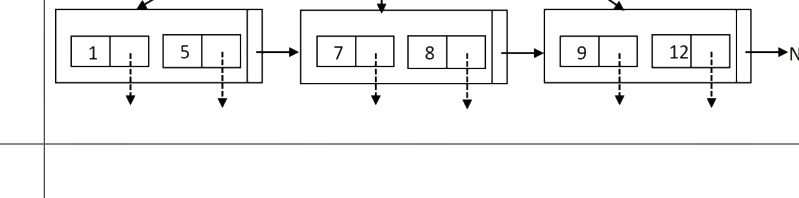
Consider a B+ Tree where the maximum number of key values in each leaf node is 2 and the maximum number of pointers in each non-leaf node is 3. Let the content of the B+ Tree be as shown in the figure.
Which of the following options denotes the key value(s) stored in the root node after inserting a key value 3 in the given B+ Tree?

Question diagram

Open complete paper
8
2026 · Data Science & Artificial Intelligence · Database Management and Warehousing · Normalization, Storage and Indexing
Data Science and Artificial Intelligence (DA) 2026
Consider an ER model with the entities E1(A11, A12, A13) and E2(A21, A22, A23), where, A11, A12, A13 are the attributes of E1, and A21, A22, A23 are the attributes of E2. Let A22 be a multi-valued attribute. A11 and A21 are the primary keys of E1 and E2, respectively.
Let R12 be a many-to-many relationship between E1 and E2. Participation of both E1 and E2 in R12 is total.
The minimum number of relations required to convert the ER model into relational model (assuming there is no other functional dependency) where each relation is in third normal form (3NF) is __________ . (Answer in integer)
Open complete paper