My Cart
Your Cart 0

    Your cart is empty.

  • Total (Amount) ₹0.00
Previous year question hub

Informed, Uninformed and Adversarial Search - AI - Data Science & Artificial Intelligence Previous Year Questions

Practice Informed, Uninformed and Adversarial Search - AI - Data Science & Artificial Intelligence previous year questions organised from real papers, with year-wise coverage and clear topic navigation.

3Papers
3Years
7Questions
1Topics

Informed, Uninformed and Adversarial Search question pattern

Every graph below is calculated only from this selection.

Questions by year

Year-wise coverage for Informed, Uninformed and Adversarial Search. Each bar uses a separate theme-derived color.

Difficulty distribution

How the classified questions are distributed by difficulty.

Medium 3 42.9%
Easy 3 42.9%
Hard 1 14.3%
Question type distribution

MCQ, numerical, multiple-select and other formats found in these papers.

MCQ 6 85.7%
Numerical Answer Type (NAT) 1 14.3%

Subject weightage

Top subjects by unique question coverage.

Data Science & Artificial Intelligence
7 Qs

Most asked topics

Top topics across the included previous year papers.

AI
7 Qs

Subtopic coverage

Top subtopics inside this exact selection.

Informed, Uninformed and Adversarial Search
7 Qs

Paper coverage

Question coverage for the most populated papers. Every active PYP paper remains listed below.

Data Science and Artificial Intelligence (DA) 2026
2 Qs
Data Science & Artificial Intelligence (DA) 2025
2 Qs
Data Science & Artificial Intelligence (DA) 2024
3 Qs

Included previous year papers

Newest papers appear first. Sort by year, question coverage or name.

PaperYear / sessionQuestions in this viewOpen
Data Science and Artificial Intelligence (DA) 202620262View paper
Data Science & Artificial Intelligence (DA) 202520252View paper
Data Science & Artificial Intelligence (DA) 202420243View paper

All Informed, Uninformed and Adversarial Search previous year questions

Practice every matching question in batches of 20, with every available option.

1
2024 · Data Science & Artificial Intelligence · AI · Informed, Uninformed and Adversarial Search
Data Science & Artificial Intelligence (DA) 2024
Let \(h_1\) and \(h_2\) be two admissible heuristics used in A* search.
Which ONE of the following expressions is always an admissible heuristic?
Open complete paper
2
2024 · Data Science & Artificial Intelligence · AI · Informed, Uninformed and Adversarial Search
Data Science & Artificial Intelligence (DA) 2024
Consider the following statement:
In adversarial search, \(\alpha-\beta\) pruning can be applied to game trees of any depth where \(\alpha\) is the __(m)__ value choice we have formed so far at any choice point along the path for the MAX player and \(\beta\) is the __(n)__ value choice we have formed so far at any choice point along the path for the MIN player.
Which ONE of the following choices of (m) and (n) makes the above statement valid?
Open complete paper
3
2024 · Data Science & Artificial Intelligence · AI · Informed, Uninformed and Adversarial Search
Data Science & Artificial Intelligence (DA) 2024
Consider a state space where the start state is number 1. The successor function for the state numbered \(n\) returns two states numbered \(n+1\) and \(n+2\). Assume that the states in the unexpanded state list are expanded in the ascending order of numbers and the previously expanded states are not added to the unexpanded state list.
Which ONE of the following statements about breadth-first search (BFS) and depth-first search (DFS) is true, when reaching the goal state number 6?
Open complete paper
4
2025 · Data Science & Artificial Intelligence · AI · Informed, Uninformed and Adversarial Search
Data Science & Artificial Intelligence (DA) 2025
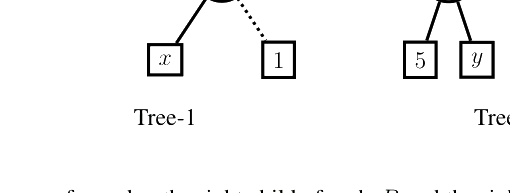
Consider game trees Tree-1 and Tree-2 as shown. The first level is a MAX agent and the second level is a MIN agent. The value in the square node is the output of the utility function. For what ranges of \( x \) and \( y \), the right child of node \( B \) and the right child of node \( E \) will be pruned by alpha-beta pruning algorithm?

Question diagram

Open complete paper
5
2025 · Data Science & Artificial Intelligence · AI · Informed, Uninformed and Adversarial Search
Data Science & Artificial Intelligence (DA) 2025
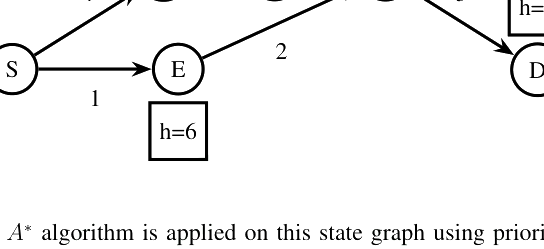
The state graph shows the action cost along the edges and the heuristic function \( h \) associated with each state. Suppose \( A^* \) algorithm is applied on this state graph using priority queue to store the frontier. In what sequence are the nodes expanded?

Question diagram

Open complete paper
6
2026 · Data Science & Artificial Intelligence · AI · Informed, Uninformed and Adversarial Search
Data Science and Artificial Intelligence (DA) 2026
Which of the following algorithms is NOT an example of uninformed search?
Open complete paper
7
2026 · Data Science & Artificial Intelligence · AI · Informed, Uninformed and Adversarial Search
Data Science and Artificial Intelligence (DA) 2026
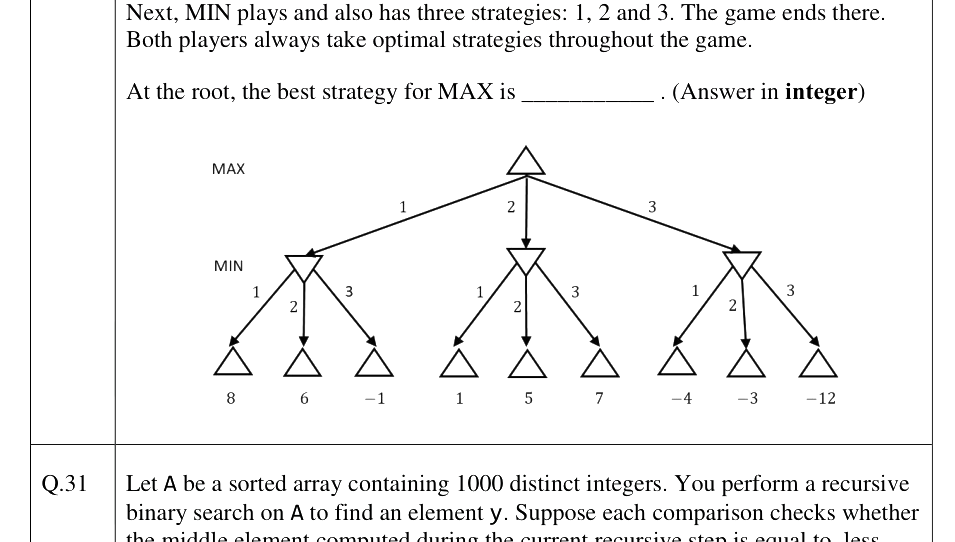
Consider the game tree for a two-player turn-taking minimax game as shown in the figure. The value of a terminal node represents the utility of the game state if the game ends there. The numbers written next to the edges denote the strategies. There are two players MAX and MIN. At any particular state of the game, MAX prefers to move to a state of maximum value. On the other hand, MIN prefers to move to a state of minimum value. Suppose MAX starts the game at the root and has three strategies: 1, 2 and 3. Next, MIN plays and also has three strategies: 1, 2 and 3. The game ends there. Both players always take optimal strategies throughout the game. At the root, the best strategy for MAX is ________. (Answer in integer)

Question diagram

Open complete paper