My Cart
Your Cart 0

    Your cart is empty.

  • Total (Amount) ₹0.00
Previous year question hub

Kinetics and Reaction Dynamics - Physical Chemistry - Chemistry Previous Year Questions

Practice Kinetics and Reaction Dynamics - Physical Chemistry - Chemistry previous year questions organised from real papers, with year-wise coverage and clear topic navigation.

20Papers
20Years
64Questions
1Topics

Kinetics and Reaction Dynamics question pattern

Every graph below is calculated only from this selection.

Questions by year

Year-wise coverage for Kinetics and Reaction Dynamics. Each bar uses a separate theme-derived color.

Difficulty distribution

How the classified questions are distributed by difficulty.

Medium 32 50%
Easy 31 48.4%
Hard 1 1.6%

Question type distribution

MCQ, numerical, multiple-select and other formats found in these papers.

MCQ 40 62.5%
Numerical Answer Type (NAT) 14 21.9%
Fill in the blanks 8 12.5%
MSQ 2 3.1%

Subject weightage

Top subjects by unique question coverage.

Chemistry
64 Qs

Most asked topics

Top topics across the included previous year papers.

Physical Chemistry
64 Qs

Subtopic coverage

Top subtopics inside this exact selection.

Kinetics and Reaction Dynamics
64 Qs

Paper coverage

Question coverage for the most populated papers. Every active PYP paper remains listed below.

Chemistry (CY) 2026
2 Qs
Chemistry (CY) 2025
2 Qs
Chemistry (CY) 2024
4 Qs
Chemistry (CY) 2023
3 Qs
Chemistry (CY) 2022
1 Qs
Chemistry (CY) 2021
2 Qs
Chemistry (CY) 2020
3 Qs
Chemistry (CY) 2019
1 Qs
Chemistry (CY) 2018
5 Qs
Chemistry (CY) 2017
5 Qs
Chemistry (CY) 2016
2 Qs
Chemistry (CY) 2015
2 Qs
Chemistry (CY) 2014
1 Qs
Chemistry (CY) 2013
4 Qs
Chemistry (CY) 2012
2 Qs
Chemistry (CY) 2011
6 Qs
Chemistry (CY) 2010
2 Qs
Chemistry (CY) 2009
4 Qs
Chemistry (CY) 2008
6 Qs
Chemistry (CY) 2007
7 Qs

Included previous year papers

Newest papers appear first. Sort by year, question coverage or name.

PaperYear / sessionQuestions in this viewOpen
Chemistry (CY) 202620262View paper
Chemistry (CY) 202520252View paper
Chemistry (CY) 202420244View paper
Chemistry (CY) 202320233View paper
Chemistry (CY) 202220221View paper
Chemistry (CY) 202120212View paper
Chemistry (CY) 202020203View paper
Chemistry (CY) 201920191View paper
Chemistry (CY) 201820185View paper
Chemistry (CY) 201720175View paper
Chemistry (CY) 201620162View paper
Chemistry (CY) 201520152View paper
Chemistry (CY) 201420141View paper
Chemistry (CY) 201320134View paper
Chemistry (CY) 201220122View paper
Chemistry (CY) 201120116View paper
Chemistry (CY) 201020102View paper
Chemistry (CY) 200920094View paper
Chemistry (CY) 200820086View paper
Chemistry (CY) 200720077View paper

All Kinetics and Reaction Dynamics previous year questions

Practice every matching question in batches of 20, with every available option.

1
2008 · Chemistry · Physical Chemistry · Kinetics and Reaction Dynamics
Chemistry (CY) 2008
For the reaction 2 X1 → 3 X2, the rate of formation of X2 is
Open complete paper
2
2008 · Chemistry · Physical Chemistry · Kinetics and Reaction Dynamics
Chemistry (CY) 2008
In a homogeneous catalytic reaction, 1.0 M of a substrate and 1.0 μM of a catalyst yields 1.0 mM of a product in 10 seconds. The turnover frequency (TOF) of the reaction (s-1) is
Open complete paper
3
2008 · Chemistry · Physical Chemistry · Kinetics and Reaction Dynamics
Chemistry (CY) 2008
Approximately one hydrogen atom per cubic meter is present in interstellar space. Assuming that the H-atom has a diameter of 10-10 m, the mean free path (m) approximately is
Open complete paper
4
2008 · Chemistry · Physical Chemistry · Kinetics and Reaction Dynamics
Chemistry (CY) 2008
For the reaction given below, the relaxation time is 10-6 s. Given that 10% of A remains at equilibrium, the value of k1 (s-1) is A ⇌ B (k1 forward, k-1 backward)
Open complete paper
5
2008 · Chemistry · Physical Chemistry · Kinetics and Reaction Dynamics
Chemistry (CY) 2008
Physisorbed particles undergo desorption at 27 °C with an activation energy of 16.628 kJ mol-1. Assuming first-order process and a frequency factor of 1012 Hz, the average residence time (in seconds) of the particles on the surface is
Open complete paper
6
2008 · Chemistry · Physical Chemistry · Kinetics and Reaction Dynamics
Chemistry (CY) 2008
The mechanism of enzyme (E) catalysed reaction of a substrate (S) to yield product (P) is E + S ⇌ [ES] ⇌ E + P ; -d[S]/dt = (k1k2[S] - k-1k-2[P]) / (k1[S] + k-2[P] + k-1 + k2) [E]0 If a small amount of S is converted to P, the maximum rate for the reaction will be observed for
Open complete paper
7
2009 · Chemistry · Physical Chemistry · Kinetics and Reaction Dynamics
Chemistry (CY) 2009
For the parallel first order reaction scheme shown below
[Reaction Scheme: X → Y (k1) and X → Z (k2)]
the value of k1 is 1 × 10⁻⁴ s-1. If the reaction starts from X, the ratio of the concentrations of Y and Z at any given time during the course of the reaction is found to be |Y|/|Z| = 1/4.
The value of k2 is
Open complete paper
8
2009 · Chemistry · Physical Chemistry · Kinetics and Reaction Dynamics
Chemistry (CY) 2009
The half-life (t1/2) for the hydrolysis of an ester varies with the initial concentration of the reactant ([E]0) as follows: [E]0 / 10-2 mol L-1: 5.0, 4.0, 3.0; t1/2 / s: 240, 300, 400. The order of the reaction is
Open complete paper
9
2009 · Chemistry · Physical Chemistry · Kinetics and Reaction Dynamics
Chemistry (CY) 2009
The overall rate constant (koverall) for the formation of P can be expressed as
Open complete paper
10
2009 · Chemistry · Physical Chemistry · Kinetics and Reaction Dynamics
Chemistry (CY) 2009

The overall activation energy (Ea,overall) for the formation of P can be expressed as

Open complete paper
11
2011 · Chemistry · Physical Chemistry · Kinetics and Reaction Dynamics
Chemistry (CY) 2011

For a given first order reaction, the reactant reduces to 1/4th its initial value in 10 minutes. The rate constant of the reaction is

Open complete paper
12
2011 · Chemistry · Physical Chemistry · Kinetics and Reaction Dynamics
Chemistry (CY) 2011

According to conventional transition state theory, for elementary bimolecular reactions, the molar entropy of activation ΔS0‡ is

Open complete paper
13
2011 · Chemistry · Physical Chemistry · Kinetics and Reaction Dynamics
Chemistry (CY) 2011
For 1 mole of a monoatomic ideal gas, the relation between pressure (p), volume (V) and average molecular kinetic energy (E) is
Open complete paper
14
2011 · Chemistry · Physical Chemistry · Kinetics and Reaction Dynamics
Chemistry (CY) 2011
Under the steady state approximation for the intermediates, the rate of decomposition of ozone, $-\dfrac{d[O_3]}{dt}$, is
Open complete paper
15
2011 · Chemistry · Physical Chemistry · Kinetics and Reaction Dynamics
Chemistry (CY) 2011
Assuming $k_2[O_3] >> k_2[O_2][M]$, the activation energy of the overall reaction is
Open complete paper
16
2011 · Chemistry · Physical Chemistry · Kinetics and Reaction Dynamics
Chemistry (CY) 2011
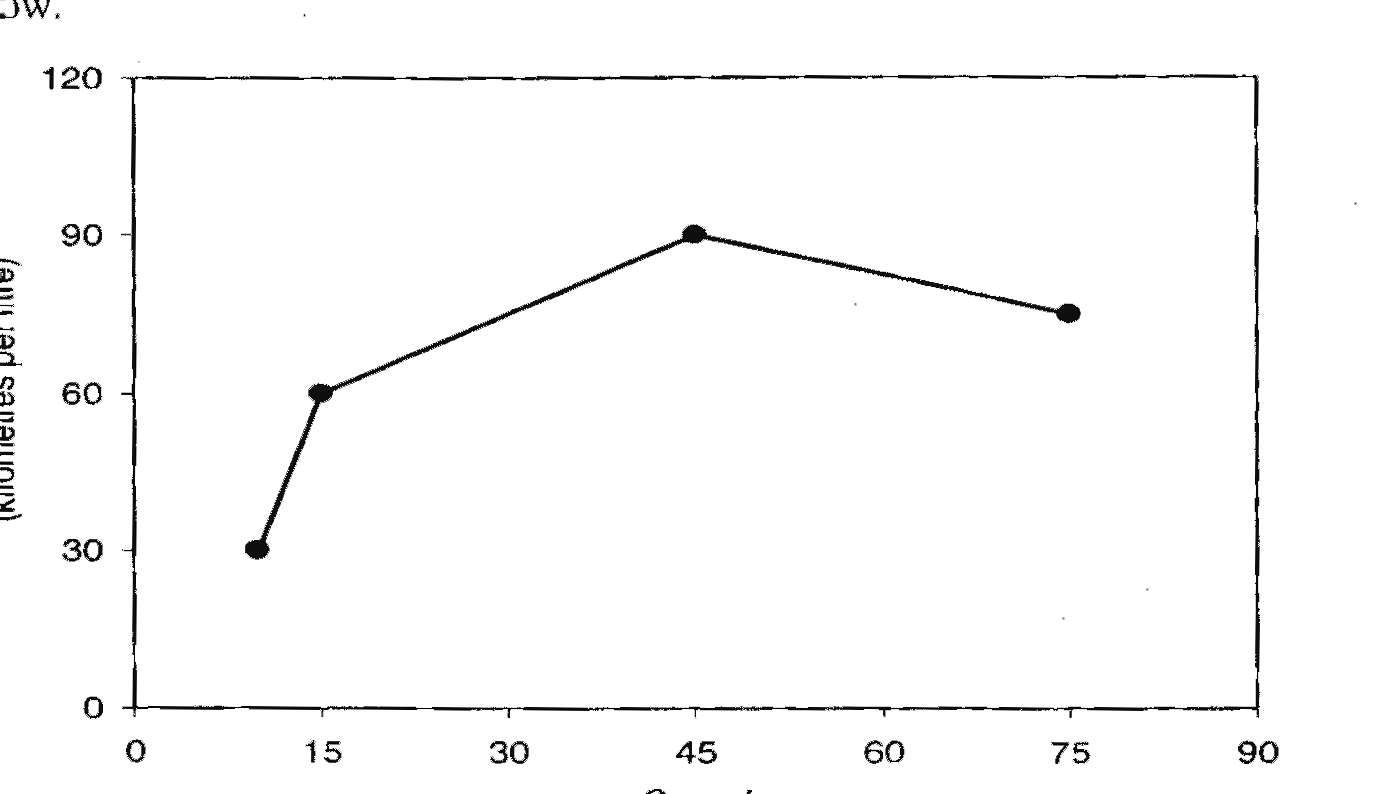
The fuel consumed by a motorcycle during a journey while traveling at various speeds is indicated in the graph below. The distances covered during four laps of the journey are listed in the table below. From the given data, we can conclude that the fuel consumed per kilometre was least during the lap
Open complete paper
17
2012 · Chemistry · Physical Chemistry · Kinetics and Reaction Dynamics
Chemistry (CY) 2012
For a reaction involving two steps given below
First step: \( \begin{array}{ccc} \ce{G} & \rightleftharpoons & \ce{2H} \end{array} \)
Second step: \( \begin{array}{ccc} \ce{G + H} & \longrightarrow & \ce{P} \end{array} \)
assume that the first step attains equilibrium rapidly. The rate of formation of P is proportional to
Open complete paper
18
2012 · Chemistry · Physical Chemistry · Kinetics and Reaction Dynamics
Chemistry (CY) 2012
Consider the reaction
H2 + C2H4 → C2H6
The molecular diameters of H2 and C2H4 are 1.8 Å and 3.6 Å respectively. The pre-exponential factor in the rate constant calculated using collision theory in \(m^3 (mole)^{-1} s^{-1}\) is approximately
(For this reaction at 300 K, \(\left(\frac{8k_B T}{\pi \mu}\right)^{1/2} N_A = 1.11 \times 10^7 \ m \ (mole)^{-1} s^{-1}\), where the symbols have their usual meanings)
Open complete paper
19
2013 · Chemistry · Physical Chemistry · Kinetics and Reaction Dynamics
Chemistry (CY) 2013
For the first order consecutive reaction $P \rightarrow Q \rightarrow R$, under steady state approximation to [Q], the variations of [P], [Q] and [R] with time are best represented by
Open complete paper
20
2013 · Chemistry · Physical Chemistry · Kinetics and Reaction Dynamics
Chemistry (CY) 2013
For a reaction of the type X k1\[\rightleftharpoons\]k-1 Y , the correct rate expression is ([X]0 and [X] correspond to the concentrations of X at time t=0 and t, respectively)
Open complete paper

Showing 20 of 64 questions