My Cart
Your Cart 0

    Your cart is empty.

  • Total (Amount) ₹0.00
Previous year question hub

Organic Synthesis - Organic Chemistry - Chemistry Previous Year Questions

Practice Organic Synthesis - Organic Chemistry - Chemistry previous year questions organised from real papers, with year-wise coverage and clear topic navigation.

16Papers
16Years
54Questions
1Topics

Organic Synthesis question pattern

Every graph below is calculated only from this selection.

Questions by year

Year-wise coverage for Organic Synthesis. Each bar uses a separate theme-derived color.

Difficulty distribution

How the classified questions are distributed by difficulty.

Hard 41 75.9%
Easy 8 14.8%
Medium 5 9.3%
Question type distribution

MCQ, numerical, multiple-select and other formats found in these papers.

MCQ 48 88.9%
MSQ 5 9.3%
Numerical Answer Type (NAT) 1 1.9%

Subject weightage

Top subjects by unique question coverage.

Chemistry
54 Qs

Most asked topics

Top topics across the included previous year papers.

Organic Chemistry
54 Qs

Subtopic coverage

Top subtopics inside this exact selection.

Organic Synthesis
54 Qs

Paper coverage

Question coverage for the most populated papers. Every active PYP paper remains listed below.

Chemistry (CY) 2026
4 Qs
Chemistry (CY) 2025
3 Qs
Chemistry (CY) 2024
3 Qs
Chemistry (CY) 2023
5 Qs
Chemistry (CY) 2021
4 Qs
Chemistry (CY) 2020
5 Qs
Chemistry (CY) 2019
3 Qs
Chemistry (CY) 2018
3 Qs
Chemistry (CY) 2017
4 Qs
Chemistry (CY) 2016
4 Qs
Chemistry (CY) 2014
2 Qs
Chemistry (CY) 2013
2 Qs
Chemistry (CY) 2012
3 Qs
Chemistry (CY) 2011
4 Qs
Chemistry (CY) 2009
3 Qs
Chemistry (CY) 2008
2 Qs

Included previous year papers

Newest papers appear first. Sort by year, question coverage or name.

PaperYear / sessionQuestions in this viewOpen
Chemistry (CY) 202620264View paper
Chemistry (CY) 202520253View paper
Chemistry (CY) 202420243View paper
Chemistry (CY) 202320235View paper
Chemistry (CY) 202120214View paper
Chemistry (CY) 202020205View paper
Chemistry (CY) 201920193View paper
Chemistry (CY) 201820183View paper
Chemistry (CY) 201720174View paper
Chemistry (CY) 201620164View paper
Chemistry (CY) 201420142View paper
Chemistry (CY) 201320132View paper
Chemistry (CY) 201220123View paper
Chemistry (CY) 201120114View paper
Chemistry (CY) 200920093View paper
Chemistry (CY) 200820082View paper

All Organic Synthesis previous year questions

Practice every matching question in batches of 20, with every available option.

1
2008 · Chemistry · Organic Chemistry · Organic Synthesis
Chemistry (CY) 2008

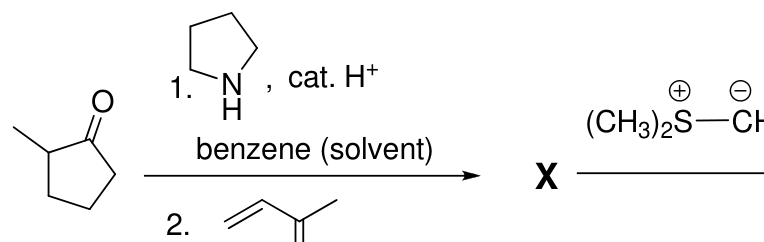
The reagent X in the following reaction is

Open complete paper
2
2008 · Chemistry · Organic Chemistry · Organic Synthesis
Chemistry (CY) 2008

The most appropriate sequence of reactions for carrying out the following transformation is

Open complete paper
3
2009 · Chemistry · Organic Chemistry · Organic Synthesis
Chemistry (CY) 2009
In the reaction [image] (* = \(^{13}\)C labelled carbon) the major products X and Y are
Open complete paper
4
2009 · Chemistry · Organic Chemistry · Organic Synthesis
Chemistry (CY) 2009
In the reaction [image] the major product X is
Open complete paper
5
2009 · Chemistry · Organic Chemistry · Organic Synthesis
Chemistry (CY) 2009
In the reaction
[Reaction Scheme: Ph3P → (MeI) [X] → (n-BuLi) [Y]]
the compounds X and Y, respectively, are
Open complete paper
6
2011 · Chemistry · Organic Chemistry · Organic Synthesis
Chemistry (CY) 2011
In the following reaction
\[\text{2-cyclohexen-1-one} + \text{PhCHO} \xrightarrow{\text{NaCN (cat.), DMF}} [\text{X}]\]
the major product [X] is
Open complete paper
7
2011 · Chemistry · Organic Chemistry · Organic Synthesis
Chemistry (CY) 2011
The most appropriate sequence of reactions for carrying out the following conversion
\[\text{Substrate} \rightarrow \text{Product}\]
is
Open complete paper
8
2011 · Chemistry · Organic Chemistry · Organic Synthesis
Chemistry (CY) 2011
In the following reaction sequence
\[\text{Cyclopentanone} + \text{Pyrrolidine} \xrightarrow{\text{i) PTSA, C}_6\text{H}_6, \text{heat, ii) CHCl}_3, \text{NaOH, iii) H}_3\text{O}^+} [\text{X}]\]
the major product [X] is
Open complete paper
9
2011 · Chemistry · Organic Chemistry · Organic Synthesis
Chemistry (CY) 2011
In the following conversion
\[\text{Substrate} \xrightarrow{\text{i) Cu, Li, ii) I}_2, \text{HMPTA}} [\text{X}]\]
the major product [X] is
Open complete paper
10
2012 · Chemistry · Organic Chemistry · Organic Synthesis
Chemistry (CY) 2012

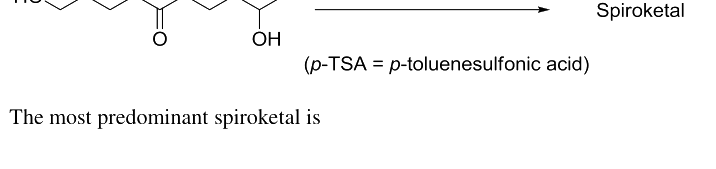
The acid catalyzed cyclization of 5-ketodecan-1,9-diol is given below

\[ \text{HO-(CH2)_4-CO-(CH2)_3-CH(OH)-CH3} \xrightarrow{p\text{-TSA, benzene, heat}} \text{Spiroketal} \]

(p-TSA = p-toluenesulfonic acid)

The most predominant spiroketal is

Question diagram

Open complete paper
11
2012 · Chemistry · Organic Chemistry · Organic Synthesis
Chemistry (CY) 2012

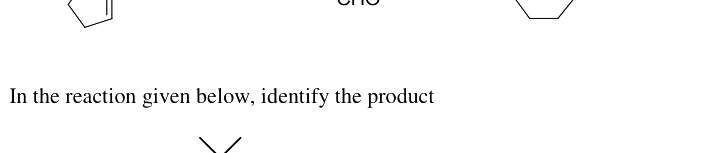
In the reaction given below, identify the product

\[ \text{Reactant} \xrightarrow[\text{2. H}_3\text{O}^+\text{, 3. excess CH}_3\text{C(OMe)}_3\text{, }p\text{-TSA, heat}]{\text{1. CH}_2\text{=CHMgBr, THF}} \text{Product} \]

(p-TSA = p-toluenesulfonic acid; THF = tetrahydrofuran)

Question diagram

Open complete paper
12
2012 · Chemistry · Organic Chemistry · Organic Synthesis
Chemistry (CY) 2012
The product is
Open complete paper
13
2013 · Chemistry · Organic Chemistry · Organic Synthesis
Chemistry (CY) 2013

Among the compounds given in the options A-D, the one that can be used as a formyl anion equivalent (in the presence of a strong base) is

Open complete paper
14
2013 · Chemistry · Organic Chemistry · Organic Synthesis
Chemistry (CY) 2013
The major product X formed in the reaction given below is
Open complete paper
15
2014 · Chemistry · Organic Chemistry · Organic Synthesis
Chemistry (CY) 2014
The most suitable reagent combination to effect the following conversion is

Question diagram

Open complete paper
16
2014 · Chemistry · Organic Chemistry · Organic Synthesis
Chemistry (CY) 2014
The major products X and Y formed in the following reaction sequence are

Question diagram

Open complete paper
17
2016 · Chemistry · Organic Chemistry · Organic Synthesis
Chemistry (CY) 2016

The major products X and Y formed in the following synthetic scheme, are

Open complete paper
18
2016 · Chemistry · Organic Chemistry · Organic Synthesis
Chemistry (CY) 2016

The major products S and T formed in the following synthetic scheme, are

Source question diagram

Open complete paper
19
2016 · Chemistry · Organic Chemistry · Organic Synthesis
Chemistry (CY) 2016

The major products M and N in the following reaction sequence are

Open complete paper
20
2016 · Chemistry · Organic Chemistry · Organic Synthesis
Chemistry (CY) 2016

The major products P and Q in the following reaction sequence, are

Open complete paper

Showing 20 of 52 questions