Difficulty distribution
How the classified questions are distributed by difficulty.
12questions
Not classified
12
100%
Your cart is empty.
Practice Waves - Mechanics - Physics previous year questions organised from real papers, with year-wise coverage and clear topic navigation.
Every graph below is calculated only from this selection.
Year-wise coverage for Waves. Each bar uses a separate theme-derived color.
How the classified questions are distributed by difficulty.
MCQ, numerical, multiple-select and other formats found in these papers.
Top subjects by unique question coverage.
Top topics across the included previous year papers.
Top subtopics inside this exact selection.
Question coverage for the most populated papers. Every active PYP paper remains listed below.
Newest papers appear first. Sort by year, question coverage or name.
| Paper | Year / session | Questions in this view | Open |
|---|---|---|---|
| BITSAT 2025 | 2025 | 2 | View paper |
| BITSAT 2023 | 2023 | 3 | View paper |
| BITSAT 2022 | 2022 | 4 | View paper |
| BITSAT 2021 | 2021 | 2 | View paper |
| BITSAT 2020 | 2020 | 1 | View paper |
Practice every matching question in batches of 20, with every available option.
The vibrations of a string of length 60 cm fixed at both ends are represented by the equation
$$y = 4\sin \left( {{{\pi x} \over {15}}} \right)\cos (96\pi t)$$
where x and y are in cm and t is in second. Calculate the velocity of the particle at x = 7.5 cm at t = 0.25 s.
The equation of progressive wave is given by \(Y = \sin \left[ {x\left( {{t \over 5} - {x \over 9}} \right) + {\pi \over 6}} \right]\) cm. Which one of the following is correct?
Two cars approach a stationary observer from opposite sides as shown in the figure.
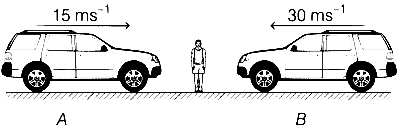
The observer hears no beats. If the frequency of the horn of the car B is 504 Hz, then the frequency of the horn of the car A will be
A submarine A travelling at 17 m/s is being chased along the line of its velocity by another submarine B travelling at 34 m/s. B sends a sonar signal of 600 Hz to detect A and receives a reflected sound of frequency \(\nu\). The of \(\nu\) is
[Speed of sound in water = 1500 ms\(-\)1]
In a resonance coloum first and second resonance are obtained at depths 24 cm and 78 cm the third resonance will be obtained at depth.
Transverse waves of the same frequency are generated in two steel wires A and B. The diameter of A is twice that of B and the tension in A is half that in B. The ratio of the velocities of the waves in A and B is
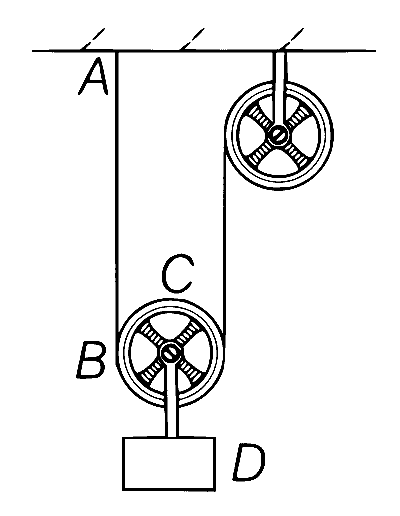
In the diagram shown below, both the strings AB and CD are made of same material and have same cross-section. The pulleys are light and fictionless. If the speed of wave in string AB is v1 and in CD is v2, then \({{{v_1}} \over {{v_2}}}\) is
When a string is divided into four segments of \(l_1, l_2, l_3\) and \(l_4\). The fundamental frequencies of these three segments are \(v_1, v_2, v_3\) and \(v_4\), respectively. The original fundamental frequency \((v)\) of the string is
The fundamental frequency of an open organ pipe is \(600 \mathrm{~Hz}\). The first overtone of this pipe has same frequency as first overtone of a closed organ pipe. If speed of sound is \(330 \mathrm{~m} / \mathrm{s}\), then the length of a closed organ pipe is
The wavelength of two waves are 40 and \(42 \mathrm{~cm}\) respectively. If the temperature of the room is \(20^{\circ} \mathrm{C}\) then what will be the number of beats produced per second by these waves. When the speed of sound at \(0^{\circ} \mathrm{C}\) is \(332 \mathrm{~m} / \mathrm{s}\) ?
A standing wave $y=A \sin \left(\frac{20}{3} \pi x\right) \cos (1000 \pi t)$ is maintained in a taught string, where $y$ and $x$ are in metres. The distance between two successive points oscillating with the amplitude $\frac{A}{2}$ across a node is
The fundamental frequency of a closed organ pipe is same as the first overtone frequency of an open organ pipe. If the length of open organ pipe is 50 cm , then the length of closed organ pipe is