Difficulty distribution
How the classified questions are distributed by difficulty.
8questions
Not classified
8
100%
Your cart is empty.
Practice Motion - Mechanics - Physics previous year questions organised from real papers, with year-wise coverage and clear topic navigation.
Every graph below is calculated only from this selection.
Year-wise coverage for Motion. Each bar uses a separate theme-derived color.
How the classified questions are distributed by difficulty.
MCQ, numerical, multiple-select and other formats found in these papers.
Top subjects by unique question coverage.
Top topics across the included previous year papers.
Top subtopics inside this exact selection.
Question coverage for the most populated papers. Every active PYP paper remains listed below.
Newest papers appear first. Sort by year, question coverage or name.
| Paper | Year / session | Questions in this view | Open |
|---|---|---|---|
| BITSAT 2025 | 2025 | 1 | View paper |
| BITSAT 2024 | 2024 | 1 | View paper |
| BITSAT 2023 | 2023 | 1 | View paper |
| BITSAT 2022 | 2022 | 1 | View paper |
| BITSAT 2021 | 2021 | 2 | View paper |
| BITSAT 2020 | 2020 | 2 | View paper |
Practice every matching question in batches of 20, with every available option.
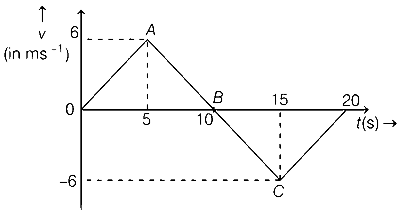
Based on the provided velocity-time graph for an object’s straight-line movement, determine the total distance covered and the average speed between t = 0 and t = 20 seconds.
The acceleration of a particle in m/s2 is given by a = (3t2 \(-\) 2t + 1), where t is in second. If the particle starts with a velocity v = 1 m/s at t = 1s, then velocity of the particle at the end of 4s is
A man walks in a straight line for 5 min with a velocity of 45 m/s. What is the speed with which he has to move in order to comeback to its original position in 1.5 min?
A projectile is given an initial velocity of \((\widehat i + \widehat j)\) m/s, where, \(\widehat i\) is along the ground and \(\widehat j\) is along the vertical. If g = 10 m/s2, then the equation of its trajectory is
A projectile is projected with the velocity of \((3\widehat i + 4\widehat j)\) m/s. The horizontal range of the projectile will be
A boat crosses a river from part \(A\) to part \(B\), which are just on the opposite side. The speed of the water. \(v_\omega\) and the of boat is \(v_B\) relative to still water. Assume \(v_B=\sqrt{2} v_\omega\). What is the time taken by the boat, if it has to cross the river directly on the \(A B\) line (\(D=\) width of the river) ?
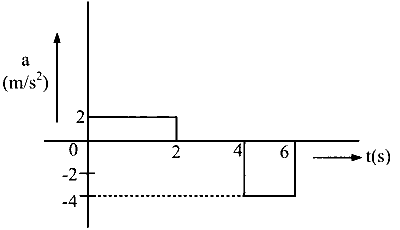
The acceleration versus time graph of a particle moving along a straight line is shown in the figure. Draw the respective velocity time graph. (Assuming at $t=0, v=0$ )