Difficulty distribution
How the classified questions are distributed by difficulty.
19questions
Not classified
19
100%
Your cart is empty.
Practice Heat And Thermodynamics - Mechanics - Physics previous year questions organised from real papers, with year-wise coverage and clear topic navigation.
Every graph below is calculated only from this selection.
Year-wise coverage for Heat And Thermodynamics. Each bar uses a separate theme-derived color.
How the classified questions are distributed by difficulty.
MCQ, numerical, multiple-select and other formats found in these papers.
Top subjects by unique question coverage.
Top topics across the included previous year papers.
Top subtopics inside this exact selection.
Question coverage for the most populated papers. Every active PYP paper remains listed below.
Newest papers appear first. Sort by year, question coverage or name.
| Paper | Year / session | Questions in this view | Open |
|---|---|---|---|
| BITSAT 2025 | 2025 | 4 | View paper |
| BITSAT 2024 | 2024 | 2 | View paper |
| BITSAT 2023 | 2023 | 2 | View paper |
| BITSAT 2022 | 2022 | 2 | View paper |
| BITSAT 2021 | 2021 | 3 | View paper |
| BITSAT 2020 | 2020 | 6 | View paper |
Practice every matching question in batches of 20, with every available option.
A vessel contains one mole of O2 gas (molar mass 32) at a temperature T. The pressure of the gas is p. An identical vessel containing one mole of He gas (molar mass 4) at a temperature 2T has a pressure of
A black body radiates energy at the rate E Wm\(-\)2 at high temperature TK. When the temperature is reduced to \(\left( {{T \over 4}} \right)\) K, the new radiant energy is
A Carnot engine has the same efficiency between 600 K to 300 K and 1600 K to x K, then the value of x is
In an adiabatic process, where pressure is decreased by \({3 \over 4}\)%, if \({{{C_p}} \over {{C_v}}} = {4 \over 3}\), then the volume increases by
When 2 moles of a monoatomic gas are mixed with 3 moles of a diatomic gas, the value of adiabatic exponent for the mixture is
The figure shows graphs of pressure (p) versus density (d) for an ideal gas at two temperatures T1 and T2, then

An ideal monoatomic gas is taken round the cycle ABCDA as shown in the p-diagram

The work done during the cycle is
Which of the following graphs show the correct relation between conductivity and temperature for a metallic conductor?


The ratio of the specific heats \({{{C_v}} \over {{C_p}}} = {1 \over \gamma }\) in terms of degrees of freedom (n) is given by
One mole of an ideal diatomic gas undergoes a process as shown in the figure. The molar specific heat of the gas in the process is
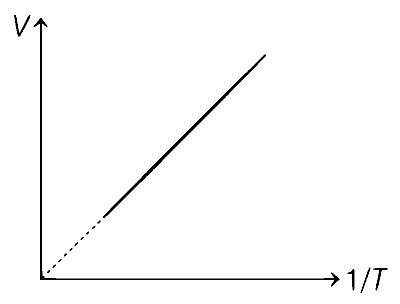
A monoatomic gas of molar mass m is kept in a insulated container. Container is moving with velocity v. If the container is suddenly stopped, then the change in the temperature of the gas is
A Carnot's heat engine works between the temperature \(527^{\circ} \mathrm{C}\) and \(127^{\circ} \mathrm{C}\). What amount of heat should it consume per second to deliver mechanical work at the rate of \(1.0 \mathrm{~kW}\) ?
A vessel containing 1 mole of \(\mathrm{O}_2\) gas (molar mass 32) at temperature \(T\). The pressure of the gas is \(p\). An identical vessel containing one mole of He gas (molar mass 4) at temperature \(4 T\) has a pressure of

Two rods $P$ and $Q$ have equal lengths. Their thermal conductivities are $K_1$ and $K_2$ and cross-sectional areas are $A_1$ and $A_2$. When the temperature at ends of each rod are $T_1$ and $T_2$ respectively, the rate of flow of heat through $P$ and $Q$ will be equal, if
A vessel is filled with a gas at a pressure of 76 cm of mercury at a certain temperature. The mass of gas is increased by $50 \%$ introducing more gas in the vessel at the same temperature. Now the resultant pressure of the gas is
A cylinder of radius $R$ made of a material of thermal conductivity $k_1$ is surrounded by a cylindrical shell of inner radius $R$ and outer radius $2 R$ made of a material of thermal conductivity $k_2$. The two ends of a combined system are maintained at two different temperature. There is no loss of heat across the cylindrical surface and the system is in steady state. The effective thermal conductivity of the system is
In a certain process, 400 cal of heat is supplied to a system and at the same time 105 J of mechanical work was done on the system. The increase in its internal energy is