Difficulty distribution
How the classified questions are distributed by difficulty.
8questions
Not classified
8
100%
Your cart is empty.
Practice Alternating Current - Electromagnetism - Physics previous year questions organised from real papers, with year-wise coverage and clear topic navigation.
Every graph below is calculated only from this selection.
Year-wise coverage for Alternating Current. Each bar uses a separate theme-derived color.
How the classified questions are distributed by difficulty.
MCQ, numerical, multiple-select and other formats found in these papers.
Top subjects by unique question coverage.
Top topics across the included previous year papers.
Top subtopics inside this exact selection.
Question coverage for the most populated papers. Every active PYP paper remains listed below.
Newest papers appear first. Sort by year, question coverage or name.
| Paper | Year / session | Questions in this view | Open |
|---|---|---|---|
| BITSAT 2025 | 2025 | 1 | View paper |
| BITSAT 2023 | 2023 | 2 | View paper |
| BITSAT 2022 | 2022 | 2 | View paper |
| BITSAT 2021 | 2021 | 1 | View paper |
| BITSAT 2020 | 2020 | 2 | View paper |
Practice every matching question in batches of 20, with every available option.
Three solenoid coils of same dimensions, same number of turns and same number of layers of windings are taken. Coil 1 has inductance L1 wounded by Mn wire of resistance 6 \(\Omega\)m\(-\)1, coil 2 with inductance L2 wounded by similar wire but in reverse direction in each layer. Coil 3 with inductance L3 wounded by a superconducting wire. The relation between their self inductances will be
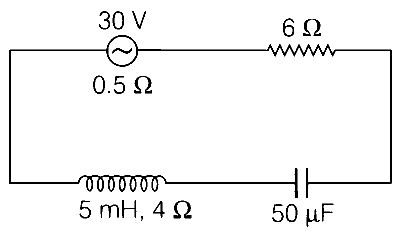
In the circuit shown in figure, the AC source has angular frequency \(\omega\) = 2000 rad s\(-\)1. The amplitude of the current will be nearest to
The phasor diagram of a load represents which circuit?

A direct current of 6 A is superimposed on an alternating current I = 10 sin \(\omega\)t flowing through a wire. The effective value of the resulting current will be
In the circuit shown in the figure, the AC source gives a voltage V = 20 cos (2000t) neglecting source resistance, the voltmeter and ammeter reading will be

A resistance \(R\) and inductance \(L\) and a capacitor \(C\) all are connected in series with an \(\mathrm{AC}\) supply. The resistance of \(R\) is \(24 \mathrm{~ohm}\) and for a given frequency, the inductive reactance of \(L\) is 36 ohm and capacitive reactance of \(C\) is \(24 \mathrm{~ohm}\). If the current in the circuit is \(5 \mathrm{~amp}\). Find the potential difference across \(R, L\) and \(C\).
A direct current of \(10 \mathrm{~A}\) is superimposed on an alternating current \(i=10 \sin \omega t\) flowing through the wire. The effective value of the resulting current will be.
A pure resistive circuit element $X$, when connected to an AC supply of peak voltage 200 V , gives a peak current of 5 A . A second circuit element $Y$, when connected to the same AC supply also gives the same value of peak current but the current lags behind by $90^{\circ}$. If the series combination of $X$ and $Y$ is connected to the same supply, what will be the rms value of current?