Difficulty distribution
How the classified questions are distributed by difficulty.
14questions
Not classified
14
100%
Your cart is empty.
Practice Thermodynamics - Physical Chemistry - Chemistry previous year questions organised from real papers, with year-wise coverage and clear topic navigation.
Every graph below is calculated only from this selection.
Year-wise coverage for Thermodynamics. Each bar uses a separate theme-derived color.
How the classified questions are distributed by difficulty.
MCQ, numerical, multiple-select and other formats found in these papers.
Top subjects by unique question coverage.
Top topics across the included previous year papers.
Top subtopics inside this exact selection.
Question coverage for the most populated papers. Every active PYP paper remains listed below.
Newest papers appear first. Sort by year, question coverage or name.
| Paper | Year / session | Questions in this view | Open |
|---|---|---|---|
| BITSAT 2025 | 2025 | 2 | View paper |
| BITSAT 2024 | 2024 | 1 | View paper |
| BITSAT 2023 | 2023 | 3 | View paper |
| BITSAT 2022 | 2022 | 2 | View paper |
| BITSAT 2021 | 2021 | 3 | View paper |
| BITSAT 2020 | 2020 | 3 | View paper |
Practice every matching question in batches of 20, with every available option.
The enthalpies of combustion of carbon and carbon monoxide in excess of oxygen at 298 K and constant pressure are \(-\)393.5 kJ/mol and \(-\)280.0 kj/mol respectively. The heat of formation of carbon monoxide at constant volume is
Which of the following statement is correct?
At the top of a mountain the thermometer reads 0\(^\circ\)C and the barometer reads 710 mm Hg. At the bottom of the mountain the temperature is 30\(^\circ\)C and the pressure is 760 mm Hg. The ratio of the density of air at the top to that of the bottom is
For the complete combustion of ethanol, \({C_2}{H_5}OH(I) + 3{O_2}(g) \to 2C{O_2}(g) + 3{H_2}O(I)\), the amount of heat produced as measured in bomb calorimeter is 1364.47 kJ mol\(-\)1 at 25\(^\circ\)C. Assuming ideality the enthalpy of combustion, \(\Delta\)HC, for the reaction will be (R = 8.314 JK\(-\)1 mol\(-\)1)
The incorrect expression among the following is
SI unit of Boltzmann's constant is
In an adiabatic process, no transfer of heat takes place between system and surrounding. Choose the correct option for free expansion of an ideal gas under adiabatic condition from the following.
Standard entropy of X2, Y2 and XY3 are 60, 40 and 50 JK\(-\)1mol\(-\)1, respectively. For the reaction, \(\frac{1}{2}\)X2 + \(\frac{3}{2}\)Y2 \(\to\) XY3, \(\Delta\)H = \(-\)30 kJ, to be at equilibrium, the temperature will be
The value of enthalpy change \((\Delta H)\) for the reaction \(\mathrm{C}_2 \mathrm{H}_5 \mathrm{OH}(l)+3 \mathrm{O}_2(\mathrm{~g}) \longrightarrow 2 \mathrm{CO}_2(\mathrm{~g})+ 3 \mathrm{H}_2 \mathrm{O}(l)\), at \(27^{\circ} \mathrm{C}\) is \(-1366 \cdot 5 \mathrm{~kJ} \mathrm{~mol}^{-1}\). The value of internal energy change for the above reaction at this temperature will be
A mixture of two moles of carbon monoxide and one mole of oxygen, in a closed vessel is ignited to convert the carbon monoxide to carbon dioxide. If \(\Delta H\) is the enthalpy change and \(\Delta E\) is the change in internal energy, then
The temperature of \(K\) at which \(\Delta G=0\), for a given reaction with \(\Delta H=-20.5 \mathrm{~kJ} \mathrm{~mol}^{-1}\) and \(\Delta S=-50.0 \mathrm{~JK}^{-1} \mathrm{~mol}^{-1}\) is
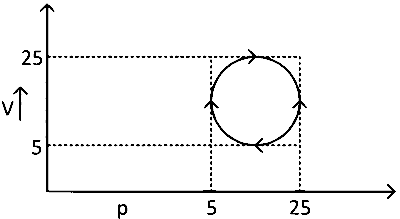
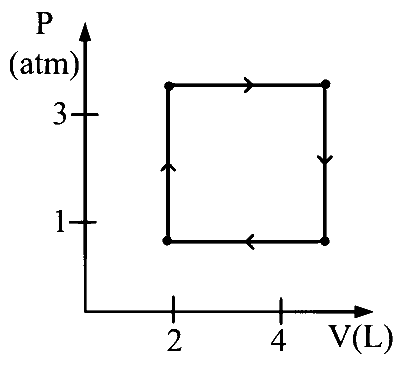
In a cyclic $p V$ process forming $A$ square loop from $(p=1 \mathrm{~atm}, V=2 \mathrm{~L})$ to $(p=3 \mathrm{~atm}$, $V=4 \mathrm{~L})$, Then, the net heat absorbed by the gas is
The bond dissociation energies of $A_2, B_2$ and $A B$ are in the ratio $1: 4: 2$. If $\Delta H$ for formation of $A B$ from $A_2$ and $B_2$ is $-100 \mathrm{~kJ} / \mathrm{mol}$, calculate the bond dissociation energy of $B_2$.