My Cart
Your Cart 0

    Your cart is empty.

  • Total (Amount) ₹0.00
Previous year question hub

Wave Optics - Physics PYQ & Practice Test

Practice Wave Optics previous year questions from AP EAPCET exams. 27 PYQs across 5 years for topic-wise mock test and exam practice.

27Papers
5Years
27Questions
1Topics

Wave Optics question pattern

Every graph below is calculated only from this selection.

Questions by year

Year-wise coverage for Wave Optics. Each bar uses a separate theme-derived color.

Difficulty distribution

How the classified questions are distributed by difficulty.

Not classified 32 100%

Question type distribution

MCQ, numerical, multiple-select and other formats found in these papers.

Multiple Choices 32 100%

Subject weightage

Top subjects by unique question coverage.

Physics
27 Qs

Most asked topics

Top topics across the included previous year papers.

Optics
27 Qs

Subtopic coverage

Top subtopics inside this exact selection.

Wave Optics
27 Qs

Paper coverage

Question coverage for the most populated papers. Every active PYP paper remains listed below.

AP EAPCET 2025 26TH MAY MORNING SHIFT
2 Qs
AP EAPCET 2025 21ST MAY MORNING SHIFT
1 Qs
AP EAPCET 2025 22ND MAY EVENING SHIFT
1 Qs
AP EAPCET 2025 22ND MAY MORNING SHIFT
1 Qs
AP EAPCET 2025 23RD MAY EVENING SHIFT
1 Qs
AP EAPCET 2025 23RD MAY MORNING SHIFT
1 Qs
AP EAPCET 2025 26TH MAY EVENING SHIFT
1 Qs
AP EAPCET 2025 27TH MAY MORNING SHIFT
1 Qs
AP EAPCET 2024 18TH MAY MORNING SHIFT
1 Qs
AP EAPCET 2024 19TH MAY EVENING SHIFT
1 Qs
AP EAPCET 2024 20TH MAY EVENING SHIFT
1 Qs
AP EAPCET 2024 20TH MAY MORNING SHIFT
1 Qs
AP EAPCET 2024 21TH MAY EVENING SHIFT
1 Qs
AP EAPCET 2024 22TH MAY EVENING SHIFT
1 Qs
AP EAPCET 2024 22TH MAY MORNING SHIFT
1 Qs
AP EAPCET 2024 23TH MAY MORNING SHIFT
1 Qs
AP EAPCET 2023 - 15th May Morning Shift
2 Qs
AP EAPCET 2023 - 15th May Morning Shift
2 Qs
AP EAPCET 2023 - 15th May Morning Shift
2 Qs
AP EAPCET 2023 - 15th May Evening Shift
1 Qs
AP EAPCET 2023 - 15th May Evening Shift
1 Qs
AP EAPCET 2022 5TH JULY MORNING SHIFT
2 Qs
AP EAPCET 2022 4TH JULY EVENING SHIFT
1 Qs
AP EAPCET 2021 19TH AUGUST EVENING SHIFT
1 Qs
AP EAPCET 2021 19TH AUGUST MORNING SHIFT
1 Qs
AP EAPCET 2021 20TH AUGUST EVENING SHIFT
1 Qs
AP EAPCET 2021 20TH AUGUST MORNING SHIFT
1 Qs

Included previous year papers

Newest papers appear first. Sort by year, question coverage or name.

PaperYear / sessionQuestions in this viewOpen
AP EAPCET 2025 21ST MAY MORNING SHIFT20251View paper
AP EAPCET 2025 22ND MAY EVENING SHIFT20251View paper
AP EAPCET 2025 22ND MAY MORNING SHIFT20251View paper
AP EAPCET 2025 23RD MAY EVENING SHIFT20251View paper
AP EAPCET 2025 23RD MAY MORNING SHIFT20251View paper
AP EAPCET 2025 26TH MAY EVENING SHIFT20251View paper
AP EAPCET 2025 26TH MAY MORNING SHIFT20252View paper
AP EAPCET 2025 27TH MAY MORNING SHIFT20251View paper
AP EAPCET 2024 18TH MAY MORNING SHIFT20241View paper
AP EAPCET 2024 19TH MAY EVENING SHIFT20241View paper
AP EAPCET 2024 20TH MAY EVENING SHIFT20241View paper
AP EAPCET 2024 20TH MAY MORNING SHIFT20241View paper
AP EAPCET 2024 21TH MAY EVENING SHIFT20241View paper
AP EAPCET 2024 22TH MAY EVENING SHIFT20241View paper
AP EAPCET 2024 22TH MAY MORNING SHIFT20241View paper
AP EAPCET 2024 23TH MAY MORNING SHIFT20241View paper
AP EAPCET 2023 - 15th May Evening Shift20231View paper
AP EAPCET 2023 - 15th May Morning Shift20232View paper
AP EAPCET 2022 4TH JULY EVENING SHIFT20221View paper
AP EAPCET 2022 5TH JULY MORNING SHIFT20222View paper
AP EAPCET 2021 19TH AUGUST EVENING SHIFT20211View paper
AP EAPCET 2021 19TH AUGUST MORNING SHIFT20211View paper
AP EAPCET 2021 20TH AUGUST EVENING SHIFT20211View paper
AP EAPCET 2021 20TH AUGUST MORNING SHIFT20211View paper

All Wave Optics previous year questions

Practice every matching question in batches of 20, with every available option.

1
2021 · Physics · Optics · Wave Optics
AP EAPCET 2021 19TH AUGUST EVENING SHIFT

In Young’s double slit experiment, the separation between the slits is halved and the distance between the screen is doubled. The fringe width is

A
unchanged
B
halved
C
doubled
D
quadrupled
Open complete paper
2
2021 · Physics · Optics · Wave Optics
AP EAPCET 2021 19TH AUGUST MORNING SHIFT

In a diffraction pattern due to a single slit of width \(a\), the first minimum is observed at an angle \(30 \Upsilon\) when light of wavelength \(500 \mathrm{~nm}\) is incident on the slit. The first secondary maximum is observed at an angle of

A
\(\sin ^{-1}\left(\frac{1}{2}\right)\)
B
\(\sin ^{-1}\left(\frac{3}{4}\right)\)
C
\(\sin ^{-1}\left(\frac{1}{4}\right)\)
D
\(\sin ^{-1}\left(\frac{2}{3}\right)\)
Open complete paper
3
2021 · Physics · Optics · Wave Optics
AP EAPCET 2021 20TH AUGUST EVENING SHIFT

The wavefront is a surface in which

A
all points are in the same phase
B
there are pairs of points in opposite phase
C
there are pairs of points with phase difference \(\left(\frac{\pi}{2}\right)\)
D
there is no relation between the phases
Open complete paper
4
2021 · Physics · Optics · Wave Optics
AP EAPCET 2021 20TH AUGUST MORNING SHIFT

The position of the direct image obtained at O, when a monochromatic beam of light is passed through a plane transmission grating at normal incidence is shown in figure. The diffracted images A, B, and C correspond to the first, second and third order diffraction. When the source is replaced by another source of shorter wavelength,
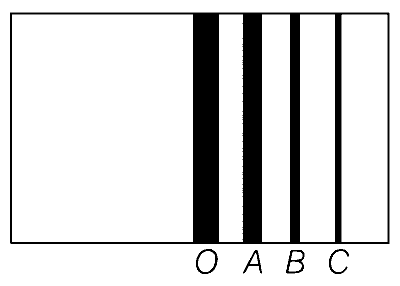
AP EAPCET 2021 - 20th August Morning Shift Physics - Wave Optics Question 25 English 1AP EAPCET 2021 - 20th August Morning Shift Physics - Wave Optics Question 25 English 2

A
all the four will shift in the direction C to O
B
all the four will shift in the direction O to C
C
the images C, B and A will shift towards O
D
the images C, B and A will shift away from O
Open complete paper
5
2022 · Physics · Optics · Wave Optics
AP EAPCET 2022 4TH JULY EVENING SHIFT

When monochromatic light of wavelength 600 nm is used in Young's double slit experiment, the fifth order bright fringe is formed at 6 mm from the central bright fringe on the screen. If the experiment is conducted with light of wavelength 400 nm from the central bright fringe, the third order bright fringe will be located at

A
1.6 mm
B
2 mm
C
2.4 mm
D
3 mm
Open complete paper
6
2022 · Physics · Optics · Wave Optics
AP EAPCET 2022 5TH JULY MORNING SHIFT

Young's double slit experiment is conducted with monochromatic light of wavelength 5000\(\mathop A\limits^o\), with slit separation of 3 mm and observer at 20 cm away from the slits. If a 1 mm transparent plate is placed infront of one of the slits, the fringes shift by 6 mm . The refractive index of the transparent plate is

A
1.08
B
1.09
C
1.1
D
1.2
Open complete paper
7
2022 · Physics · Optics · Wave Optics
AP EAPCET 2022 5TH JULY MORNING SHIFT

In Young's double slit experiment the slits are 3 mm apart and are illuminated by light of two wavelengths \(3750 \mathop A\limits^o\) and \(7500 \mathop A\limits^o\). The screen is placed at 4 m from the slits. The minimum distance from the common central bright fringe on the screen at which the bright fringe of one interference pattern due to one wavelength coincide with the bright fringe of the other is

A
2 mm
B
3 mm
C
1 mm
D
8 mm
Open complete paper
8
2024 · Physics · Optics · Wave Optics
AP EAPCET 2024 18TH MAY MORNING SHIFT
In Young's double slit experiment with monochromatic light of wavelength 6000 A . The fringe width is 3 mm . If the distance between the screen and slits is increased by $50 \%$ and the distance between the slits is decreased by $10 \%$, then the fringe width is
A
12 mm
B
5 mm
C
6 mm
D
10 mm
Open complete paper
9
2024 · Physics · Optics · Wave Optics
AP EAPCET 2024 19TH MAY EVENING SHIFT
In Young's double slit experiment, the intensity at a point where the path difference is $\frac{\lambda}{6}$ ( $\lambda$ being the wavelength of the light used) is $I$. If $I_0$ denotes the maximum intensity, $\frac{I}{I_0}$ is equal to
A
$\frac{1}{\sqrt{2}}$
B
$\frac{\sqrt{3}}{2}$
C
$\frac{1}{2}$
D
$\frac{3}{4}$
Open complete paper
10
2024 · Physics · Optics · Wave Optics
AP EAPCET 2024 20TH MAY EVENING SHIFT
If a microscope is placed in air, the minimum separation of two objects seen as distinct is $6 \mu \mathrm{~m}$. If the same is placed in a medium of refractive index 1.5, then the minimum separation of the two objects to see as distinct is
A
$4 \mu \mathrm{~m}$
B
$6 \mu \mathrm{~m}$
C
$3 \mu \mathrm{~m}$
D
$9 \mu \mathrm{~m}$
Open complete paper
11
2024 · Physics · Optics · Wave Optics
AP EAPCET 2024 20TH MAY MORNING SHIFT
In Young's double slit experiment two slits are placed 2 mm from each other. Interference pattern is observed on a screen placed 2 m from the plane of the slits. Then the fringe width for a light of wavelength 400 nm is
A
$0.4 \times 10^{-6} \mathrm{~m}$
B
$4 \times 10^{-6} \mathrm{~m}$
C
$0.4 \times 10^{-3} \mathrm{~m}$
D
400 m
Open complete paper
12
2024 · Physics · Optics · Wave Optics
AP EAPCET 2024 21TH MAY EVENING SHIFT
In case of diffraction, if $a$ is a slit width and $\lambda$ is the wavelength of the incident light, then the required condition for diffraction to take place is
A
$\frac{a}{\lambda}=1000$
B
$\frac{a}{\lambda} \leq 1$
C
$a \ll \lambda$
D
$a \gg \lambda$
Open complete paper
13
2024 · Physics · Optics · Wave Optics
AP EAPCET 2024 22TH MAY EVENING SHIFT
The angle between the axes of a polariser and an analyser is $45^{\circ}$. If the intensity of the unpolarised light incident on the polariser is $I$, then the intensity of light emerged from the analyser is
A
21
B
$\frac{1}{2}$
C
1
D
$\frac{1}{4}$
Open complete paper
14
2024 · Physics · Optics · Wave Optics
AP EAPCET 2024 22TH MAY MORNING SHIFT

If a slit of width $x$ was illuminated by red light having wavelength $6500\mathop {\rm{A}}\limits^{\rm{^\circ }}$, the first minima was obtained at $\theta=30^{\circ}$. Then, the value of $x$ is

A
$1.4 \times 10^{-4} \mu \mathrm{~m}$
B
$1.2 \times 10^{-5} \mathrm{~m}$
C
$1.3 \mu \mathrm{~m}$
D
$1.2 \mu \mathrm{~m}$
Open complete paper
15
2024 · Physics · Optics · Wave Optics
AP EAPCET 2024 23TH MAY MORNING SHIFT
Two light waves of intensities $I$ and $2 I$ superimpose on each other. If the path difference between the light waves reaching a point is $12.5 \%$ of the wavelength of the light, then the resultant intensity at the point, is (Both the light waves have same wavelength)
A
1
B
91
C
31
D
51
Open complete paper
16
2025 · Physics · Optics · Wave Optics
AP EAPCET 2025 21ST MAY MORNING SHIFT

In Young's double slit experiment, the wavelengths of red and blue lights used are $7.5 \times 10^{-5} \mathrm{~cm}$ and $5 \times 10^{-5} \mathrm{~cm}$ respectively. If $n$th bright fringe of red color coincides with $(n+1)$ th bright fringe of blue colour, then the value of ' $n$ ' is

A

1

B

2

C

4

D

8

Open complete paper
17
2025 · Physics · Optics · Wave Optics
AP EAPCET 2025 22ND MAY EVENING SHIFT

In Young's double slit experiment, the wavelength of monochromatic light is increased by $20 \%$ and the distance between the two slits is decreased by $25 \%$. If the initial fringe width is 0.3 mm , then the final fringe width is

A

0.72 mm

B

0.60 mm

C

0.16 mm

D

0.48 mm

Open complete paper
18
2025 · Physics · Optics · Wave Optics
AP EAPCET 2025 22ND MAY MORNING SHIFT

An unpolarised beam of light incidents on a group of three polarising sheets arranged such that the angle between the axes of any two adjascent sheets is $30^{\circ}$. The ratio of the intensities of polarised light emerging from the second and third sheets is

A

$1: 1$

B

$2: 1$

C

$4: 3$

D

$3: 2$

Open complete paper
19
2025 · Physics · Optics · Wave Optics
AP EAPCET 2025 23RD MAY EVENING SHIFT

In Young's double slit experiment, if the distance between the slits is increased to 3 times initial distance, then the ratio of initial and final fringe widths is

A

$9: 1$

B

$1: 9$

C

$1: 3$

D

$3: 1$

Open complete paper
20
2025 · Physics · Optics · Wave Optics
AP EAPCET 2025 23RD MAY MORNING SHIFT
In Young's double slit experiment, the distance between the slits is 0.2 cm , the distance between the screen and the slits is 1 m . If the wavelength of light used in the experiment is $5000 \mathop {\rm{A}}\limits^{\rm{o}}$, then the distance between two consecutive dark fringes on the screen is
A

0.25 mm

B

0.26 mm

C

0.27 mm

D

0.28 mm

Open complete paper

Showing 20 of 27 questions