Difficulty distribution
How the classified questions are distributed by difficulty.
62questions
Not classified
62
100%
Your cart is empty.
Practice 57 electrostatics PYQs from 31 AP EAPCET papers (5 years). Year-wise MCQ practice tests for electromagnetism in Physics.
Every graph below is calculated only from this selection.
Year-wise coverage for Electrostatics. Each bar uses a separate theme-derived color.
How the classified questions are distributed by difficulty.
MCQ, numerical, multiple-select and other formats found in these papers.
Top subjects by unique question coverage.
Top topics across the included previous year papers.
Top subtopics inside this exact selection.
Question coverage for the most populated papers. Every active PYP paper remains listed below.
Newest papers appear first. Sort by year, question coverage or name.
| Paper | Year / session | Questions in this view | Open |
|---|---|---|---|
| AP EAPCET 2025 21ST MAY EVENING SHIFT | 2025 | 2 | View paper |
| AP EAPCET 2025 21ST MAY MORNING SHIFT | 2025 | 2 | View paper |
| AP EAPCET 2025 22ND MAY EVENING SHIFT | 2025 | 3 | View paper |
| AP EAPCET 2025 22ND MAY MORNING SHIFT | 2025 | 2 | View paper |
| AP EAPCET 2025 23RD MAY EVENING SHIFT | 2025 | 2 | View paper |
| AP EAPCET 2025 23RD MAY MORNING SHIFT | 2025 | 1 | View paper |
| AP EAPCET 2025 24TH MAY MORNING SHIFT | 2025 | 1 | View paper |
| AP EAPCET 2025 26TH MAY EVENING SHIFT | 2025 | 2 | View paper |
| AP EAPCET 2025 26TH MAY MORNING SHIFT | 2025 | 2 | View paper |
| AP EAPCET 2025 27TH MAY MORNING SHIFT | 2025 | 2 | View paper |
| AP EAPCET 2024 18TH MAY MORNING SHIFT | 2024 | 2 | View paper |
| AP EAPCET 2024 19TH MAY EVENING SHIFT | 2024 | 2 | View paper |
| AP EAPCET 2024 20TH MAY EVENING SHIFT | 2024 | 2 | View paper |
| AP EAPCET 2024 20TH MAY MORNING SHIFT | 2024 | 2 | View paper |
| AP EAPCET 2024 21TH MAY EVENING SHIFT | 2024 | 1 | View paper |
| AP EAPCET 2024 21TH MAY MORNING SHIFT | 2024 | 3 | View paper |
| AP EAPCET 2024 22TH MAY EVENING SHIFT | 2024 | 2 | View paper |
| AP EAPCET 2024 22TH MAY MORNING SHIFT | 2024 | 2 | View paper |
| AP EAPCET 2024 23TH MAY MORNING SHIFT | 2024 | 3 | View paper |
| AP EAPCET 2023 - 15th May Evening Shift | 2023 | 1 | View paper |
| AP EAPCET 2023 - 15th May Evening Shift | 2023 | 1 | View paper |
| AP EAPCET 2023 - 15th May Morning Shift | 2023 | 2 | View paper |
| AP EAPCET 2023 - 15th May Morning Shift | 2023 | 2 | View paper |
| AP EAPCET 2023 - 15th May Morning Shift | 2023 | 2 | View paper |
| AP EAPCET 2022 4TH JULY EVENING SHIFT | 2022 | 3 | View paper |
| AP EAPCET 2022 4TH JULY MORNING SHIFT | 2022 | 3 | View paper |
| AP EAPCET 2022 5TH JULY MORNING SHIFT | 2022 | 2 | View paper |
| AP EAPCET 2021 19TH AUGUST EVENING SHIFT | 2021 | 2 | View paper |
| AP EAPCET 2021 19TH AUGUST MORNING SHIFT | 2021 | 1 | View paper |
| AP EAPCET 2021 20TH AUGUST EVENING SHIFT | 2021 | 3 | View paper |
| AP EAPCET 2021 20TH AUGUST MORNING SHIFT | 2021 | 2 | View paper |
Practice every matching question in batches of 20, with every available option.
Gauss's law helps in
Charge on the outer sphere is \(q\) and the inner sphere is grounded. The charge on the inner sphere is \(q^{\prime}\), for \(\left(r_2 > r_1\right)\). Then,
Which statement(s) among the following are incorrect?
(i) A negative test charge experiences a force opposite to the direction of the field.
(ii) The tangent drawn to a line of force represents the direction of electric field.
(iii) The electric field lines never intersect.
(iv) The electric field lines form a closed loop.
When a number of charged liquid drops coalesce, which of the following quantity does not change?
What is the angle between maximum value of potential gradient and equipotential surface?
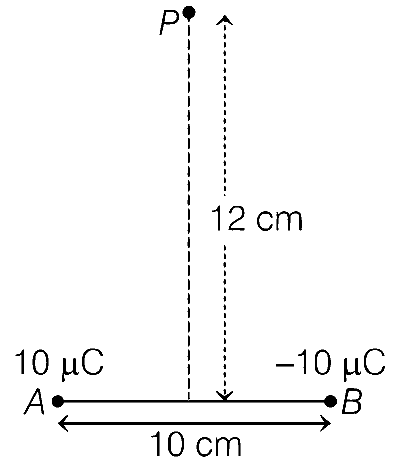
Two charges \(10 ~\mu \mathrm{C}\) and \(-10 ~\mu \mathrm{C}\) are placed at points \(A\) and \(B\) separated by a distance of \(10 \mathrm{~cm}\). Find the electric field at a point \(P\) on the perpendicular bisector of \(A B\), at a distance of \(12 \mathrm{~cm}\) from its mid-point.
Two charges 8 \(\mu\)C each are placed at the corners A and B of an equilateral triangle of side 0.2 m in air. The electric potential at the third corner C is
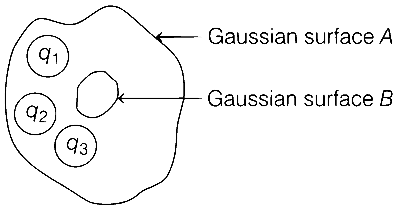
What is the electric flux for Gaussian surface \(A\) that encloses the charged particles in free space? [Given, \(q_1=-14 \mathrm{~nC}, q_2=78.85 \mathrm{~nC}, \left.q_3=-56 \mathrm{~nC}\right]\)
A solid sphere of radius \(R\) carries a positive charge \(Q\) distributed uniformly throughout its volume. A very thin hole is drilled through it's centre. A particle of mass \(m\) and charge \(-\)q performs simple harmonic motion about the centre of the sphere in this hole. The frequency of oscillation is
Assertion (A) In a region of constant potential, the electric field is zero and there can be no charge inside the region.
Reason (R) According to Gauss law, charge inside the region should be zero if electric field is zero.
Statement (A) Inside a charged hollow metal sphere, \(E=0, V \neq 0\), (where, \(E=\) electric field, \(V=\) electric potential).
Statement (B) The work done in moving a positive charge on an equipotential surface is zero.
Statement (C) When two like charges are brought closer, their mutual electrostatic potential energy will increase.
Electrostatic force between two identical charges placed in vacuum at distance of \(r\) is F. A slab of width \(\frac{r}{5}\) and dielectric constant 9 is inserted between these two charges, then the force between the charges is
An electric dipole with dipole moment \(5 \times 10^{-7} \mathrm{C}-\mathrm{m}\) is in the electric field of \(2 \times 10^4 \mathrm{NC}^{-1}\) at an angle of \(60^{\circ}\) with the direction of the electric field. The torque acting on the dipole is
Two positive point charges of \(10 \mu \mathrm{C}\) and \(12 \mu \mathrm{C}\) are placed 10 cm apart in air. The work done to bring them 6 cm closer is
A large number of positive charges each of magnitude \(q\) are placed along the \(X\)-axis at the origin and at every 1 cm distance in both the directions. The electric flux through a spherical surface of radius 2.5 cm centred at the origin is
The electric field in a region of space is given as \(\mathbf{E}=\left(5 \mathrm{NC}^{-1}\right) x \hat{i}\). Consider point \(A\) on the \(Y\)-axis at \(y=5 \mathrm{~m}\) and point \(B\) on the \(X\)-axis at \(x=2 \mathrm{~m}\). If the potentials at points \(A\) and \(B\) are \(V_A\) and \(V_B\) respectively, then \(\left(V_B-V_A\right)\) is
Showing 20 of 57 questions