Difficulty distribution
How the classified questions are distributed by difficulty.
54questions
Not classified
54
100%
Your cart is empty.
Practice 54 Thermodynamics PYQs (AP EAPCET): MCQ practice from 26 papers across 4 years with year-wise previous year questions and topic navigation.
Every graph below is calculated only from this selection.
Year-wise coverage for Thermodynamics. Each bar uses a separate theme-derived color.
How the classified questions are distributed by difficulty.
MCQ, numerical, multiple-select and other formats found in these papers.
Top subjects by unique question coverage.
Top topics across the included previous year papers.
Top subtopics inside this exact selection.
Question coverage for the most populated papers. Every active PYP paper remains listed below.
Newest papers appear first. Sort by year, question coverage or name.
| Paper | Year / session | Questions in this view | Open |
|---|---|---|---|
| AP EAPCET 2025 21ST MAY EVENING SHIFT | 2025 | 2 | View paper |
| AP EAPCET 2025 21ST MAY MORNING SHIFT | 2025 | 1 | View paper |
| AP EAPCET 2025 22ND MAY EVENING SHIFT | 2025 | 2 | View paper |
| AP EAPCET 2025 22ND MAY MORNING SHIFT | 2025 | 2 | View paper |
| AP EAPCET 2025 23RD MAY EVENING SHIFT | 2025 | 2 | View paper |
| AP EAPCET 2025 23RD MAY MORNING SHIFT | 2025 | 2 | View paper |
| AP EAPCET 2025 24TH MAY MORNING SHIFT | 2025 | 2 | View paper |
| AP EAPCET 2025 26TH MAY EVENING SHIFT | 2025 | 2 | View paper |
| AP EAPCET 2025 26TH MAY MORNING SHIFT | 2025 | 2 | View paper |
| AP EAPCET 2025 27TH MAY MORNING SHIFT | 2025 | 2 | View paper |
| AP EAPCET 2024 18TH MAY MORNING SHIFT | 2024 | 2 | View paper |
| AP EAPCET 2024 19TH MAY EVENING SHIFT | 2024 | 2 | View paper |
| AP EAPCET 2024 20TH MAY EVENING SHIFT | 2024 | 3 | View paper |
| AP EAPCET 2024 20TH MAY MORNING SHIFT | 2024 | 2 | View paper |
| AP EAPCET 2024 21TH MAY EVENING SHIFT | 2024 | 2 | View paper |
| AP EAPCET 2024 21TH MAY MORNING SHIFT | 2024 | 4 | View paper |
| AP EAPCET 2024 22TH MAY EVENING SHIFT | 2024 | 3 | View paper |
| AP EAPCET 2024 22TH MAY MORNING SHIFT | 2024 | 2 | View paper |
| AP EAPCET 2024 23TH MAY MORNING SHIFT | 2024 | 1 | View paper |
| AP EAPCET 2022 4TH JULY EVENING SHIFT | 2022 | 4 | View paper |
| AP EAPCET 2022 4TH JULY MORNING SHIFT | 2022 | 2 | View paper |
| AP EAPCET 2022 5TH JULY MORNING SHIFT | 2022 | 2 | View paper |
| AP EAPCET 2021 19TH AUGUST EVENING SHIFT | 2021 | 2 | View paper |
| AP EAPCET 2021 19TH AUGUST MORNING SHIFT | 2021 | 1 | View paper |
| AP EAPCET 2021 20TH AUGUST EVENING SHIFT | 2021 | 2 | View paper |
| AP EAPCET 2021 20TH AUGUST MORNING SHIFT | 2021 | 1 | View paper |
Practice every matching question in batches of 20, with every available option.
Two flasks \(A\) and \(B\) have equal volumes. \(A\) is maintained at \(300 \mathrm{~K}\) and \(B\) at \(600 \mathrm{~K}\). Equal masses of \(\mathrm{H}_2\) and \(\mathrm{CO}_2\) are taken in flasks \(A\) and \(B\) respectively. Find the ratio of total KE of gases in flask \(A\) to that of \(B\).
When the temperature of 2 moles of an ideal gas is increased by 20\(^\circ\)C at constant pressure. Find the work involved in the process.
If a chemical reaction is known to be non-spontaneous at 298 K but spontaneous at 350 K, then which among the following conditions is true for the reaction?
When an ideal gas expands isothermally from \(5 \mathrm{~m}^3\) to \(10 \mathrm{~m}^3\) at \(25^{\circ} \mathrm{C}\) against a constant pressure of \(10^7 \mathrm{~Nm}^{-2}\), then the work done on the gas is
Find the approximate value of \((\Delta H-\Delta U)\) in \(\mathrm{Jmol}^{-1}\), for the formation of CO from its elements at \(298 \mathrm{~K} .\left(R=8.314 \mathrm{JK}^{-1} \mathrm{~mol}^{-1}\right)\)
For the reaction, \(\mathrm{H}_2 \mathrm{O}(l) \longrightarrow \mathrm{H}_2 \mathrm{O}(\mathrm{g})\) at \(T=100^{\circ} \mathrm{C}\) and \(p=1 \mathrm{~atm}\), choose the correct option.
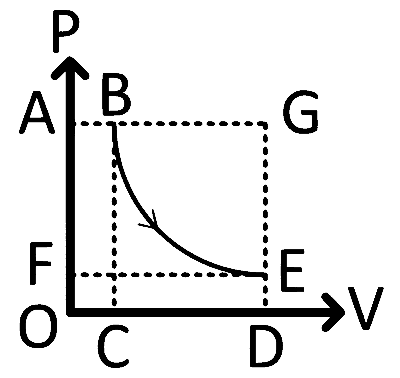
From the following plots, find the correct option.

Observe the following properties : Volume, enthalpy, density, temperature, heat capacity, pressure and internal energy. The number of extensive properties in the above list is
Match the following.
| A. | Isothermal process | i. | $$ q=\Delta U $$ |
|---|---|---|---|
| B. | Adiabatic process | ii. | $$ W=-p \times \Delta V $$ |
| C. | Isobaric process | iii. | $$ W=\Delta U $$ |
| D. | Isochoric process | iv. | $$ \[W=-n R T \ln \left(\frac{V_t}{V_i}\right)\] $$ |
Which of the following expression is correct?
Identify the reaction/process in which the entropy increases.
State \(1 \rightleftharpoons\) State \(2 \rightleftharpoons\) State 3 \(\left(\begin{array}{l}T=300 \mathrm{~K} \\ p=15 \mathrm{bar} \\ 1 \mathrm{~mol}\end{array}\right)\left(\begin{array}{l}T=300 \mathrm{~K} \\ p=10 \mathrm{bar} \\ 1 \mathrm{~mol}\end{array}\right)\left(\begin{array}{l}T=300 \mathrm{~K} \\ p=5 \mathrm{bar} \\ 1 \mathrm{~mol}\end{array}\right)\)
Above shows a cyclic process. Calculate the total work done during one complete cycle. [Assume a single step to reach the next state].
Identify the correct statements from the following.
I. At 0 K , the entropy of pure crystalline materials approach zero.
II. Entropy for the process, \(\mathrm{H}_2 \mathrm{O}(\mathrm{l}) \longrightarrow \mathrm{H}_2 \mathrm{O}(\mathrm{g})\) decreases.
III. Gibb's energy is a state function.
Use the data from table to estimate the enthalpy of formation of \(\mathrm{CH}_3 \mathrm{CHO}\).
| Bond enthalpy | Bond | Enthalpy of formation |
|---|---|---|
| $$\mathrm{400~kJ~mol^{-1}}$$ | $$\mathrm{C-H}$$ | $$\mathrm{C}(\mathrm{g}) 700 \mathrm{~kJ} \mathrm{~mol}^{-1}$$ |
| $$\mathrm{350~kJ~mol^{-1}}$$ | $$\mathrm{C-C}$$ | $$\mathrm{H}(\mathrm{g}) 200 \mathrm{~kJ} \mathrm{~mol}^{-1}$$ |
| $$\mathrm{700~kJ~mol^{-1}}$$ | $$\mathrm{C=O}$$ | $$\mathrm{O}(\mathrm{g}) 250 \mathrm{~kJ} \mathrm{~mol}^{-1}$$ |
Identify the incorrect statements form the following.
I. $ \Delta S_{\text {pum }}=\left(\Delta S_{\text {nal }}+\Delta S_{\text {um }}\right) $
II. $A(\bar{i} \rightarrow A(\phi)$ : For this process entropy change decreases.
III. Entropy units are $\mathrm{JK} \mathrm{mol}^{-1}$.
Given below are two statements :
Statement I For isothermal irreversible change of an ideal gas, $q=-w=p_{\text {ext }}\left(V_{\text {final }}-V_{\text {initial }}\right)$
Statement II For adiabatic change, $\Delta U=w_{\text {adiabatic }}$
The correct answer is :


Showing 20 of 54 questions