Difficulty distribution
How the classified questions are distributed by difficulty.
23questions
Not classified
23
100%
Your cart is empty.
Practice 23 PYQ MCQs on Carboxylic Acids & Derivatives from AP EAPCET (16 papers, 4 years). Ideal exam practice.
Every graph below is calculated only from this selection.
Year-wise coverage for Carboxylic Acids And Its Derivatives. Each bar uses a separate theme-derived color.
How the classified questions are distributed by difficulty.
MCQ, numerical, multiple-select and other formats found in these papers.
Top subjects by unique question coverage.
Top topics across the included previous year papers.
Top subtopics inside this exact selection.
Question coverage for the most populated papers. Every active PYP paper remains listed below.
Newest papers appear first. Sort by year, question coverage or name.
| Paper | Year / session | Questions in this view | Open |
|---|---|---|---|
| AP EAPCET 2025 21ST MAY EVENING SHIFT | 2025 | 1 | View paper |
| AP EAPCET 2025 21ST MAY MORNING SHIFT | 2025 | 1 | View paper |
| AP EAPCET 2025 22ND MAY EVENING SHIFT | 2025 | 2 | View paper |
| AP EAPCET 2025 23RD MAY EVENING SHIFT | 2025 | 2 | View paper |
| AP EAPCET 2025 24TH MAY MORNING SHIFT | 2025 | 1 | View paper |
| AP EAPCET 2025 26TH MAY EVENING SHIFT | 2025 | 2 | View paper |
| AP EAPCET 2025 26TH MAY MORNING SHIFT | 2025 | 1 | View paper |
| AP EAPCET 2024 18TH MAY MORNING SHIFT | 2024 | 1 | View paper |
| AP EAPCET 2024 20TH MAY EVENING SHIFT | 2024 | 2 | View paper |
| AP EAPCET 2024 20TH MAY MORNING SHIFT | 2024 | 2 | View paper |
| AP EAPCET 2024 21TH MAY EVENING SHIFT | 2024 | 1 | View paper |
| AP EAPCET 2024 21TH MAY MORNING SHIFT | 2024 | 1 | View paper |
| AP EAPCET 2024 22TH MAY EVENING SHIFT | 2024 | 3 | View paper |
| AP EAPCET 2022 4TH JULY EVENING SHIFT | 2022 | 1 | View paper |
| AP EAPCET 2022 4TH JULY MORNING SHIFT | 2022 | 1 | View paper |
| AP EAPCET 2021 20TH AUGUST MORNING SHIFT | 2021 | 1 | View paper |
Practice every matching question in batches of 20, with every available option.
The correct order of acidic strength among the following is
An aryl carboxylic acid on treatment with sodium hydrogen carbonate liberates a gaseous molecule. Identify the gas molecule liberated.
In the presence of peroxide, styrene reacts with HBr to give \(X\). When \(X\) is reacted with magnesium in dry ether followed by \(\mathrm{CO}_2\) and hydrolysis gave \(Y\). Treatment of Y with \(\mathrm{PCl}_5\) and then next with \(\mathrm{H}_2\). \(\mathrm{Pd}-\mathrm{BaSO}_4\) gave Z . What is Z ?



What are $A$ and $B$ in the following reaction sequence ?
$$\mathrm{CH}_3 \mathrm{COOH} \xrightarrow{A} X \xrightarrow[\mathrm{H}^{+}]{Y} B \text { (Analgesic drug) }$$





$$\text { Benzamide } \xrightarrow{\mathrm{Br}_2 / \mathrm{NaOH}} X \xrightarrow[\text { Alc. } \mathrm{KOH}]{\mathrm{CHCl}_3} Y$$
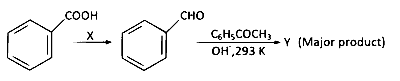
The conversion of $X$ to $Y$ is
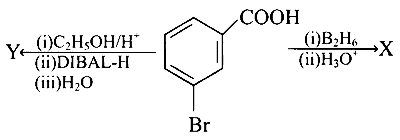
What are $X$ and $Y$ respectively in the following reactions?
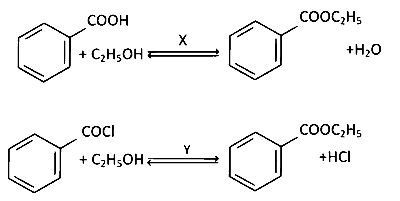
In the reaction sequence $Y$ is
$$\mathrm{CH}_3 \mathrm{CO}_2 \mathrm{H} \xrightarrow[(2) \Delta]{(1) \mathrm{NH}_3} P \xrightarrow{\mathrm{Br} / \mathrm{NaOH}} Y$$
Assertion (A) : Carboxylic acids are more acidic than phenols
Reason (R) : Resonance structures of carboxylate ion are equivalent, while resonance structures of phenoxide ion are not equivalent.
Consider the following reactions
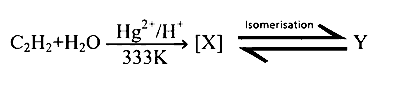
$Y$ can not be obtained from which of the following reaction?
Arrange the products I, II, III from the following reactions in decreasing order of their acid strength.
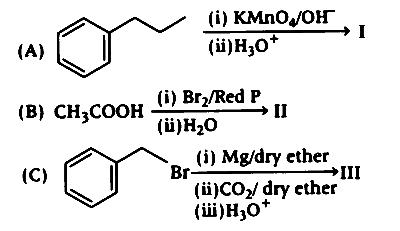
$$\text { The most acidic carboxylic acid is }$$


HCOOH
$\mathrm{CH}_3 \mathrm{COOH}$
What are $X, Y, Z$ in the following reaction sequence?
But-2-ene $\xrightarrow{X}$ Ethanoic acid $\xrightarrow{Y}$ Ethanoyl chloride $\xrightarrow[\text { Anhy. } \mathrm{AlCl}_3]{\text { Benzene }} Z$
An alkyl bromide $X\left(\mathrm{C}_5 \mathrm{H}_{11} \mathrm{Br}\right)$ undergoes hydrolysis in a two step mechanism $X$ is converted to Grignard reagent and then reacted with $\mathrm{CO}_2$ in dry ether followed by acidification gave $Y$. What is $Y$ ?


Consider the following sequence of reactions
$$\mathrm{C}_6 \mathrm{H}_5 \mathrm{COONa} \xrightarrow[\Delta]{\mathrm{NaOH} / \mathrm{CaO}} X \xrightarrow[\text { Anhy } \cdot \mathrm{AlCl}_3]{\text { CO+ } \mathrm{HCl}} Y \xrightarrow[\text { NaOH }]{\text { Conc. }} A+B$$
If $A$ is the reduction product of $Y$, what is $B$ ?
$$\text { The final product }(C) \text { in the given reaction sequence is }$$
$$\mathrm{C}_6 \mathrm{H}_5 \mathrm{COOH} \xrightarrow{\mathrm{SOCl}_2}(A) \xrightarrow[\text { anhy } \cdot \mathrm{AlCl}_3]{\mathrm{C}_6 \mathrm{H}_6}(B) \xrightarrow[\text { (ii) } \mathrm{KOH}_4 /\left(\mathrm{CH}_2 \mathrm{OH}\right)_2]{\text { (i) } \mathrm{NH}_2-\mathrm{NH}_2}(C)$$
Showing 20 of 23 questions