My Cart
Your Cart 0

    Your cart is empty.

  • Total (Amount) ₹0.00
Previous year question hub

Turbomachinery - Propulsion - Aerospace Engineering Previous Year Questions

Practice Turbomachinery - Propulsion - Aerospace Engineering previous year questions organised from real papers, with year-wise coverage and clear topic navigation.

2Papers
2Years
12Questions
1Topics

Turbomachinery question pattern

Every graph below is calculated only from this selection.

Questions by year

Year-wise coverage for Turbomachinery. Each bar uses a separate theme-derived color.

Difficulty distribution

How the classified questions are distributed by difficulty.

Medium 8 66.7%
Easy 3 25%
Hard 1 8.3%
Question type distribution

MCQ, numerical, multiple-select and other formats found in these papers.

Multiple Choices 8 66.7%
Numerical Answer Type (NAT) 4 33.3%

Subject weightage

Top subjects by unique question coverage.

Aerospace Engineering
12 Qs

Most asked topics

Top topics across the included previous year papers.

Propulsion
12 Qs

Subtopic coverage

Top subtopics inside this exact selection.

Turbomachinery
12 Qs

Paper coverage

Question coverage for the most populated papers. Every active PYP paper remains listed below.

Aerospace Engineering (AE) 2026
9 Qs
Aerospace Engineering (AE) 2025
3 Qs

Included previous year papers

Newest papers appear first. Sort by year, question coverage or name.

PaperYear / sessionQuestions in this viewOpen
Aerospace Engineering (AE) 202620269View paper
Aerospace Engineering (AE) 202520253View paper

All Turbomachinery previous year questions

Practice every matching question in batches of 20, with every available option.

1
2025 · Aerospace Engineering · Propulsion · Turbomachinery
Aerospace Engineering (AE) 2025
In a centrifugal compressor, the eye tip diameter is 10 cm. For a shaft rotational speed of 490 rotations per second, the tangential speed at the inducer tip is ____ m/s (rounded off to one decimal place).
Enter a numerical response
Open complete paper
2
2025 · Aerospace Engineering · Propulsion · Turbomachinery
Aerospace Engineering (AE) 2025
An ideal turbofan with a bypass ratio of 5 has core mass flow rate, \(\dot{m}_{a,c} = 100\) kg/s. The core and the fan exhausts are separate and optimally expanded. The core exhaust speed is 600 m/s and the fan exhaust speed is 120 m/s. If the fuel mass flow rate is negligible in comparison to \(\dot{m}_{a,c}\), the static specific thrust (\(T/\dot{m}_{a,c}\)) developed by the engine is ____ Ns/kg (rounded off to the nearest integer).
Enter a numerical response
Open complete paper
3
2025 · Aerospace Engineering · Propulsion · Turbomachinery
Aerospace Engineering (AE) 2025
A single-stage axial compressor, with a 50 % degree of reaction, runs at a mean blade speed of 250 m/s. The overall pressure ratio developed is 1.3. Inlet pressure and temperature are 1 bar and 300 K, respectively. Axial velocity is 200 m/s. Specific heat at constant pressure, \(C_p = 1005\) J/kg/K and specific heat ratio, \(\gamma = 1.4\). The rotor blade angle at the outlet is ____ degrees (rounded off to two decimal places).
Enter a numerical response
Open complete paper
4
2026 · Aerospace Engineering · Propulsion · Turbomachinery
Aerospace Engineering (AE) 2026

Which one of the following makes an ideal air-standard Stirling cycle?

A

Two reversible isobars, and two reversible adiabatics

B

Two reversible isotherms, and two reversible isobars

C

Two reversible isotherms, and two reversible isochores

D
Isentropic compression, constant volume heat addition, isentropic expansion, and constant volume heat rejection
Open complete paper
5
2026 · Aerospace Engineering · Propulsion · Turbomachinery
Aerospace Engineering (AE) 2026
For a given air-standard power, the propulsive efficiency of a turbofan engine is more than that of a turbojet engine. Which of the following is/are the reason(s) for this?
A

The mass flow rate is more for a turbofan engine

B

The exit velocity is lower for a turbofan engine

C

A turbofan engine operates at a lower altitude

D

The fan of a turbofan engine consumes lesser power

Open complete paper
6
2026 · Aerospace Engineering · Propulsion · Turbomachinery
Aerospace Engineering (AE) 2026
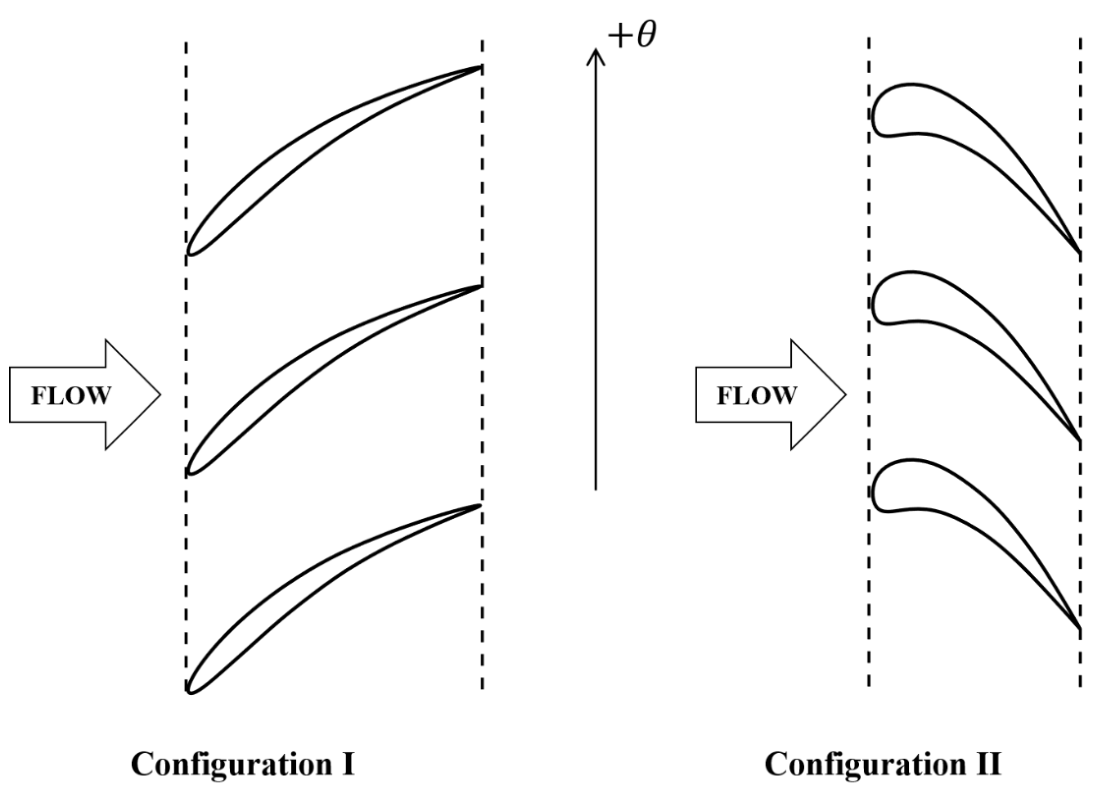
The figure below shows the blading of the rotors of two different axial turbomachines under their typical operating conditions, labelled as Configuration I and Configuration II. Which of the following statements is/are TRUE?

Question source image

A
Configuration I corresponds to the rotor of a compressor and Configuration II corresponds to the rotor of a turbine
B
Configuration I corresponds to the rotor of a turbine and Configuration II corresponds to the rotor of a compressor
C
The rotor blades of the turbomachine in Configuration I move along the +θ direction
D
The rotor blades of the turbomachine in Configuration II move along the +θ direction
Open complete paper
7
2026 · Aerospace Engineering · Propulsion · Turbomachinery
Aerospace Engineering (AE) 2026
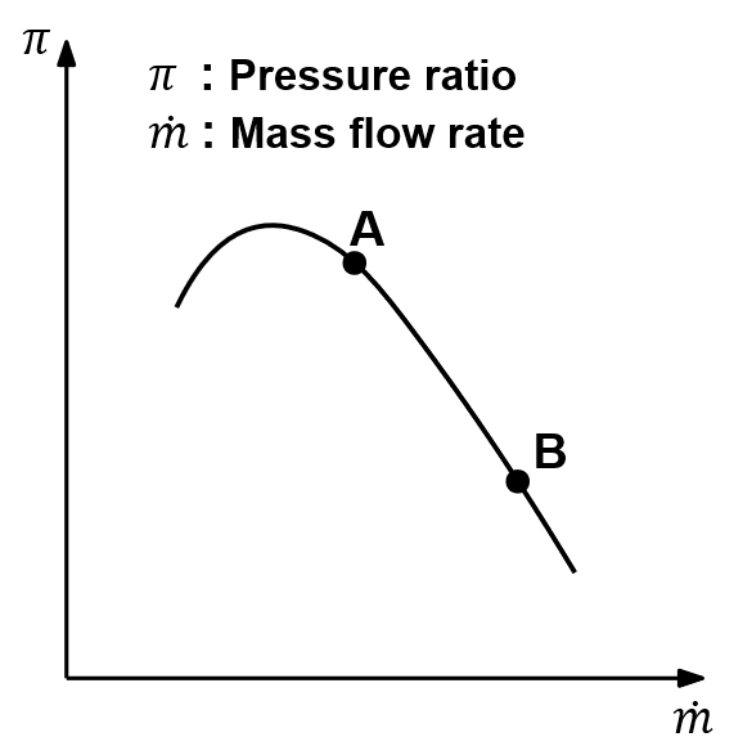
A multi-stage axial compressor can be operated at two points, A and B, both of which lie on the same speed line, as shown in the figure below. If η is the isentropic efficiency of the compressor, select the statements that is/are TRUE.

Question source image

A
η_A > η_B
B
η_B > η_A
C

In comparison to point B, point A is closer to the surge point

D

In comparison to point A, point B is closer to the choke point

Open complete paper
8
2026 · Aerospace Engineering · Propulsion · Turbomachinery
Aerospace Engineering (AE) 2026
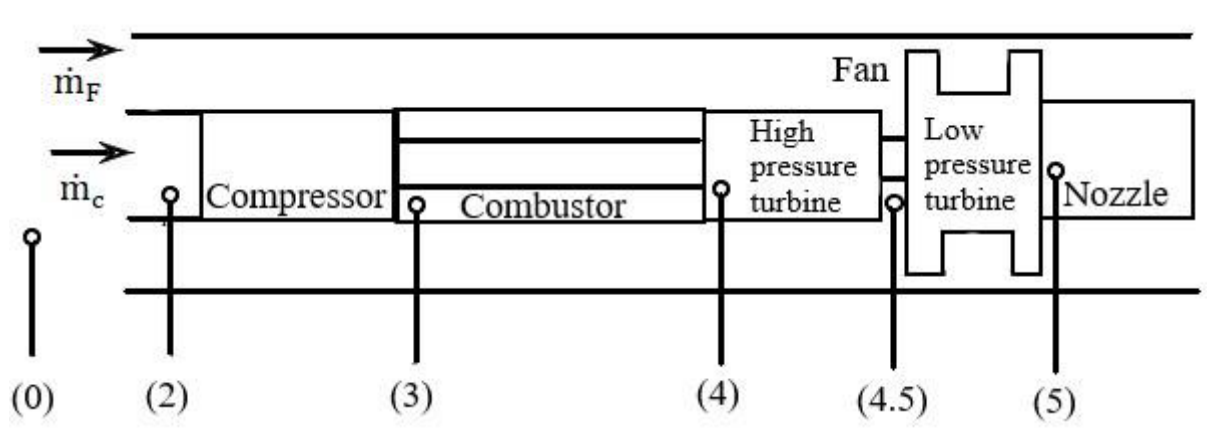
In an ideal turbofan engine shown in the figure below, the compressor is driven by the high pressure turbine, and the fan is driven by the low pressure turbine. The stations 0, 2, 3, 4, 4.5, and 5 refer to free-stream, compressor inlet, compressor outlet, combustor exit, high pressure turbine exit, and low pressure turbine exit, respectively, and the subscript 't' refers to the total condition. Also, \(\tau_r = T_{t0}/T_0\), \(\tau_c = T_{t3}/T_{t2}\) and \(\tau_\lambda = T_{t4}/T_0\). The total temperature ratio of the high pressure turbine (\(T_{t4.5}/T_{t4}\)) is given by ______.

Question source image

A
\(1 - \frac{\tau_r}{\tau_\lambda}(\tau_c - 1)\)
B
\(1 + \frac{\tau_r}{\tau_\lambda}(\tau_c + 1)\)
C
\(1 - \frac{\tau_r}{\tau_\lambda}(\tau_c + 1)\)
D
\(1 + \frac{\tau_r}{\tau_\lambda}(\tau_c - 1)\)
Open complete paper
9
2026 · Aerospace Engineering · Propulsion · Turbomachinery
Aerospace Engineering (AE) 2026
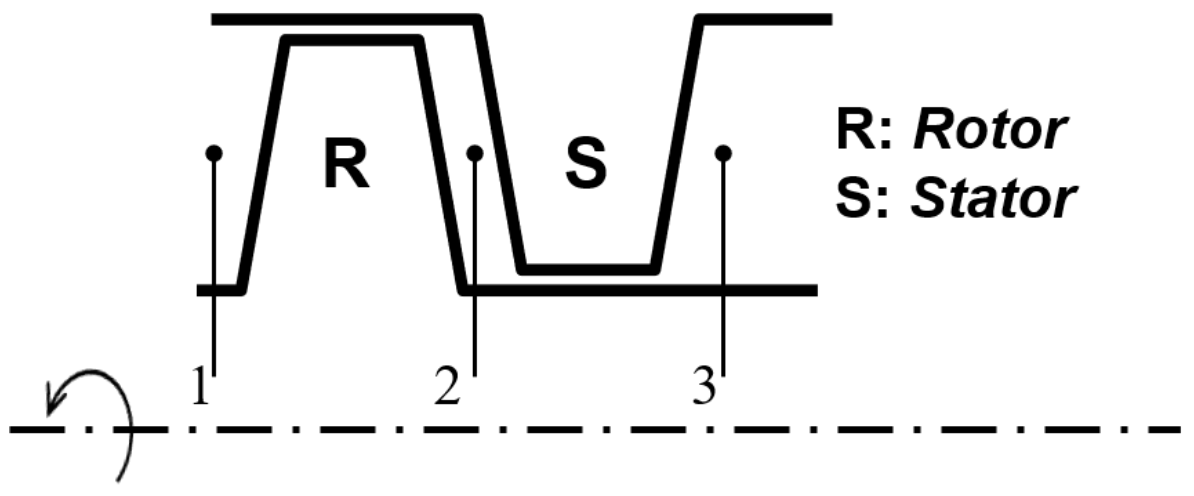
The figure below shows a compressor stage with station numbers 1, 2, and 3 as indicated. If \( p_{01} \), \( T_{01} \), and \( C_1 \) refer to the average values of total pressure, total temperature, and absolute flow speed, respectively, at the \( i^{th} \) station, select the CORRECT option considering losses.

Question source image

A
\(p_{01} < p_{02}, p_{02} > p_{03} \; ; \; T_{01} < T_{02}, T_{02} \approx T_{03} \; ; \; C_1 < C_2, C_2 > C_3 \)
B
\(p_{01} < p_{02}, p_{02} = p_{03} \; ; \; T_{01} < T_{02}, T_{02} \approx T_{03} \; ; \; C_1 < C_2, C_2 = C_3 \)
C
\(p_{01} < p_{02}, p_{02} > p_{03} \; ; \; T_{01} < T_{02}, T_{02} < T_{03} \; ; \; C_1 > C_2, C_2 > C_3 \)
D
\(p_{01} < p_{02}, p_{02} < p_{03} \; ; \; T_{01} < T_{02}, T_{02} < T_{03} \; ; \; C_1 = C_2 = C_3 \)
Open complete paper
10
2026 · Aerospace Engineering · Propulsion · Turbomachinery
Aerospace Engineering (AE) 2026
Which of the following process(es) is/are involved in the compression of air in an ideal ramjet engine?
A

oblique shock

B

mechanical compression

C

normal shock

D

subsonic diffusion

Open complete paper
11
2026 · Aerospace Engineering · Propulsion · Turbomachinery
Aerospace Engineering (AE) 2026
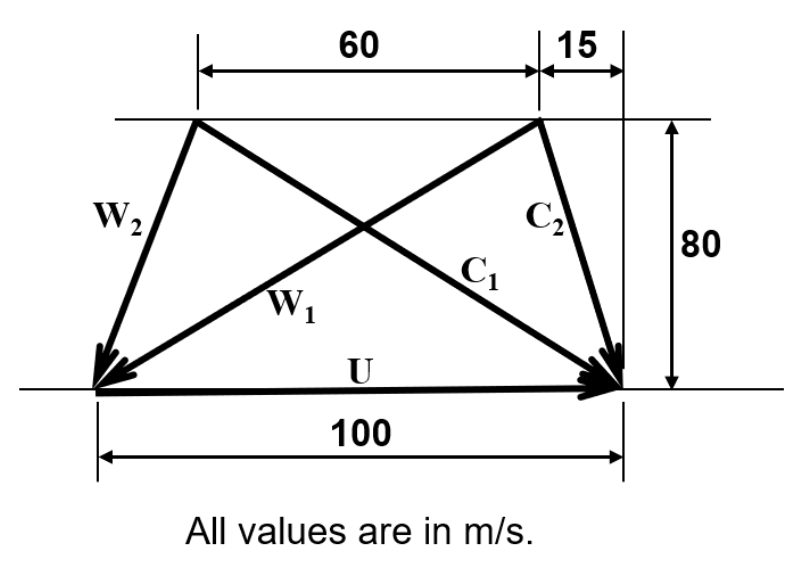
The figure below shows the velocity triangles at the inlet and outlet of the rotor of a low hub-to-tip ratio axial compressor at the mid-span of the blade. The absolute and relative velocities of the flow are denoted by C and W, respectively. The subscripts 1 and 2 refer to the locations before and after the rotor, respectively. The blade velocity is denoted by U. Select the CORRECT statement(s) for this device.

Question source image

A

The axial velocity is constant across the rotor

B

The flow coefficient is 0.6

C

The blade loading coefficient is 0.6

D
If the acoustic velocity at the rotor inlet is 350 m/s, then the inlet relative Mach number is 0.333
Open complete paper
12
2026 · Aerospace Engineering · Propulsion · Turbomachinery
Aerospace Engineering (AE) 2026
A gas mixture at a pressure of 800 kPa and a density of 5 kg/m³ enters a turbine stage. The temperature of the gas at the nozzle exit and the stage exit are 790 K and 750 K, respectively. Assume the specific heats are constant for the gas mixture in the range of temperatures considered. The specific heat at constant pressure is 0.72 kJ/kg-K and the ratio of specific heats is 1.33. The value of the degree of reaction of the turbine stage is __________ (rounded off to 2 decimal places).
Enter a numerical response
Open complete paper