My Cart
Your Cart 0

    Your cart is empty.

  • Total (Amount) ₹0.00
Previous year question hub

Propulsion Thermodynamics and Brayton Cycle - Propulsion - Aerospace Engineering Previous Year Questions

Practice Propulsion Thermodynamics and Brayton Cycle - Propulsion - Aerospace Engineering previous year questions organised from real papers, with year-wise coverage and clear topic navigation.

1Papers
1Years
5Questions
1Topics

Propulsion Thermodynamics and Brayton Cycle question pattern

Every graph below is calculated only from this selection.

Questions by year

Year-wise coverage for Propulsion Thermodynamics and Brayton Cycle. Each bar uses a separate theme-derived color.

Difficulty distribution

How the classified questions are distributed by difficulty.

Medium 3 60%
Easy 2 40%

Question type distribution

MCQ, numerical, multiple-select and other formats found in these papers.

MCQ 3 60%
Numerical Answer Type (NAT) 2 40%

Subject weightage

Top subjects by unique question coverage.

Aerospace Engineering
5 Qs

Most asked topics

Top topics across the included previous year papers.

Propulsion
5 Qs

Subtopic coverage

Top subtopics inside this exact selection.

Propulsion Thermodynamics and Brayton Cycle
5 Qs

Paper coverage

Question coverage for the most populated papers. Every active PYP paper remains listed below.

Aerospace Engineering (AE) 2026
5 Qs

Included previous year papers

Newest papers appear first. Sort by year, question coverage or name.

PaperYear / sessionQuestions in this viewOpen
Aerospace Engineering (AE) 202620265View paper

All Propulsion Thermodynamics and Brayton Cycle previous year questions

Practice every matching question in batches of 20, with every available option.

1
2026 · Aerospace Engineering · Propulsion · Propulsion Thermodynamics and Brayton Cycle
Aerospace Engineering (AE) 2026

Which one of the following makes an ideal air-standard Stirling cycle?

Open complete paper
2
2026 · Aerospace Engineering · Propulsion · Propulsion Thermodynamics and Brayton Cycle
Aerospace Engineering (AE) 2026
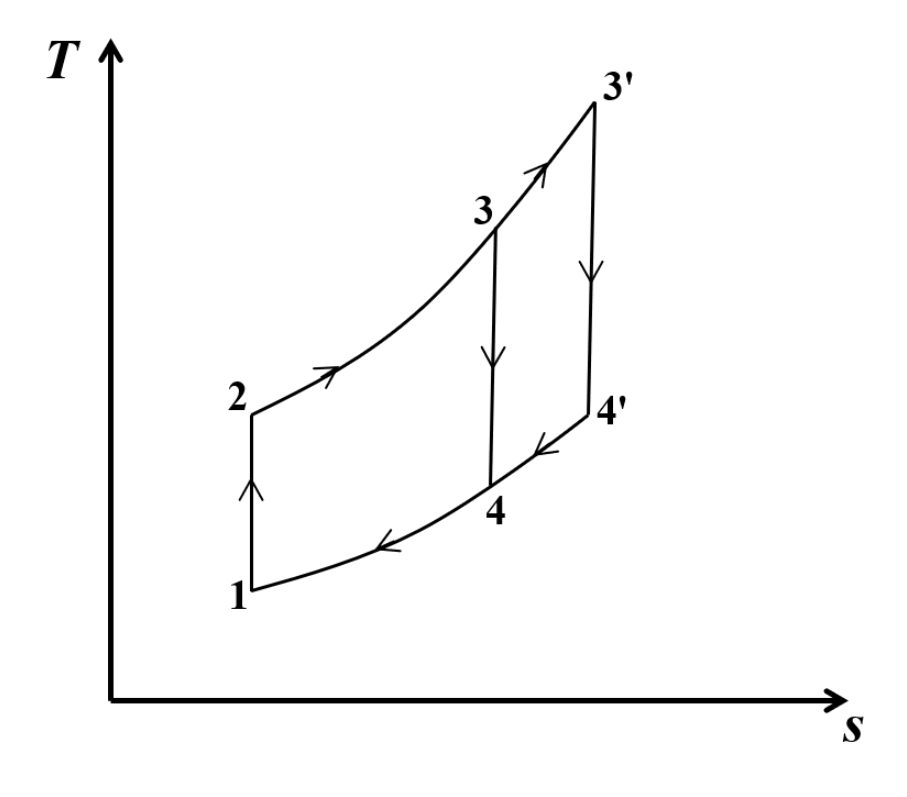
The figure below depicts two ideal gas turbine cycles, cycle 1-2-3-4-1 and cycle 1-2-3'-4'-1, on a T-s diagram. Which one the following statements is FALSE?

Question source image

Open complete paper
3
2026 · Aerospace Engineering · Propulsion · Propulsion Thermodynamics and Brayton Cycle
Aerospace Engineering (AE) 2026
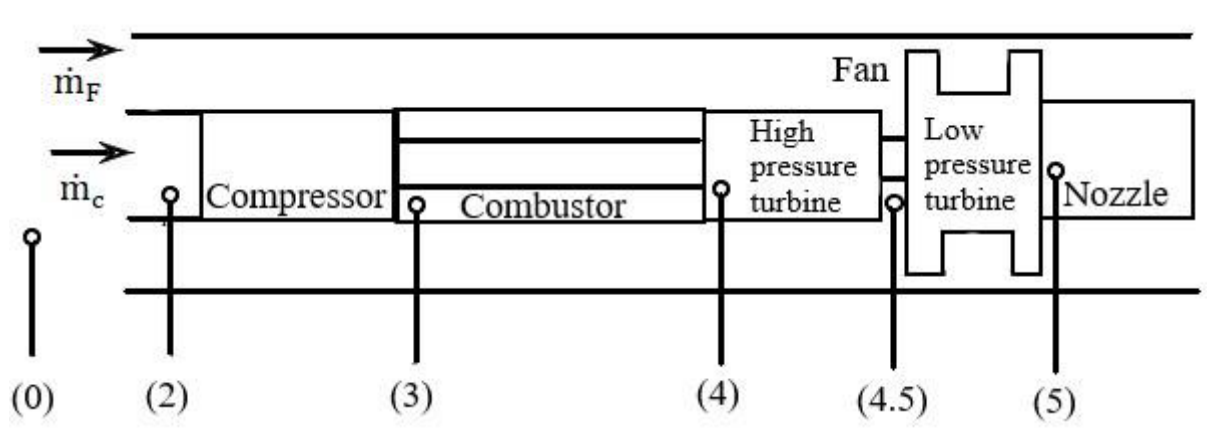
In an ideal turbofan engine shown in the figure below, the compressor is driven by the high pressure turbine, and the fan is driven by the low pressure turbine. The stations 0, 2, 3, 4, 4.5, and 5 refer to free-stream, compressor inlet, compressor outlet, combustor exit, high pressure turbine exit, and low pressure turbine exit, respectively, and the subscript 't' refers to the total condition. Also, \(\tau_r = T_{t0}/T_0\), \(\tau_c = T_{t3}/T_{t2}\) and \(\tau_\lambda = T_{t4}/T_0\). The total temperature ratio of the high pressure turbine (\(T_{t4.5}/T_{t4}\)) is given by ______.

Question source image

Open complete paper
4
2026 · Aerospace Engineering · Propulsion · Propulsion Thermodynamics and Brayton Cycle
Aerospace Engineering (AE) 2026
Isobutane (\( C_4H_{10} \)) is burnt completely in pure oxygen as per the reaction given below. Given that the standard heats of formation (in kcal/mole) of isobutane, carbon dioxide, and water vapour are \( -31.489 \), \( -94.052 \), and \( -60.150 \), respectively, the heat of reaction is __________ kcal (rounded off to 2 decimal places).
\( C_4H_{10} + 6.5 O_2 \rightarrow 4 CO_2 + 5 H_2O \)
Open complete paper
5
2026 · Aerospace Engineering · Propulsion · Propulsion Thermodynamics and Brayton Cycle
Aerospace Engineering (AE) 2026
A furnace of 250 MW rating is used to melt and raise the temperature of aluminium from 25 °C to 900 °C. Aluminium has a solid-state specific heat, latent heat, and liquid-state specific heat of 0.9 kJ/kg·K, 390 kJ/kg, and 1.108 kJ/kg·K, respectively, and the furnace has 70% efficiency. The melting point of aluminium is 660 °C. The amount of aluminium that can be processed per hour is __________ kg (rounded off to 1 decimal place).
Open complete paper