My Cart
Your Cart 0

    Your cart is empty.

  • Total (Amount) ₹0.00
Previous year question hub

Gas turbine combustor - Propulsion - Aerospace Engineering Previous Year Questions

Practice Gas turbine combustor - Propulsion - Aerospace Engineering previous year questions organised from real papers, with year-wise coverage and clear topic navigation.

2Papers
2Years
6Questions
1Topics

Gas turbine combustor question pattern

Every graph below is calculated only from this selection.

Questions by year

Year-wise coverage for Gas turbine combustor. Each bar uses a separate theme-derived color.

Difficulty distribution

How the classified questions are distributed by difficulty.

Easy 3 50%
Medium 3 50%

Question type distribution

MCQ, numerical, multiple-select and other formats found in these papers.

Multiple Choices 3 50%
Numerical Answer Type (NAT) 3 50%

Subject weightage

Top subjects by unique question coverage.

Aerospace Engineering
6 Qs

Most asked topics

Top topics across the included previous year papers.

Propulsion
6 Qs

Subtopic coverage

Top subtopics inside this exact selection.

Gas turbine combustor
6 Qs

Paper coverage

Question coverage for the most populated papers. Every active PYP paper remains listed below.

Aerospace Engineering (AE) 2026
2 Qs
Aerospace Engineering (AE) 2025
4 Qs

Included previous year papers

Newest papers appear first. Sort by year, question coverage or name.

PaperYear / sessionQuestions in this viewOpen
Aerospace Engineering (AE) 202620262View paper
Aerospace Engineering (AE) 202520254View paper

All Gas turbine combustor previous year questions

Practice every matching question in batches of 20, with every available option.

1
2025 · Aerospace Engineering · Propulsion · Gas turbine combustor
Aerospace Engineering (AE) 2025
\(\delta Q\) and \(\delta W\) are the heat and work interactions of a system with its surroundings, and \(dU\) is the change in the internal energy of the system. For an adiabatic process in a closed, constant pressure combustor, which one of the following options is correct?
A
\(|\delta Q| = |dU| \neq 0\) and \(|\delta W| = 0\)
B
\(|\delta Q| = |\delta W| = 0\) and \(|dU| \neq 0\)
C
\(|\delta Q| = |\delta W| = |dU| = 0\)
D
\(|\delta W| = |dU| \neq 0\) and \(|\delta Q| = 0\)
Open complete paper
2
2025 · Aerospace Engineering · Propulsion · Gas turbine combustor
Aerospace Engineering (AE) 2025
A gaseous fuel mixture comprising 3 moles of methane and 2 moles of ammonia is combusted in X moles of pure oxygen in stoichiometric amount. Assuming complete combustion, with only \(CO_2\), \(H_2O\) and \(N_2\) in the product gases, the value of X is ____.
\(3 CH_4 + 2 NH_3 + X O_2 \rightarrow \text{Products } (CO_2, H_2O, N_2)\)
A
7.5
B
5.5
C
8.5
D
9.5
Open complete paper
3
2025 · Aerospace Engineering · Propulsion · Gas turbine combustor
Aerospace Engineering (AE) 2025
A perfect gas flows through a frictionless constant-area duct with heat addition. The inlet conditions are as follows: pressure 100 kPa, density 1 kg/m³, and velocity 100 m/s. At a particular downstream location, the gas velocity is 200 m/s. The static pressure at the downstream location is ________ kPa (answer in integer).
Enter a numerical response
Open complete paper
4
2025 · Aerospace Engineering · Propulsion · Gas turbine combustor
Aerospace Engineering (AE) 2025
Air at temperature 300 K is compressed isentropically from a pressure of 1 bar to 10 bar in a compressor. Eighty percent of the compressed air is supplied to a combustor. In the combustor, 0.88 MJ of heat is added per kg of air. The specific heat at constant pressure is \(C_p = 1005\) J/kg/K and the specific heat ratio is \(\gamma = 1.4\). The temperature of the air leaving the combustor is ____ K (rounded off to one decimal place).
Enter a numerical response
Open complete paper
5
2026 · Aerospace Engineering · Propulsion · Gas turbine combustor
Aerospace Engineering (AE) 2026
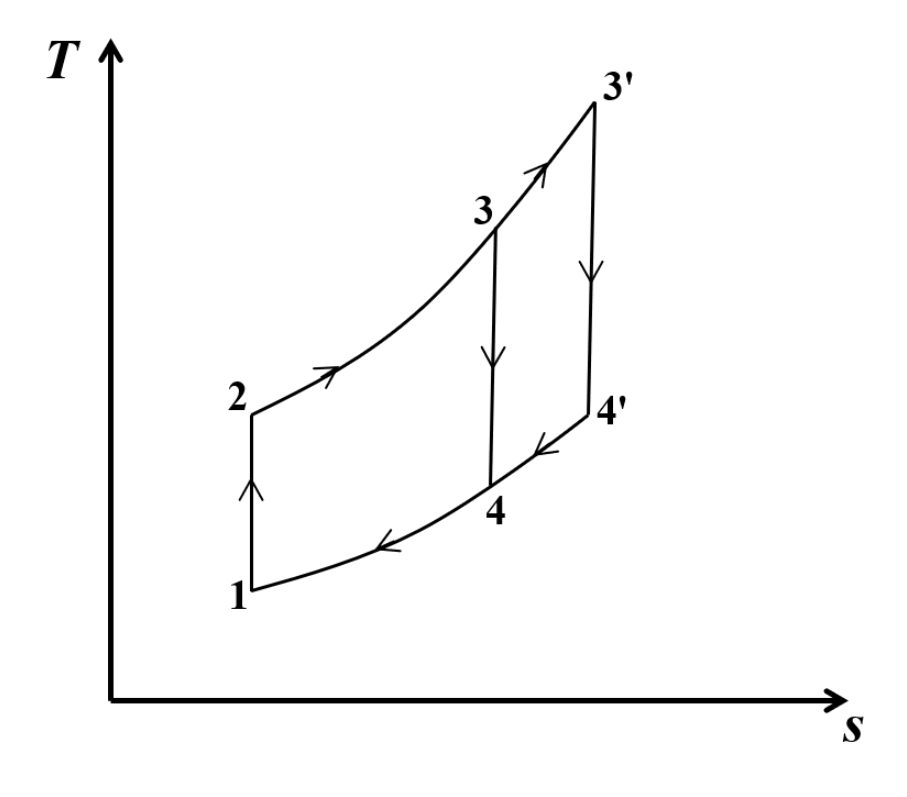
The figure below depicts two ideal gas turbine cycles, cycle 1-2-3-4-1 and cycle 1-2-3'-4'-1, on a T-s diagram. Which one the following statements is FALSE?

Question source image

A

The thermal efficiency of the two cycles is the same

B

The specific work of the two cycles is the same

C

The processes 2-3 and 2-3' are isobaric

D
The amount of heat added in the combustion process is greater for the cycle 1-2-3'-4'-1
Open complete paper
6
2026 · Aerospace Engineering · Propulsion · Gas turbine combustor
Aerospace Engineering (AE) 2026
Isobutane (\( C_4H_{10} \)) is burnt completely in pure oxygen as per the reaction given below. Given that the standard heats of formation (in kcal/mole) of isobutane, carbon dioxide, and water vapour are \( -31.489 \), \( -94.052 \), and \( -60.150 \), respectively, the heat of reaction is __________ kcal (rounded off to 2 decimal places).
\( C_4H_{10} + 6.5 O_2 \rightarrow 4 CO_2 + 5 H_2O \)
Enter a numerical response
Open complete paper