My Cart
Your Cart 0

    Your cart is empty.

  • Total (Amount) ₹0.00
Previous year question hub

Space Dynamics - Flight Mechanics & Space Dynamics - Aerospace Engineering Previous Year Questions

Practice Space Dynamics - Flight Mechanics & Space Dynamics - Aerospace Engineering previous year questions organised from real papers, with year-wise coverage and clear topic navigation.

2Papers
2Years
4Questions
1Topics

Space Dynamics question pattern

Every graph below is calculated only from this selection.

Questions by year

Year-wise coverage for Space Dynamics. Each bar uses a separate theme-derived color.

Difficulty distribution

How the classified questions are distributed by difficulty.

Medium 3 75%
Easy 1 25%

Question type distribution

MCQ, numerical, multiple-select and other formats found in these papers.

Multiple Choices 2 50%
Numerical Answer Type (NAT) 2 50%

Subject weightage

Top subjects by unique question coverage.

Aerospace Engineering
4 Qs

Most asked topics

Top topics across the included previous year papers.

Flight Mechanics & Space Dynamics
4 Qs

Subtopic coverage

Top subtopics inside this exact selection.

Space Dynamics
4 Qs

Paper coverage

Question coverage for the most populated papers. Every active PYP paper remains listed below.

Aerospace Engineering (AE) 2026
2 Qs
Aerospace Engineering (AE) 2025
2 Qs

Included previous year papers

Newest papers appear first. Sort by year, question coverage or name.

PaperYear / sessionQuestions in this viewOpen
Aerospace Engineering (AE) 202620262View paper
Aerospace Engineering (AE) 202520252View paper

All Space Dynamics previous year questions

Practice every matching question in batches of 20, with every available option.

1
2025 · Aerospace Engineering · Flight Mechanics & Space Dynamics · Space Dynamics
Aerospace Engineering (AE) 2025
An ideal two-stage rocket has identical specific impulse and structural coefficient for its two stages. For an optimized rocket, the two stages have identical payload ratio as well. The payload is 2 tons and the initial mass of the rocket is 200 tons. The mass of the second stage of the rocket (including the final payload mass) is ____ tons.
A
100
B
10
C
20
D
50
Open complete paper
2
2025 · Aerospace Engineering · Flight Mechanics & Space Dynamics · Space Dynamics
Aerospace Engineering (AE) 2025
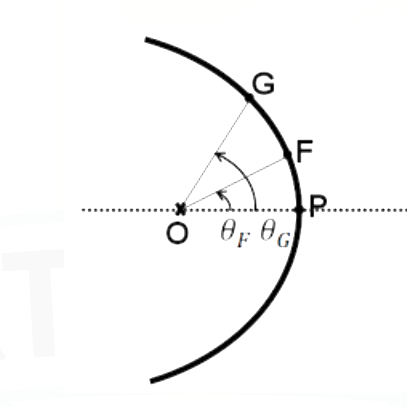
F and G denote two points on a spacecraft’s orbit around a planet, as indicated in the figure. O is the center of the planet, P is the periapsis, and the angles are as indicated in the figure. If OF = 8000 km, OG = 10000 km, \(\theta_F = 0\) deg, and \(\theta_G = 60\) deg, the eccentricity of the spacecraft’s orbit is ________ (rounded off to two decimal places).

Question diagram

Enter a numerical response
Open complete paper
3
2026 · Aerospace Engineering · Flight Mechanics & Space Dynamics · Space Dynamics
Aerospace Engineering (AE) 2026
An earth satellite has the instantaneous position vector \(\vec{r}\) and velocity vector \(\vec{v}\) as given below. Here \(\hat{p}\) and \(\hat{q}\) denote the unit vectors along the \(x\) and \(y\) axes of the perifocal frame, respectively. Assume that the value of gravitational parameter is \(398600\ \text{km}^3/\text{s}^2\). Which one of the following trajectories does the satellite follow? \(\vec{r} = (8000\hat{p} + 9000\hat{q})\ \text{km}\) and \(\vec{v} = (-6\hat{p} + 6\hat{q})\ \text{km/s}\)
A

Circle

B

Hyperbola

C

Parabola

D

Straight line

Open complete paper
4
2026 · Aerospace Engineering · Flight Mechanics & Space Dynamics · Space Dynamics
Aerospace Engineering (AE) 2026
An earth satellite moves in an elliptical orbit with a perigee altitude of 300 km and an apogee altitude of 3000 km. Assume that the radius of the earth is 6378 km. The eccentricity of the orbit is __________ (rounded off to three decimal places).
Enter a numerical response
Open complete paper