My Cart
Your Cart 0

    Your cart is empty.

  • Total (Amount) ₹0.00
Previous year question hub

Two-dimensional potential flow theory - Aerodynamics - Aerospace Engineering Previous Year Questions

Practice Two-dimensional potential flow theory - Aerodynamics - Aerospace Engineering previous year questions organised from real papers, with year-wise coverage and clear topic navigation.

2Papers
2Years
6Questions
1Topics

Two-dimensional potential flow theory question pattern

Every graph below is calculated only from this selection.

Questions by year

Year-wise coverage for Two-dimensional potential flow theory. Each bar uses a separate theme-derived color.

Difficulty distribution

How the classified questions are distributed by difficulty.

Medium 3 50%
Easy 3 50%

Question type distribution

MCQ, numerical, multiple-select and other formats found in these papers.

Multiple Choices 5 83.3%
Numerical Answer Type (NAT) 1 16.7%

Subject weightage

Top subjects by unique question coverage.

Aerospace Engineering
6 Qs

Most asked topics

Top topics across the included previous year papers.

Aerodynamics
6 Qs

Subtopic coverage

Top subtopics inside this exact selection.

Two-dimensional potential flow theory
6 Qs

Paper coverage

Question coverage for the most populated papers. Every active PYP paper remains listed below.

Aerospace Engineering (AE) 2026
4 Qs
Aerospace Engineering (AE) 2025
2 Qs

Included previous year papers

Newest papers appear first. Sort by year, question coverage or name.

PaperYear / sessionQuestions in this viewOpen
Aerospace Engineering (AE) 202620264View paper
Aerospace Engineering (AE) 202520252View paper

All Two-dimensional potential flow theory previous year questions

Practice every matching question in batches of 20, with every available option.

1
2025 · Aerospace Engineering · Aerodynamics · Two-dimensional potential flow theory
Aerospace Engineering (AE) 2025
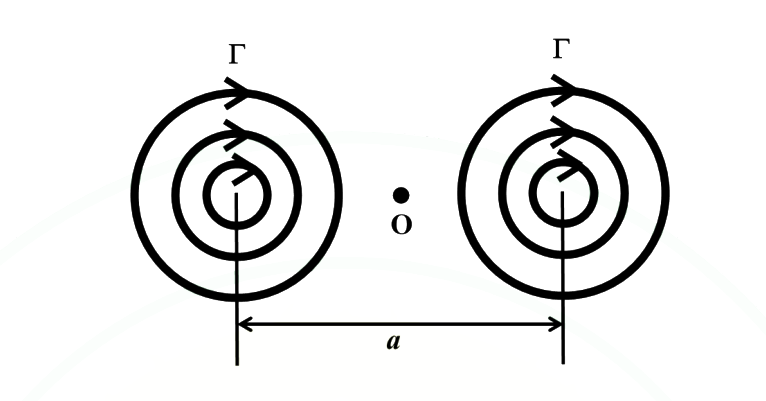
Consider a pair of point vortices with clockwise circulation \(\Gamma\) each. The distance between their centers is \(a\), as shown in the figure. Assume two-dimensional, incompressible, inviscid flow. Which one of the following options is correct?

Question diagram

A
The vortices translate downwards together with a velocity \(\frac{\Gamma}{2\pi a}\)
B
The vortices translate upwards together with a velocity \(\frac{\Gamma}{2\pi a}\)
C
The vortices rotate clockwise around each other about their centroid O.
D
The vortices rotate counter-clockwise around each other about their centroid O.
Open complete paper
2
2025 · Aerospace Engineering · Aerodynamics · Two-dimensional potential flow theory
Aerospace Engineering (AE) 2025
The lift per unit span for a spinning circular cylinder in a potential flow is 6 N/m. The free-stream velocity is 30 m/s, and the density of air is 1.225 kg/m³. The circulation around the cylinder is ____ m²/s (rounded off to two decimal places).
Enter a numerical response
Open complete paper
3
2026 · Aerospace Engineering · Aerodynamics · Two-dimensional potential flow theory
Aerospace Engineering (AE) 2026

In fluid dynamics, d’Alembert’s paradox refers to which one of the following?

A
Deviation of drag from \(D \propto v^2 \) at very low speeds
B
Deviation of drag from \(D \propto v^2 \) at high subsonic speeds
C

Prediction of zero drag by potential flow theory

D

Presence of shocks in transonic flows

Open complete paper
4
2026 · Aerospace Engineering · Aerodynamics · Two-dimensional potential flow theory
Aerospace Engineering (AE) 2026
The velocity potential function \( (\varphi) \) given below represents which one of the following? \[ \varphi = 5x - 12y \]
A

Doublet

B

Irrotational vortex

C

Source

D

Uniform flow

Open complete paper
5
2026 · Aerospace Engineering · Aerodynamics · Two-dimensional potential flow theory
Aerospace Engineering (AE) 2026
The deformation of an open-section bar subjected to pure torsion can be solved by choosing an appropriate Prandtl stress function. Which of the following statements is/are true about the Prandtl stress function?
A

It satisfies the equilibrium equation

B

It is zero on the lateral surfaces of the bar

C

It satisfies the compatibility equation

D

It does not satisfy the equilibrium equation

Open complete paper
6
2026 · Aerospace Engineering · Aerodynamics · Two-dimensional potential flow theory
Aerospace Engineering (AE) 2026
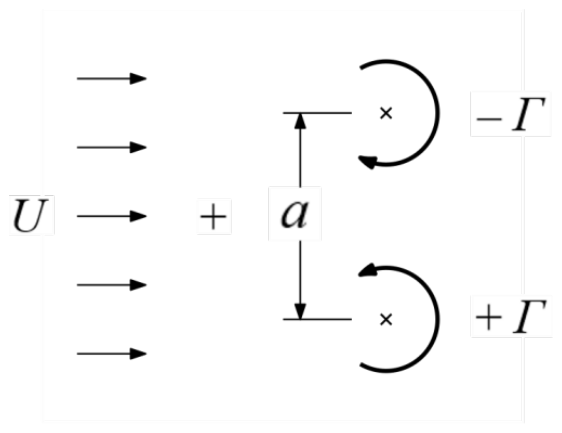
Consider the flow over an oval modeled using the elementary potential flows as shown below. U represents uniform flow velocity and Γ represents circulation around an irrotational line vortex.

Which of the following statements is/are TRUE for this model?

Question source image

A
Increasing U enlarges the oval
B
Increasing Γ enlarges the oval
C

Interchanging the sense of the two vortices does not alter the oval

D

Moving the vortices too far apart causes the oval to break up

Open complete paper