My Cart
Your Cart 0

    Your cart is empty.

  • Total (Amount) ₹0.00
Previous year question hub

Compressible flows - Aerodynamics - Aerospace Engineering Previous Year Questions

Practice Compressible flows - Aerodynamics - Aerospace Engineering previous year questions organised from real papers, with year-wise coverage and clear topic navigation.

2Papers
2Years
9Questions
1Topics

Compressible flows question pattern

Every graph below is calculated only from this selection.

Questions by year

Year-wise coverage for Compressible flows. Each bar uses a separate theme-derived color.

Difficulty distribution

How the classified questions are distributed by difficulty.

Medium 8 88.9%
Easy 1 11.1%

Question type distribution

MCQ, numerical, multiple-select and other formats found in these papers.

Numerical Answer Type (NAT) 5 55.6%
Multiple Choices 4 44.4%

Subject weightage

Top subjects by unique question coverage.

Aerospace Engineering
9 Qs

Most asked topics

Top topics across the included previous year papers.

Aerodynamics
9 Qs

Subtopic coverage

Top subtopics inside this exact selection.

Compressible flows
9 Qs

Paper coverage

Question coverage for the most populated papers. Every active PYP paper remains listed below.

Aerospace Engineering (AE) 2026
5 Qs
Aerospace Engineering (AE) 2025
4 Qs

Included previous year papers

Newest papers appear first. Sort by year, question coverage or name.

PaperYear / sessionQuestions in this viewOpen
Aerospace Engineering (AE) 202620265View paper
Aerospace Engineering (AE) 202520254View paper

All Compressible flows previous year questions

Practice every matching question in batches of 20, with every available option.

1
2025 · Aerospace Engineering · Aerodynamics · Compressible flows
Aerospace Engineering (AE) 2025
In a fluid flow, Mach number is an estimate of _____.
A
\(\sqrt{\frac{\text{inertia force}}{\text{viscous force}}}\)
B
\(\sqrt{\frac{\text{inertia force}}{\text{elastic force}}}\)
C
\(\sqrt{\frac{\text{elastic force}}{\text{viscous force}}}\)
D
\(\sqrt{\frac{\text{viscous force}}{\text{inertia force}}}\)
Open complete paper
2
2025 · Aerospace Engineering · Aerodynamics · Compressible flows
Aerospace Engineering (AE) 2025
An aircraft is flying at an altitude of 4500 m above sea level, where the ambient pressure, temperature and density are 57 kPa, 259 K and 0.777 kg/m³, respectively. The speed of the aircraft (V) is 230 m/s. Gas constant R= 287 J/kg/K, and specific heat ratio \(\gamma = 1.4\). If the stagnation pressure is \(p_0\), and static pressure is \(p\), the value of \(\left[\frac{p_0 - p}{\frac{1}{2} \rho V^2}\right]\) is ____ (rounded off to two decimal places).
Enter a numerical response
Open complete paper
3
2025 · Aerospace Engineering · Aerodynamics · Compressible flows
Aerospace Engineering (AE) 2025
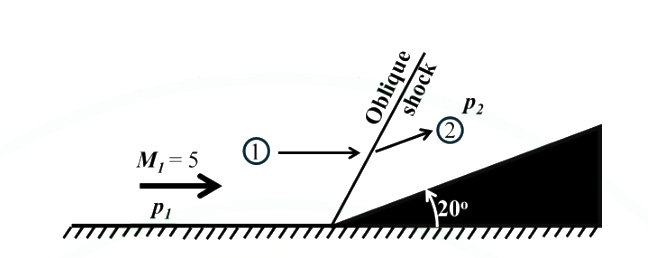
A supersonic stream of an ideal gas at Mach number \(M_1 = 5\) is turned by a ramp, as shown in the figure. The ramp angle is 20°. The pressure ratio is \(\frac{p_2}{p_1} = 7.125\) and the specific heat ratio is \(\gamma = 1.4\). The pressure coefficient on the ramp surface is ________ (rounded off to two decimal places).

Question diagram

Enter a numerical response
Open complete paper
4
2025 · Aerospace Engineering · Aerodynamics · Compressible flows
Aerospace Engineering (AE) 2025
The mass flow rate in a supersonic wind tunnel is 2 kg/s when the stagnation pressure and stagnation temperature are 1 MPa and 800 K, respectively. If the stagnation pressure and stagnation temperature are changed to 3 MPa and 200 K, the mass flow rate in the tunnel changes to ________ kg/s (answer in integer).
Enter a numerical response
Open complete paper
5
2026 · Aerospace Engineering · Aerodynamics · Compressible flows
Aerospace Engineering (AE) 2026
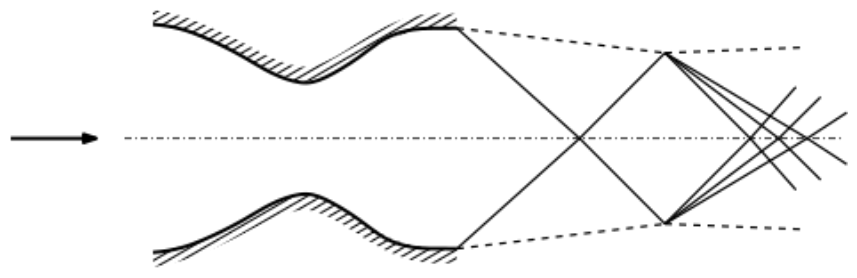
In the figure shown below, the flow at the nozzle exit is ______.

Question source image

A

overexpanded

B

underexpanded

C

ideally expanded

D

subsonic

Open complete paper
6
2026 · Aerospace Engineering · Aerodynamics · Compressible flows
Aerospace Engineering (AE) 2026
Which of the following statements is/are TRUE regarding critical and drag divergence Mach numbers of a wing?
A
Critical Mach number is the minimum freestream Mach number for which sonic condition is attained somewhere over the wing
B

Drag divergence Mach number is always higher than the critical Mach number

C
Drag divergence Mach number is the local Mach number over the wing at which the drag increases drastically
D

Critical Mach number is independent of the angle of attack

Open complete paper
7
2026 · Aerospace Engineering · Aerodynamics · Compressible flows
Aerospace Engineering (AE) 2026
A flow is steady, inviscid and one-dimensional, with no shaft work or body forces. Which of the following is/are possible under the given conditions?
A

Oblique shocks

B

Sound propagation

C

Rayleigh flow

D

Fanno flow

Open complete paper
8
2026 · Aerospace Engineering · Aerodynamics · Compressible flows
Aerospace Engineering (AE) 2026
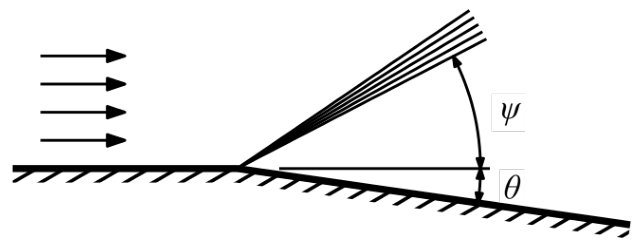
Consider a centered Prandtl-Meyer expansion fan at a \(\theta = 4^\circ\) corner in a Mach 1.78 air flow, as shown in the figure below. The angle \(\psi\) (see figure) made by the ending wave of the fan with respect to the incoming stream is __________ degrees (rounded off to 1 decimal place).
An excerpt from the table of Prandtl-Meyer function for air is provided below.
\(M\)\(\nu\) [deg]\(M\)\(\nu\) [deg]\(M\)\(\nu\) [deg]
1.7218.401.8221.301.9224.15
1.7418.981.8421.881.9424.71
1.7619.561.8622.451.9625.27
1.7820.151.8823.021.9825.83
1.8020.731.9023.592.0026.38

Question source image

Enter a numerical response
Open complete paper
9
2026 · Aerospace Engineering · Aerodynamics · Compressible flows
Aerospace Engineering (AE) 2026
A Mach 1.5 air flow enters a round duct of length 20 cm and diameter 3 cm. If the flow exits with Mach number 1.1, the average Fanning friction factor \(f\) of the duct is __________ \(\times 10^{-3}\) (rounded off to 1 decimal place).
An excerpt from the Fanno flow table for air is given below.
\(M\)1.11.21.31.41.51.6
\(\frac{4fL^*}{D} \times 10^4\)99.35336.4648.3997.413611724
Enter a numerical response
Open complete paper