My Cart
Your Cart 0

    Your cart is empty.

  • Total (Amount) ₹0.00
Previous year question hub

Airfoils and wings - Aerodynamics - Aerospace Engineering Previous Year Questions

Practice Airfoils and wings - Aerodynamics - Aerospace Engineering previous year questions organised from real papers, with year-wise coverage and clear topic navigation.

2Papers
2Years
11Questions
1Topics

Airfoils and wings question pattern

Every graph below is calculated only from this selection.

Questions by year

Year-wise coverage for Airfoils and wings. Each bar uses a separate theme-derived color.

Difficulty distribution

How the classified questions are distributed by difficulty.

Medium 8 72.7%
Easy 3 27.3%

Question type distribution

MCQ, numerical, multiple-select and other formats found in these papers.

Multiple Choices 6 54.5%
Numerical Answer Type (NAT) 5 45.5%

Subject weightage

Top subjects by unique question coverage.

Aerospace Engineering
11 Qs

Most asked topics

Top topics across the included previous year papers.

Aerodynamics
11 Qs

Subtopic coverage

Top subtopics inside this exact selection.

Airfoils and wings
11 Qs

Paper coverage

Question coverage for the most populated papers. Every active PYP paper remains listed below.

Aerospace Engineering (AE) 2026
7 Qs
Aerospace Engineering (AE) 2025
4 Qs

Included previous year papers

Newest papers appear first. Sort by year, question coverage or name.

PaperYear / sessionQuestions in this viewOpen
Aerospace Engineering (AE) 202620267View paper
Aerospace Engineering (AE) 202520254View paper

All Airfoils and wings previous year questions

Practice every matching question in batches of 20, with every available option.

1
2025 · Aerospace Engineering · Aerodynamics · Airfoils and wings
Aerospace Engineering (AE) 2025
For a NACA 4415 airfoil, the location of maximum camber, as a fraction of the chord length from the leading edge, is _____.
A
0.44
B
0.40
C
0.15
D
0.04
Open complete paper
2
2025 · Aerospace Engineering · Aerodynamics · Airfoils and wings
Aerospace Engineering (AE) 2025
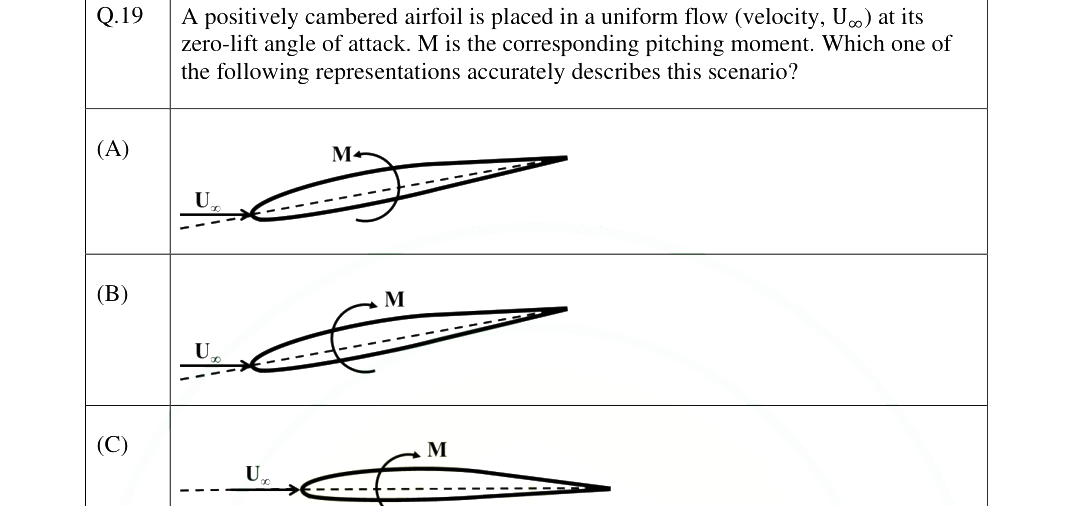
A positively cambered airfoil is placed in a uniform flow (velocity, \(U_\infty\)) at its zero-lift angle of attack. M is the corresponding pitching moment. Which one of the following representations accurately describes this scenario?

Question diagram

A
The airfoil with \(U_\infty\) to the left, moment M counterclockwise.

Option A diagram

B
The airfoil with \(U_\infty\) to the left, moment M clockwise.

Option B diagram

C
The airfoil with \(U_\infty\) to the left, moment M counterclockwise, lower surface curved.

Option C diagram

D
The airfoil with \(U_\infty\) to the left, moment M clockwise, lower surface curved.

Option D diagram

Open complete paper
3
2025 · Aerospace Engineering · Aerodynamics · Airfoils and wings
Aerospace Engineering (AE) 2025
A lifting surface has a spanwise circulation distribution of \(\Gamma(\theta) = A \sin 3\theta\) (where \(A \neq 0\)) over its span \(-\frac{b}{2} \le y \le \frac{b}{2}\) and \(y = -\frac{b}{2} \cos \theta\) is the spanwise coordinate. Furthermore, the downwash varies along the span as \(w(\theta) = V_\infty \left(\frac{3A \sin 3\theta}{b \sin \theta}\right)\), where \(V_\infty\) is the freestream velocity. Which one of the following options represents the total lift (\(L\)) and induced drag (\(D_i\))?
A
\(L = 0\) and \(D_i = 0\)
B
\(L = 0\) and \(D_i \neq 0\)
C
\(L \neq 0\) and \(D_i = 0\)
D
\(L \neq 0\) and \(D_i \neq 0\)
Open complete paper
4
2025 · Aerospace Engineering · Aerodynamics · Airfoils and wings
Aerospace Engineering (AE) 2025
A rectangular wing of 1.2 m chord length and aspect ratio 5 is tested in a wind tunnel at an air speed of 60 m/s. The density and the dynamic viscosity of air are 1.3 kg/m³ and 1.8×10⁻⁵ kg/m-s, respectively. A second rectangular wing of the same span, but with an aspect ratio of 6, is to be tested in the same tunnel at the same Reynolds number. The air speed at which the second test should be performed is ____ m/s (answer in integer).
Enter a numerical response
Open complete paper
5
2026 · Aerospace Engineering · Aerodynamics · Airfoils and wings
Aerospace Engineering (AE) 2026
The fundamental purpose of the Kutta condition in the thin airfoil theory is ______.
A

to determine the total strength of the source distribution

B

to determine the speed of the uniform flow

C

to incorporate the essential effect of viscosity in the potential flow theory

D

to incorporate the concept of induced drag in the inviscid theory

Open complete paper
6
2026 · Aerospace Engineering · Aerodynamics · Airfoils and wings
Aerospace Engineering (AE) 2026
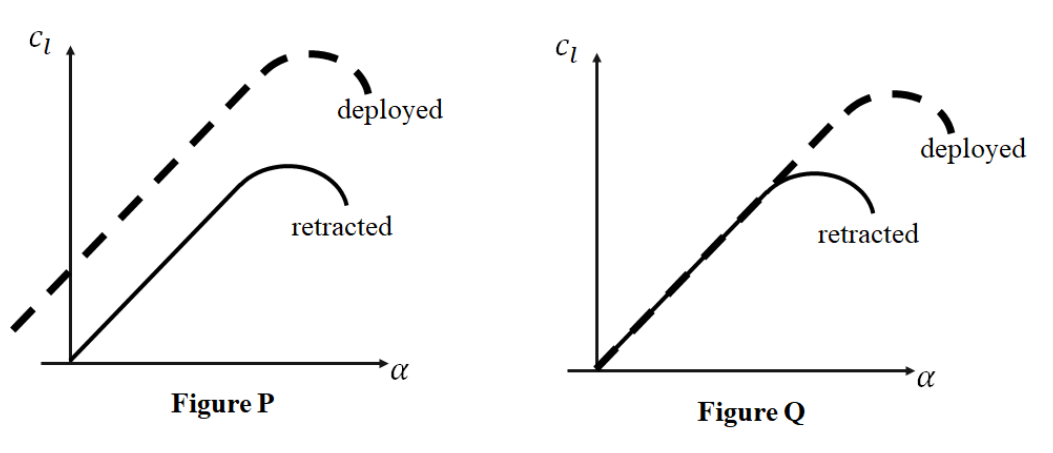
Shown below are qualitative illustrations of the lift curve for an airfoil when two different control surfaces are in their respective retracted and deployed configurations. Which of the following is/are TRUE?

Question source image

A

Figure P is for a flap

B

Figure P is for a slat

C

Figure Q is for a slat

D

Figure Q is for a flap

Open complete paper
7
2026 · Aerospace Engineering · Aerodynamics · Airfoils and wings
Aerospace Engineering (AE) 2026
An elliptic wing has a span of 6 m and a planform area of 6 m². When generating a lift coefficient of 0.6, the induced drag it incurs is _______ × 10⁻³ (rounded off to 1 decimal place).
Enter a numerical response
Open complete paper
8
2026 · Aerospace Engineering · Aerodynamics · Airfoils and wings
Aerospace Engineering (AE) 2026
What is/are the use(s) of the single horseshoe vortex model of finite wing aerodynamic theory?
A

It can approximate the wing pitching moment coefficient

B

It can approximate the wing induced drag coefficient

C
It can approximate the effect of the wing on the induced drag coefficient of a typical horizontal tail
D
It can approximate the aerodynamic benefit/penalty of formation flight compared to isolated flight
Open complete paper
9
2026 · Aerospace Engineering · Aerodynamics · Airfoils and wings
Aerospace Engineering (AE) 2026
For an airfoil section the pitching moment coefficient is determined about a reference point that is 0.3 times the chord behind the leading edge. It varies with the lift coefficient as shown in the table below. The distance of the aerodynamic center from the leading edge of the airfoil as a fraction of the chord is __________ (rounded off to one decimal place).
\( c_l \)0.20.40.60.8
\( c_m \)\( -0.02 \)00.020.04
Enter a numerical response
Open complete paper
10
2026 · Aerospace Engineering · Aerodynamics · Airfoils and wings
Aerospace Engineering (AE) 2026
Consider a finite wing of aspect ratio 10 with span effectiveness factor 0.95. Its airfoil section has a lift slope of 0.106 per degree and a zero-lift angle of attack of \( -1.5° \). The lift coefficient of the wing at an angle of attack of 3.5° is __________ (rounded off to 2 decimal places).
Enter a numerical response
Open complete paper
11
2026 · Aerospace Engineering · Aerodynamics · Airfoils and wings
Aerospace Engineering (AE) 2026
Thin airfoil theory predicts the zero-lift angle of attack \(\alpha_{L=0}\) of NACA 2412 airfoil as −2.1°. The corresponding prediction of \(\alpha_{L=0}\) for NACA 5410 airfoil is __________ degrees (rounded off to 1 decimal place).
Enter a numerical response
Open complete paper