Exam Details
JEE MAIN 2025 ONLINE 28TH JANUARY MORNING SHIFT
Review the key details, then start the test when you are ready. You can also open the full package to see related papers.
Questions
75
Duration
180 mins
Package
IIT-JEE Main - Previous Year Papers
Paper pattern & analysis
Filter this paper by subject, topic or subtopic. Every graph updates from the selected questions.
Topic distribution
Subtopic distribution
Difficulty distribution
75questions
Medium
54
72%
Easy
14
18.7%
Hard
7
9.3%
Question type distribution
75questions
Multiple Choices
60
80%
Numerical Answer Type (NAT)
15
20%
Syllabus
Full Syllabus
Sample questions from this paper
Questions are selected across the paper subjects wherever the paper contains that variety.
2025 · Physics · Mechanics · Rotational Motion
JEE MAIN 2025 ONLINE 28TH JANUARY MORNING SHIFT
Two iron solid discs of negligible thickness have radii $R_1$ and $R_2$ and moment of intertia $I_1$ and $I_2$, respectively. For $R_2=2 R_1$, the ratio of $I_1$ and $I_2$ would be $1 / x$, where $\mathrm{x}=$ _______ .
Enter a numerical response
2025 · Chemistry · Inorganic Chemistry · Periodic Table And Periodicity
JEE MAIN 2025 ONLINE 28TH JANUARY MORNING SHIFT
Consider the following elements $\mathrm{In}, \mathrm{Tl}, \mathrm{Al}, \mathrm{Pb}, \mathrm{Sn}$ and Ge . The most stable oxidation states of elements with highest and lowest first ionisation enthalpies, respectively, are
2025 · Mathematics · Algebra · Binomial Theorem
JEE MAIN 2025 ONLINE 28TH JANUARY MORNING SHIFT
If $\alpha=1+\sum\limits_{r=1}^6(-3)^{r-1} \quad{ }^{12} \mathrm{C}_{2 r-1}$, then the distance of the point $(12, \sqrt{3})$ from the line $\alpha x-\sqrt{3} y+1=0$ is ________.
Enter a numerical response
2025 · Physics · Mechanics · Rotational Motion
JEE MAIN 2025 ONLINE 28TH JANUARY MORNING SHIFT
The moment of inertia of a solid disc rotating along its diameter is 2.5 times higher than the moment of inertia of a ring rotating in similar way. The moment of inertia of a solid sphere which has same radius as the disc and rotating in similar way, is $n$ times higher than the moment of inertia of the given ring. Here, $\mathrm{n}=$ ________ Consider all the bodies have equal masses.
Enter a numerical response
2025 · Chemistry · Organic Chemistry · Haloalkanes And Haloarenes
JEE MAIN 2025 ONLINE 28TH JANUARY MORNING SHIFT
Consider the following sequence of reactions:
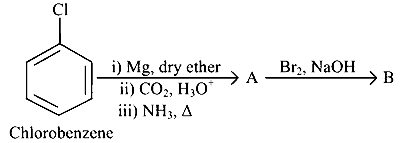
11.25 mg of chlorobenzene will produce ___________$\times 10^{-1} \mathrm{mg}$ of product B.
(Consider the reactions result in complete conversion.)
[Given molar mass of $\mathrm{C}, \mathrm{H}, \mathrm{O}, \mathrm{N}$ and Cl as $12,1,16,14$ and $35.5 \mathrm{~g} \mathrm{~mol}^{-1}$ respectively]
Enter a numerical response
2025 · Mathematics · Coordinate Geometry · Ellipse
JEE MAIN 2025 ONLINE 28TH JANUARY MORNING SHIFT
Let $\mathrm{E}_1: \frac{x^2}{9}+\frac{y^2}{4}=1$ be an ellipse. Ellipses $\mathrm{E}_{\mathrm{i}}$ 's are constructed such that their centres and eccentricities are same as that of $\mathrm{E}_1$, and the length of minor axis of $\mathrm{E}_{\mathrm{i}}$ is the length of major axis of $E_{i+1}(i \geq 1)$. If $A_i$ is the area of the ellipse $E_i$, then $\frac{5}{\pi}\left(\sum\limits_{i=1}^{\infty} A_i\right)$, is equal to _______.
Enter a numerical response