Exam Details
JEE MAIN 2025 ONLINE 23RD JANUARY MORNING SHIFT
Review the key details, then start the test when you are ready. You can also open the full package to see related papers.
Questions
75
Duration
180 mins
Package
IIT-JEE Main - Previous Year Papers
Paper pattern & analysis
Filter this paper by subject, topic or subtopic. Every graph updates from the selected questions.
Topic distribution
Subtopic distribution
Difficulty distribution
75questions
Medium
52
69.3%
Easy
18
24%
Hard
5
6.7%
Question type distribution
75questions
Multiple Choices
60
80%
Numerical Answer Type (NAT)
15
20%
Syllabus
Full Syllabus
Sample questions from this paper
Questions are selected across the paper subjects wherever the paper contains that variety.
2025 · Mathematics · Trigonometry · Trigonometric Ratio And Identites
JEE MAIN 2025 ONLINE 23RD JANUARY MORNING SHIFT
The value of $\left(\sin 70^{\circ}\right)\left(\cot 10^{\circ} \cot 70^{\circ}-1\right)$ is
2025 · Physics · Modern Physics · Atoms And Nuclei
JEE MAIN 2025 ONLINE 23RD JANUARY MORNING SHIFT
A radioactive nucleus $\mathrm{n}_2$ has 3 times the decay constant as compared to the decay constant of another radioactive nucleus $n_1$. If initial number of both nuclei are the same, what is the ratio of number of nuclei of $n_2$ to the number of nuclei of $n_1$, after one half-life of $n_1$ ?
2025 · Chemistry · Organic Chemistry · Compounds Containing Nitrogen
JEE MAIN 2025 ONLINE 23RD JANUARY MORNING SHIFT
Consider the following sequence of reactions to produce major product (A)
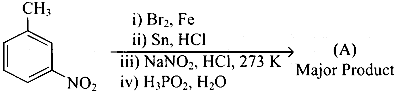
$\begin{aligned} & \text { Molar mass of product }(\mathrm{A}) \text { is } \mathrm{g} \mathrm{~mol}^{-1} \text {. } \\ & \text { (Given molar mass in } \mathrm{g} \mathrm{~mol}^{-1} \text { of } \mathrm{C}: 12, \mathrm{H}: 1, \mathrm{O}: 16, \mathrm{Br}: 80, \mathrm{~N}: 14, \mathrm{P}: 31 \text { ) }\end{aligned}$
Enter a numerical response
2025 · Mathematics · Algebra · Quadratic Equation And Inequalities
JEE MAIN 2025 ONLINE 23RD JANUARY MORNING SHIFT
If the equation $\mathrm{a}(\mathrm{b}-\mathrm{c}) \mathrm{x}^2+\mathrm{b}(\mathrm{c}-\mathrm{a}) \mathrm{x}+\mathrm{c}(\mathrm{a}-\mathrm{b})=0$ has equal roots, where $\mathrm{a}+\mathrm{c}=15$ and $\mathrm{b}=\frac{36}{5}$, then $a^2+c^2$ is equal to _________
Enter a numerical response
2025 · Physics · Electricity · Electrostatics
JEE MAIN 2025 ONLINE 23RD JANUARY MORNING SHIFT
A positive ion $A$ and a negative ion $B$ has charges $6.67 \times 10^{-19} \mathrm{C}$ and $9.6 \times 10^{-10} \mathrm{C}$, and masses $19.2 \times 10^{-27} \mathrm{~kg}$ and $9 \times 10^{-27} \mathrm{~kg}$ respectively. At an instant, the ions are separated by a certain distance $r$. At that instant the ratio of the magnitudes of electrostatic force to gravitational force is $\mathrm{P} \times 10^{-13}$, where the value of P is _________.
(Take $\frac{1}{4 \pi \varepsilon_0}=9 \times 10^9 \mathrm{Nm}^2 \mathrm{C}^{-1}$ and universal gravitational constant as $6.67 \times 10^{-11} \mathrm{Nm}^2 \mathrm{~kg}^{-2}$ )
Enter a numerical response
2025 · Chemistry · Physical Chemistry · Chemical Kinetics And Nuclear Chemistry
JEE MAIN 2025 ONLINE 23RD JANUARY MORNING SHIFT
For the thermal decomposition of $\mathrm{N}_2 \mathrm{O}_5(\mathrm{~g})$ at constant volume, the following table can be formed, for the reaction mentioned below.
$$2 \mathrm{~N}_2 \mathrm{O}_5(\mathrm{~g}) \rightarrow 2 \mathrm{~N}_2 \mathrm{O}_4(\mathrm{~g})+\mathrm{O}_2(\mathrm{~g})$$
| Sr. No. | Time/s | Total pressure/(atm) |
|---|---|---|
| 1 | 0 | 0.6 |
| 2 | 100 | '$\mathrm{x}$' |
$\mathrm{x}=$ __________ $\times 10^{-3} \mathrm{~atm}$ [nearest integer]
Given : Rate constant for the reaction is $4.606 \times 10^{-2} \mathrm{~s}^{-1}$.
Enter a numerical response