My Cart
Your Cart 0

    Your cart is empty.

  • Total (Amount) ₹0.00
NCERT Exemplar · Class 12 · Chemistry

Chapter 4: Chemical Kinetics

Practice each question, then open the answer or worked solution.

below?

40 questions
Q33Written answer

State a condition under which a bimolecular reaction is a kinetically first-order

reaction.

Show solutionHide solution
Worked solution

A condition under which the order of a chemical reaction can be altered is by taking the solvent or the reactant in the excess amount due to which its concentration does not change much.

Consider a bimolecular reaction

A + B → Product

Rate = k[A][B]

When concentration B is large rate becomes k’[A]

Where k’=k[B]

The order of the reaction will be equal to one.
Q34Written answer

Write the rate equation for the reaction 2A + B → C if the order of the reaction is zero.

Show solutionHide solution
Worked solution

The rate equation for the reaction 2A + B → C

Rate = k[A]0[B]0

The powers of the concentration of the reactants will be equal to zero. In the zero-order reactions, the rate of the equation is equal to the rate constant.

Q35Written answer

How can you determine the rate law of the following reaction?

2NO (g) + O2 (g) → 2NO2 (g)

Show solutionHide solution
Worked solution

The rate of the reaction can be determined by

Rate = k[NO]2[O2]1

It can be measured by the rate of the reaction as a function of initial concentration by keeping the concentration of one of the reactants constant and changing the other reactant.

Q36Written answer

For which type of reactions, order and molecularity have the same value?

Show solutionHide solution
Worked solution

For an elementary reaction, the order is the same as molecularity. Elementary reactions are those reactions which occur in a single step.

Q37Written answer

In a reaction, if the concentration of reactant A is tripled, the rate of reaction becomes twenty-seven times. What is the order of the reaction?

Show solutionHide solution
Worked solution

Consider a rate of a reaction with reactant A

Rate = k[A]α

27 ˟ Rate = k[A]α

By dividing the equations we get α = 3

Therefore the order of the reaction becomes three.

Q38Written answer

Derive an expression to calculate the time required for completion of the zero-order reaction.

Show solutionHide solution
Worked solution

Consider a reaction,

R → P t=0

Here R is the reactant and P is the product.

Rate = k[R]0 t=t

(Instantaneous rate) –dR/dt = k , dR =-kdt

On integrating both sides,

ʃDr = -k ʃdt

At t = 0,

000

Here [R] = concentration of reactant at time ‘t’.

0

This reaction is known as the integrated rate equation of zero order.

After completion of zero order reaction [R]= 0

Using [R]= 0 in (i)

0

t=[R0]/k

Q39Written answer

For a reaction A + B → Products, the rate law is — Rate = k [A][B]3/2 Can the reaction be an elementary reaction? Explain.

Show solutionHide solution
Worked solution

The reaction cannot be an elementary reaction because the order is different. For an elementary reaction, the molecularity and order should be the same.

Q40Written answer

For a certain reaction large fraction of molecules has energy more than the threshold energy, yet the rate of reaction is very slow. Why?

Show solutionHide solution
Worked solution

The two most important conditions for a reaction to occur according to the collision theory are:

1. Energy is greater than activation energy and proper orientation of reactant molecules at the time of the collision.

So when the reaction occurs then molecules that don’t have a proper orientation decreases the rate of a reaction.

Q41Written answer

For a zero-order reaction will the molecularity be equal to zero? Explain.

Show solutionHide solution
Worked solution

The molecularity of any reaction is the number of reacting species taking part in an elementary reaction. The zero molecularity means there is no reactant so the reaction does not occur. Therefore molecularity cannot be zero for a reaction.

Q42Written answer

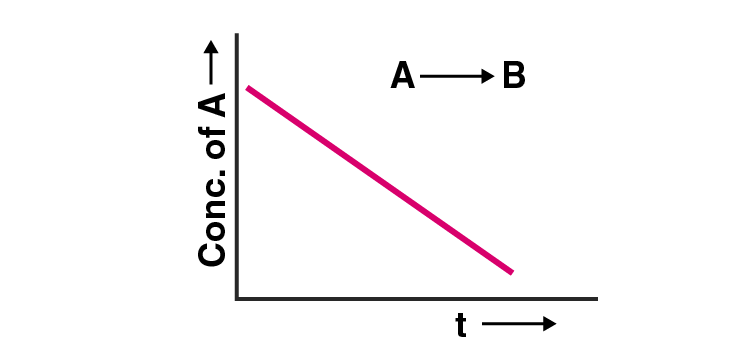
For a general reaction A → B, plot of concentration of A vs time is given in

Fig. 4.3. Answer the following question based on this graph.

(i) What is the order of the reaction?

(ii) What is the slope of the curve?

(iii) What are the units of the rate constant?

NCERT Exemplar Solutions of Class 12 Chemistry Chapter 4 Chemical Kinetics-9

Show solutionHide solution
Worked solution

(i) It is a zero-order reaction as the graph is satisfying the equation [A] = [A0] – kt.

(ii) The slope of the curve is the negative of the rate constant that is denoted by –k.

(iii) Unit of the rate constant is Ms-1 or mol L-1s-1.