My Cart
Your Cart 0

    Your cart is empty.

  • Total (Amount) ₹0.00
NCERT Exemplar · Class 12 · Chemistry

Chapter 4: Chemical Kinetics

Practice each question, then open the answer or worked solution.

below?

40 questions
Q23Written answer

In any unimolecular reaction ______________.

(i) only one reacting species is involved in the rate-determining step.

(ii) the order and the molecularity of the slowest step are equal to one.

(iii) the molecularity of the reaction is one and order is zero.

(iv) both molecularity and order of the reaction are one.

Show solutionHide solution
Worked solution

Option (i) and (ii) is the answer.
Q24Written answer

For a complex reaction ______________.

(i) order of an overall reaction is the same as molecularity of the slowest step.

(ii) order of an overall reaction is less than the molecularity of the slowest

step.

(iii) order of an overall reaction is greater than molecularity of the slowest step.

(iv) the molecularity of the slowest step is never zero or non-integer.

Show solutionHide solution
Worked solution

Option (i) and (iv) are the answers.

Q25Written answer

At high pressure, the following reaction is zero order.

2NH3(g) →1130 K Platinum catalyst N2(g) + 3H2(g)

Which of the following options are correct for this reaction?

(i) Rate of reaction = Rate constant

(ii) Rate of the reaction depends on the concentration of ammonia.

(iii) Rate of decomposition of ammonia will remain constant until ammonia

disappears completely.

(iv) Further increase in pressure will change the rate of reaction.

Show solutionHide solution
Worked solution

Option (i), (iii) and (iv) are the answers.

Q26Written answer

During decomposition of an activated complex

(i) energy is always released

(ii) energy is always absorbed

(iii) energy does not change

(iv) reactants may be formed

Show solutionHide solution
Worked solution

Option (i) and (iv) are the answers.

Q27Written answer

According to Maxwell Boltzmann distribution of energy, __________.

(i) the fraction of molecules with most probable kinetic energy decreases

at higher temperatures.

(ii) the fraction of molecules with most probable kinetic energy increases

at higher temperatures.

(iii) most probable kinetic energy increases at higher temperatures.

(iv) most probable kinetic energy decreases at higher temperatures.

Show solutionHide solution
Worked solution

Option (i) and (iii) are the answers.

Q28Written answer

In the graph showing Maxwell Boltzman distribution of energy, ___________.

(i) the area under the curve must not change with an increase in temperature.

(ii) the area under the curve increases with increase in temperature.

(iii) the area under the curve decreases with increase in temperature.

(iv) with the increase in the temperature, curve broadens and shifts to the right-hand side.

Show solutionHide solution
Worked solution

Option (i) and (iv) are the answers.

Q29Multiple choice

Which of the following statements are in accordance with the Arrhenius

equation?

Option (i) and (ii) are the answers.

Show solutionHide solution
Worked solution

Solution coming soon.

Q30Multiple choice

Mark the incorrect statements.

Show answerHide answer
Correct option: B
Show solutionHide solution
Worked solution

Option (ii) and (iv) are the answers.

Q31Written answer

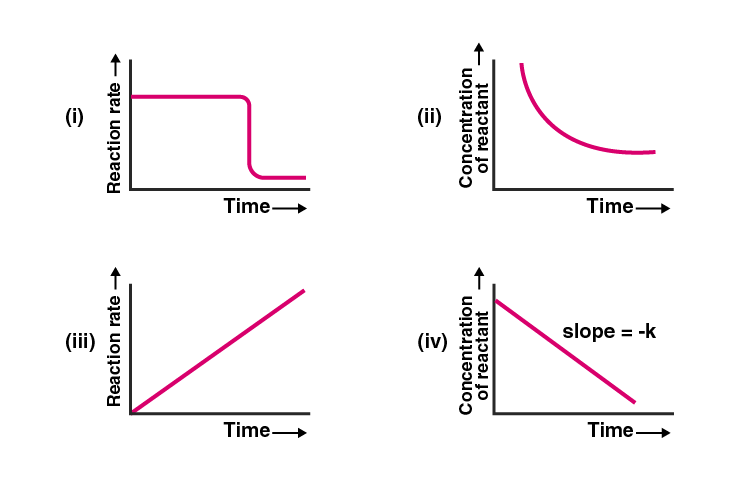
Which of the following graphs is correct for a zero-order reaction?

NCERT Exemplar Solutions of Class 12 Chemistry Chapter 4 Chemical Kinetics-7

Show solutionHide solution
Worked solution

Option (ii) and (iv) are the answers.

Q32Written answer

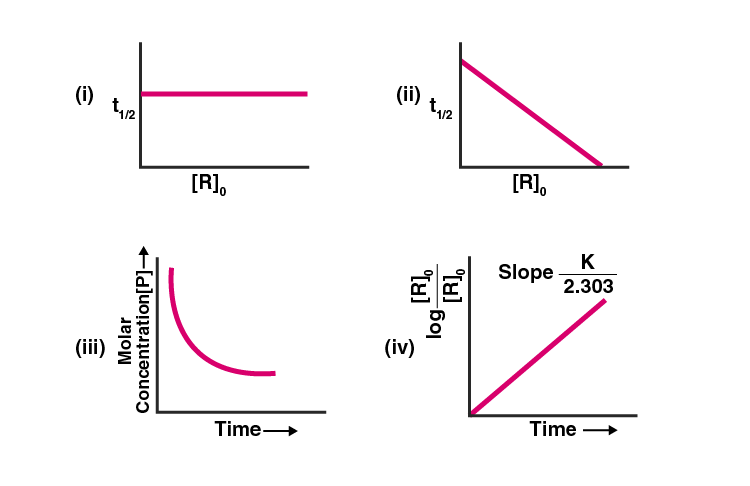
Which of the following graphs is correct for a first-order reaction?

NCERT Exemplar Solutions of Class 12 Chemistry Chapter 4 Chemical Kinetics-8

Show solutionHide solution
Worked solution

Option (i) and (iv) are the answers.

III. Short Answer Type