Q13Multiple choice
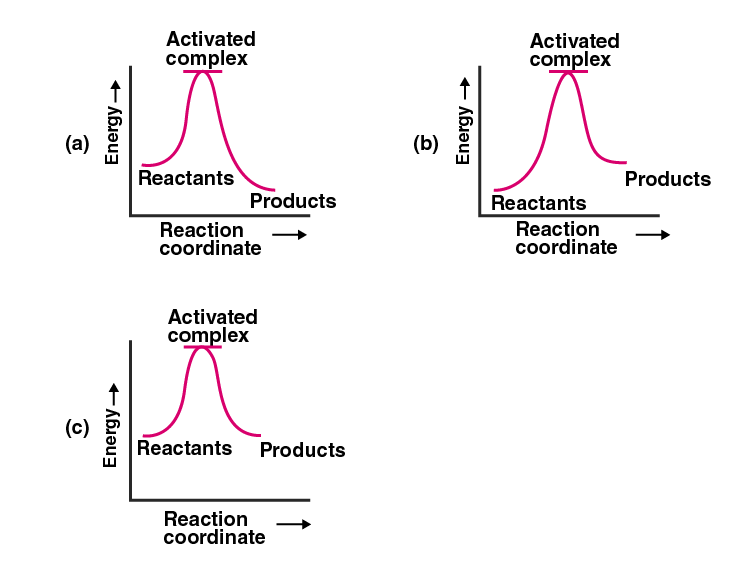
Which of the following graph represents the exothermic reaction?
Show answerHide answer
Correct option: A
Show solutionHide solution
Worked solution
Option (i) is the answer.
Your cart is empty.
Practice each question, then open the answer or worked solution.
Which of the following graph represents the exothermic reaction?
Option (i) is the answer.
The rate law for the reaction A + 2B → C is found to be
Rate = k [A][B]
The concentration of reactant ‘B’ is doubled, keeping the concentration of ‘A’
constant, the value of rate constant will be______.
(i) the same
(ii) doubled
(iii) quadrupled
(iv) halved
Option (i) is the answer.
Which of the following statements is incorrect about the collision theory of
chemical reaction?
their structural features.
results into the product formation.
orientation for the collision to be effective.
Option (iii) is the answer.
A first-order reaction is 50% completed in 1.26 × 10¹⁴ s. How much time
would it take for 100% completion?
(i) 1.26 × 10¹⁵ s
(ii) 2.52 × 10¹⁴ s
(iii) 2.52 × 1028 s
(iv) infinite
Option (iv) is the answer.
Compounds ‘A’ and ‘B’ react according to the following chemical equation.
A (g) + 2 B (g) → 2C (g)
The concentration of either ‘A’ or ‘B’ was changed keeping the concentrations of
one of the reactants constant and rates were measured as a function of initial
concentration. Following results were obtained. Choose the correct option for
the rate equations for this reaction.
| Experiment | Initial Concentration of [A]/ molL-1 | Initial concentration of [B]/ molL-1 | Initial rate concentration of [C]/molL-1S-1 |
| 1
2 3 |
0.30
0.30 0.60 |
0.30
0.60 0.30 |
0.10
0.40 0.20 |
(i) Rate = k [A]2[B]
(ii) Rate = k [A] [B]2
(iii) Rate = k [A] [B]
(iv) Rate = k [A]2[B]0
Option (ii) is the answer.
Which of the following statement is not correct for the catalyst?
reaction.
between reactants and products.
Option (ii) is the answer.
The value of rate constant of a pseudo first order reaction ____________.
(i) depends on the concentration of reactants present in a small amount.
(ii) depends on the concentration of reactants present in excess.
(iii) is independent of the concentration of reactants.
(iv) depends only on temperature.Solution:
Option (ii) is the answer.
Solution coming soon.
Consider the reaction A B. The concentration of both the reactants and
the products varies exponentially with time. Which of the following figures
correctly describes the change in concentration of reactants and products
with time?
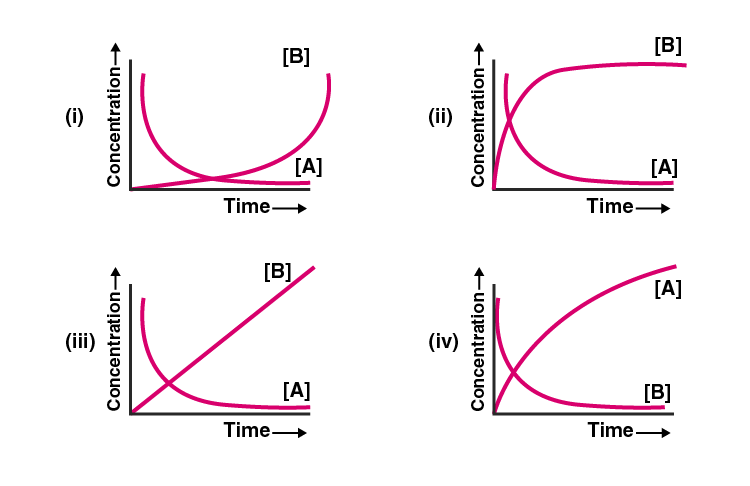
Option (ii) is the answer.
II. Multiple Choice Questions (Type-II)
Note: In the following questions two or more options may be correct.
21. Rate law cannot be determined from the balanced chemical equation if _______.
Option (i), (iii) and (iv) are the answers.
Which of the following statements apply to a balanced chemical
equation of an elementary reaction?
Option (i) and (iv) are the answers.