My Cart
Your Cart 0

    Your cart is empty.

  • Total (Amount) ₹0.00
NCERT Exemplar · Class 12 · Chemistry

Chapter 3: Electrochemistry

Practice each question, then open the answer or worked solution.

II. Multiple Choice Questions (Type-II)

32 questions
Q28Written answer

Can absolute electrode potential of an electrode be measured?

Show solutionHide solution
Worked solution

No. It cannot be measured. We can only measure the difference in electrode potential between the two half-cells. We can also measure electrode potential difference concerning a standard electrode.
Q29Written answer

Can E°cell or ΔrG° for cell reaction ever be equal to zero?

Show solutionHide solution
Worked solution

E° Cell or ∆r G° can never be equal to zero. The only standard electrode potential which is arbitrarily assigned the value zero is the standard hydrogen electrode (SHE). Since everything else is measured concerning SHE; the E° cell can never be zero.

Q30Written answer

Under what condition is ECell = 0 or ΔrG = 0?

Show solutionHide solution
Worked solution

Electrolysis happens when a redox reaction occurs. Like all reactions, redox reaction to moves towards equilibrium. At equilibrium condition, the cell has discharged completely, and cell potential drops to zero.

∆rG= -nF E cell =0

Q31Written answer

What does the negative sign in the expression E°Zn2+/Zn = -0.76V mean?

Show solutionHide solution
Worked solution

A negative value is that hydrogen gas is more stable than the reduced form of species. Here, the reduced form (Zn) is not stable. It is difficult to reduce Zn2+ to Zn. So, the reverse is more likely to happen. Zn would rather get oxidized to Zn2+ and H+ will get reduced

Q32Written answer

Aqueous copper sulphate solution and aqueous silver nitrate solution are electrolysed by 1 ampere current for 10 minutes in separate electrolytic cells. Will, the mass of copper and silver, deposited on the cathode be the same or different? Explain your answer.

Show solutionHide solution
Worked solution

W= itE/96500

= 1×10×60×31.75/96500

Equivalent mass of Cu2+ is different from the equivalent mass of Ag+ so obviously the mass of copper deposited will not be the same as the mass of silver deposited.

Q33Written answer

Depict the galvanic cell in which the cell reaction is Cu + 2Ag+→ 2Ag + Cu2+

Show solutionHide solution
Worked solution

Anode- Oxidation half-cell: Cu → Cu2+ + 2e-

Cathode- Reduction half-cell: 2Ag+ + 2e- →2Ag

Overall reaction : Cu + 2Ag+→ Cu2+ + 2Ag

Cu|Cu2+(aq,1M) || Ag+(aq, 1M)| Ag

Q34Written answer

Value of standard electrode potential for the oxidation of Cl– ions is more positive than that of water, even then in the electrolysis of aqueous sodium chloride, why is Cl–oxidised at anode instead of water?

Show solutionHide solution
Worked solution

The oxidation of water to oxygen is kinetically unfavourable and requires excess potential called over-potential. Over-potential is the excess potential required to drive a reaction at a particular rate.

Q35Written answer

What is electrode potential?

Show solutionHide solution
Worked solution

The potential difference developed between an electrode and electrolyte is called the electrode potential.

Standard electrode potential will be always reduction potential.

Q36Written answer

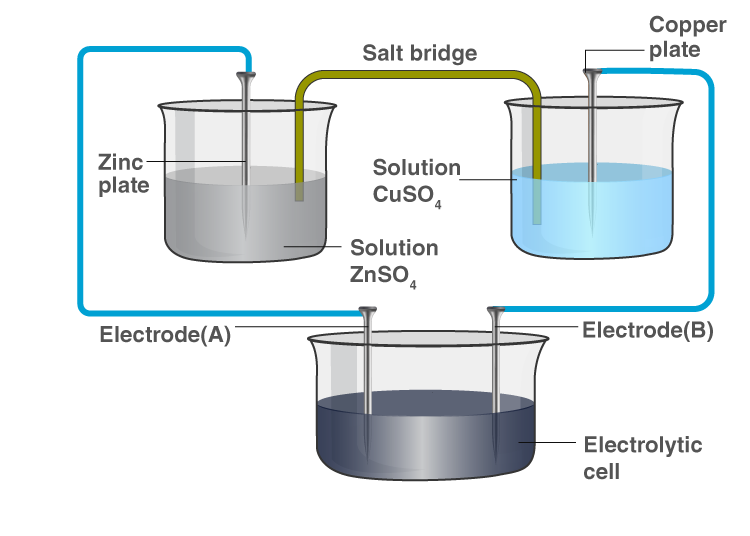
Consider the following diagram in which an electrochemical cell is coupled to an electrolytic cell. What will be the polarity of electrodes ‘A’ and ‘B’ in the electrolytic cell?

NCERT Exemplar Solution of Class 12 Chemistry Chapter 3 Electrochemistry-2

Show solutionHide solution
Worked solution

Zinc goes into solution as Zn2+ and leaves behind the electrons on Electrode A making it negatively charged. Cu2+ from the solution deposits on Electrode B making it positively charged.

Electrode A polarity- negative

Electrode B polarity- positive.

Q37Written answer

Why is alternating current used for measuring the resistance of an electrolytic solution?

Show solutionHide solution
Worked solution

The alternating current keeps the concentration of ions constant whereas direct current changes the concentration of ions. That is why alternating current used for measuring the resistance of an electrolytic solution.