My Cart
Your Cart 0

    Your cart is empty.

  • Total (Amount) ₹0.00
NCERT Exemplar · Class 12 · Chemistry

Chapter 15: Polymers

Practice each question, then open the answer or worked solution.

Short Answer Questions

33 questions
Q40Written answer

Match the polymers given in Column I with their commercial names given in Column II.

Column I

Column II

i. Polyester of glycol and phthalic acid

a. Novolac

ii. Copolymer of 1,3-butadiene and styrene

b. Glyptal

iii. Phenol and formaldehyde resin

c. Buna-S

iv. Polyester of glycol and terephthalic acid

d. Buna-N

v. Copolymer of 1,3-butadiene and acrylonitrile

e. Dacron


Show solutionHide solution
Worked solution

Ans:  (i) Glyptal is formed by the condensation polymerization of polyester of glycol and phthalic acid.

Thus, option (i) from column I is matched with (b) from column II.

(ii) Buna-S is formed from the polymerization of styrene and 1,3-butadiene.

Thus, option (ii) from column I is matched with (c) from column II.

(iii) Novolac is formed as an intermediate in the formation of Bakelite. Bakelite is formed from formaldehyde and phenol.

Thus, option (iii) from column I is matched with (a) from column II.

(iv) Dacron is obtained from the polymerization of polyester of glycol and terephthalic acid.

Thus, option (iv) from column I is matched with (e) from column II.

(v) Buna-N is formed from the polymerization of 1,3-butadiene and acrylonitrile.

Thus, option (v) from column I is matched with (d) from column II.

Q41Written answer

Match the polymers given in Column I with their main applications given in Column II

Column I

Column II

i. Bakelite

a. Unbreakable crockery

ii. LDP

b. Non-stick cookwares

iii. Melamine-formaldehyde resin

c. Packaging material for shock absorbance

iv. Nylon-6

d. Electrical switches

v. Poly tetrafluoro ethane

e. Squeeze bottles

vi. Polystyrene

f. Tyre, cords


Show solutionHide solution
Worked solution

Ans:  (i) Bakelite is used in making combs, electrical switches.

Thus, option (i) from column I is matched with (d) from column II.

(ii) LDP is used in the manufacture of squeezes bottles, toys etc.

Thus, option (ii) from column I is matched with (e) from column II.

(iii) Melamine formaldehyde resin is used in the manufacture of unbreakable crockery.

Thus, option (iii) from column I is matched with (a) from column II.

(iv) Nylon-6 is used in the manufacture of tyre, cords.

Thus, option (iv) from column I is matched with (f) from column II.

(v) Poly tetrafluoro ethane is used in the manufacture of non stick cookware items like pan, cooker.

Thus, option (v) from column I is matched with (b) from column II.

(vi) Polystyrene is used in the manufacture of packaging material.

Thus, option (vi) from column I is matched with (c) from column II.


Q42Written answer

Match the polymers given in Column I with the preferred mode of polymerisation followed by their monomers.

Column I

Column II

i. Nylon-6,6

a. Free radical polymerisation 

ii. PVC

b. Ziegler-Natta polymerisation or coordination polymerisation

iii. HDP

c. Anionic polymerisation


d. Condensation polymerisation


Show solutionHide solution
Worked solution

Ans: 

(i) Nylon-6,6 is obtained by the condensation polymerization of hexamethylenediamine with adipic acid at high pressure and temperature.

Thus, option (i) from column I is matched with (d) from column II.

(ii) Poly vinyl chloride is obtained by the free radical polymerisation.

Thus, option (ii) from column I is matched with (a) from column II.

(iii) When addition polymerisation of ethene takes place in a hydrocarbon solvent in the presence of a catalyst such as triethylaluminium and Ziegler-Natta catalyst at high temperature and pressure then high density polythene is formed.

Thus, option (iii) from column I is matched with (b) from column II.


Q43Written answer

Match the polymers given in Column I with the type of linkage present in them given in Column II.

Column I

Column II

i. Terylene

a. Glycosidic linkage

ii. Nylon

b. Ester linkage

iii. Cellulose

c. Phosphodiester linkage

iv. Protein

d. Amide linkage

v. RNA


Show solutionHide solution
Worked solution

Ans: 

(i) Terylene or Dacron have ester linkage.

Thus, option (i) from column I is matched with (b) from column II.

(ii) Nylon have amide linkage present in them.

Thus, option (ii) from column I is matched with (d) from column II.

(iii) Cellulose is stored by plants. It contains glycosidic linkage.

Thus, option (iii) from column I is matched with (a) from column II.

(iv) Proteins contains amide linkage.

Thus, option (iv) from column I is matched with (d) from column II.

(v) RNA contains phosphate, sugar and base. They contains phosphodiester linkage.

Thus, option (v) from column I is matched with (c) from column II.


Q44Written answer

Match materials given in Column I with the polymers given in Column II.

Column I

Column II

i. Natural rubber latex

a. Nylon

ii. Wood laminates

b. Neoprene

iii. Ropes and fibers

c. Dacron

iv. Polyester fabric

d. Melamine-formaldehyde resins

v. Synthetic rubber

e. Urea-formaldehyde resins

vi. Unbreakable crockery

f. cis-polyisoprene 


Show solutionHide solution
Worked solution

Ans: 

(i) Natural rubber is a linear polymer of isoprene units. It is also known as cis-polyisoprene.

Thus, option (i) from column I is matched with (f) from column II.

(ii) Urea formaldehyde resin is used in the manufature of wood laminates.

Thus, option (ii) from column I is matched with (e) from column II.

(iii) Nylon is used in making ropes and fibres.

Thus, option (iii) from column I is matched with (a) from column II.

(iv) Dacron is obtained from the polymerization of polyester of glycol and terphthalic acid.

Thus, option (iv) from column I is matched with (c) from column II.

(v) Neoprene is a type of synthetic rubber. It is formed by the free radical polymerisation of chloroprene.

Thus, option (v) from column I is matched with (b) from column II.

(vi) Melamine formaldehyde resin is used in the manufacture of unbreakable crockery.

Thus, option (vi) from column I is matched with (d) from column II.


Q45Written answer

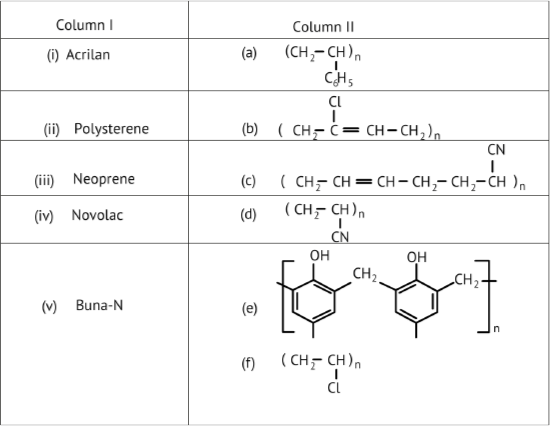
Match the polymers given in Column I with their repeating units given in Column II.


seo images

Show solutionHide solution
Worked solution

Ans: (i) Acrilan is formed by the addition polymerization of acrylonitrile in the presence of peroxide catalyst.

Thus, option (i) from column I is matched with (d) from column II.

(ii) Polystyrene is formed by the polymerization of styrene monomer.

Thus, option (ii) from column I is matched with (a) from column II.

(iii) Neoprene is a type of synthetic rubber. It is formed by the free radical polymerisation of chloroprene.

Thus, option (iii) from column I is matched with (b) from column II.

(iv) Novolac is formed as an intermediate in the formation of Bakelite. Bakelite is formed from formaldehyde and phenol.

Thus, option (iv) from column I is matched with (e) from column II.

(v) Buna-N is formed from the polymerization of 1,3-butadiene and acrylonitrile.

Thus, option (v) from column I is matched with (c) from column II.


Assertion and Reason Type

Note: In the following questions a statement of assertion followed by a statement of reason is given. Choose the correct answer out of the following choices.

(i) Assertion and reason both are correct statement but reason does not explain assertion.

(ii) Assertion and reason both are correct statements and reason explains the assertion. 

(iii) Both assertion and reason are wrong statement.

(iv) Assertion is correct statement and reason is wrong statement. 

(v) Assertion is wrong statement and reason is correct statement.


Q46Written answer

Assertion : Rayon is a semi synthetic polymer and is taken as a better choice than cotton fabric. Reason : Mechanical and aesthetic properties of cellulose can be improved by acetylation.

Show solutionHide solution
Worked solution

Ans:  (ii) Assertion and reason both are correct statements and reason explains the assertion.

Explanation:  Rayon is a semi synthetic polymer. It is preferred over cotton fabric because its properties are improved by acetylation.


Q47Written answer

Assertion : Most of the Synthetic polymers are not biodegradable. Reason : Polymerisation process induces toxic character in organic molecules.

Show solutionHide solution
Worked solution

Ans: (iv) Assertion is correct statement and reason is wrong statement. (v) Assertion is wrong statement and reason is correct statement.

Explanation:  Most of the Synthetic polymers are not biodegradable. A large number of the polymers are resistant to the degradation process of the environment and therefore, are responsible for the accumlation of polymeric solid waste material.


Q48Written answer

Assertion : Olefinic monomers undergo addition polymerisation. Reason : Polymerisation of vinylchloride is initiated by peroxides/ persulphates.

Show solutionHide solution
Worked solution

Ans: (i) Assertion and reason both are correct statement but reason does not explain assertion.

Explanation: Olefinic monomers undergo addition polymerisation. The molecules of the same monomer or different monomer are added together to form this type of polymer. This mode of polymerisation leads to an increase in chain length.


Q49Written answer

Assertion : Polyamides are best used as fibres because of high tensile strength. Reason : Strong intermolecular forces (like hydrogen bonding within polyamides) lead to close packing of chains and increase the crystalline character, hence, provide high tensile strength to polymers.

Show solutionHide solution
Worked solution

Ans: (ii) Assertion and reason both are correct statements and reason explains the assertion.

Explanation: Polyamides are best used as fibres because of high tensile strength. They have strongest intermolecular forces of attraction like hydrogen bonding. It lead to close packing of chains and increase the crystalline character.