My Cart
Your Cart 0

    Your cart is empty.

  • Total (Amount) ₹0.00
NCERT Exemplar · Class 12 · Chemistry

Chapter 15: Polymers

Practice each question, then open the answer or worked solution.

Textbook exercises

19 questions
Q11Written answer

Which of the following polymers are thermoplastic?

(A) Teflon

(B) Natural rubber

(C) Neoprene

(D) Polystyrene

Show solutionHide solution
Worked solution

Ans: Option (A) and (D)

Explanation:

Thermoplastic polymers are linear or slight branched-chain polymers. This type of polymer softens on heating and hardens on cooling. For example, Teflon and polystyrene are thermoplastic polymers.

So, options (A) and (D) are correct.

Q12Written answer

Which of the following polymers are used as fiber?

(A) Polytetrafluoroethane

(B) Polychloroprene

(C) Nylon

(D) Terylene

Show solutionHide solution
Worked solution

Ans: Option (C) and (D)

Explanation:

Fibers are thread-forming solids. They possess high tensile strength and high modulus. They have strong intermolecular forces of attraction like hydrogen bonding. Nylon and Terylene are used as fibers.


Q13Written answer

Which of the following are addition polymers?

(A) Nylon

(B) Melamine formaldehyde resin

(C) Orlon

(D) Polystyrene

Show solutionHide solution
Worked solution

Ans: Option (A) and (D)

Explanation:

The formation of addition polymers is accomplished through the repeated addition of monomer molecules with double or triple bonds, such as polythene from ethene and polypropene from propene. Homopolymers are addition polymers formed by the polymerisation of a single monomeric species. 


Q14Written answer

Which of the following polymers are condensation polymers?

(A) Bakelite

(B) Teflon

(C) Butyl rubber

(D) Melamine formaldehyde resin

Show solutionHide solution
Worked solution

Ans: Option (A) and (D)

Explanation:

Condensation polymers are formed by the addition of more than one monomeric unit. Bakelite and Melamine formaldehyde resin are condensation polymers. Bakelite is a polymer formed from phenol and formaldehyde. Melamine formaldehyde resin is a polymer formed from melamine and formaldehyde.


Q15Written answer

Which of the following monomers form biodegradable polymers?

(A) 3-hydroxybutanoic acid+ 3-hydroxypentanoic acid

(B) Glycine+Aminocaproic acid

(C) Ethylene glycol + Phtahlic acid

(D) Caprolactum

Show solutionHide solution
Worked solution

Ans: Option (A) and (B)

Explanation:

The polymers that are not harmful to the environment are biodegradable polymers. PHBV(Poly beta-hydroxybutyrate co-beta-hydroxy valerate) is a biodegradable polymer. It undergoes bacterial degradation in the environment. PHBV is obtained by the polymerization of 3-hydroxybutyric acid and 3-hydroxypentanoic acid.

Nylon-2,Nylon-6 polymers are also biodegradable. It is obtained by the polymerization of glycine and aminocaproic acid.


Q16Written answer

Which of the following are examples of synthetic rubber?

(A) Polychloroprene

(B) Polyacrylonitrile

(C) Buna-N

(D) cis-polyisoprene

Show solutionHide solution
Worked solution

Ans: Option (A) and (C)

Explanation:

Synthetic rubbers are either homopolymers or copolymers of 1,3-butadiene or its derivatives with another unsaturated monomer. Polychloroprene or neoprene and Buna-N are examples of synthetic rubber.


Q17Written answer

Which of the following polymers can have strong intermolecular forces?

(A) Nylon

(B) Polystyrene

(C) Rubber

(D) Polyesters

Show solutionHide solution
Worked solution

Ans: Option (A) and (D)

Explanation:

Polyamides: These polymers with amide linkages are important examples of synthetic fibers and are known as nylons.

Polyesters: These are the polycondensation products of dicarboxylic acids and diols.

Dacron or terylene is the most well-known example of a polyester.


Q18Written answer

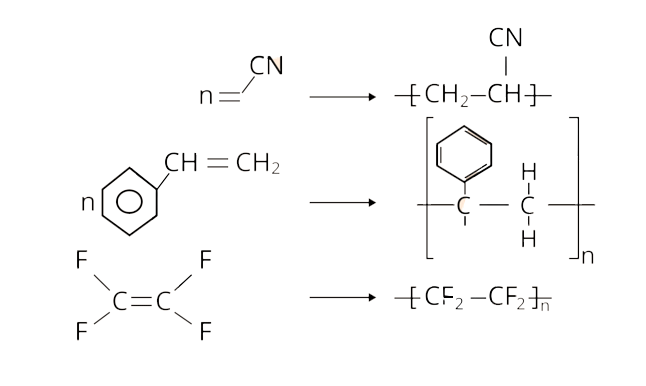
Which of the following polymers have vinylic monomer units?

(A) Acrilan

(B) Polystyrene

(C) Nylon

(D) Teflon

Show solutionHide solution
Worked solution

Ans: Option (A), (B) and (D)

Explanation:

Polyacrylonitrile is formed by the addition polymerisation of acrylonitrile in the presence of a peroxide catalyst. Polyacrylonitrile is used as a wool substitute in the manufacture of commercial fibers such as orlon or acrilan.

Polystyrene has the monomer unit styrene.

Teflon is made by heating tetrafluoroethene at high pressures with a free radical or persulphate catalyst.


seo images


Q19Written answer

Vulcanisation makes rubber ______________.

(A) more elastic

(B) soluble in inorganic solvent

(C) crystalline

(D) more stiff

Show solutionHide solution
Worked solution

Ans: Option (A) and (D)

Explanation:

Vulcanisation is a process used to improve the physical properties of natural rubber. This method involves heating a mixture of raw rubber, sulphur, and an appropriate additive to temperatures ranging from 373 K to 415 K. Sulphur forms cross links at the reactive sites of double bonds during vulcanisation, stiffening the rubber.