Q33Written answer
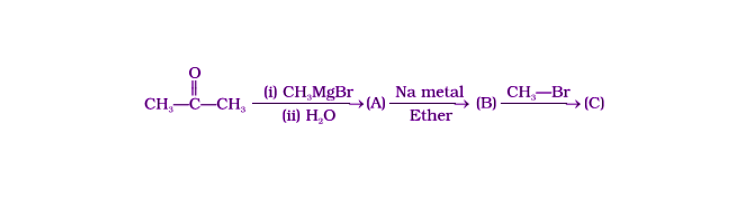
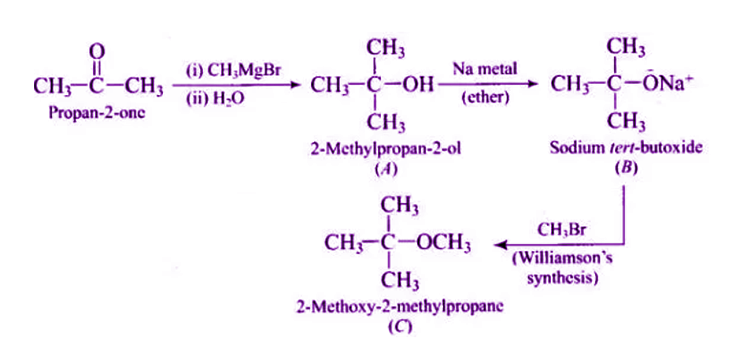
Identify the compounds A, B and C in the following reaction.
Show solutionHide solution
Worked solution
Compound A = CH3-MgBr
Compound B = CH3-COOH
Compound C = CH3COOCH3
Your cart is empty.
Practice each question, then open the answer or worked solution.
Identify the compounds A, B and C in the following reaction.
Compound A = CH3-MgBr
Compound B = CH3-COOH
Compound C = CH3COOCH3
Why are carboxylic acids more acidic than alcohols or phenols although all of them have a hydrogen atom attached to an oxygen atom (—O—H)?
Due to the resonance in carboxylic acids, the negative charge is at the more electronegative oxygen whereas, in alcohols or phenols, the negative charge is on a less electronegative atom. Thus, carboxylic acids can release proton easier than alcohols or phenols.
Complete the following reaction sequence.
Ethylbenzene is generally prepared by acetylation of benzene followed by reduction and not by direct alkylation. Think of a possible reason.
This is due to the formation of polysubstituted products.
To avoid the formation of polysubstituted products Friedel-craft’s alkylation reaction is not used for the preparation of ethylbenzene but one can use Friedel-craft’s acylation reaction.
Can Gatterman-Koch reaction be considered similar to Friedel Craft’s acylation? Discuss.
Both reactions resemble each other. In Friedel Craft’s acylation reaction, an aryl group or benzene is treated with an acid chloride in the presence of anhydrous AlCl3 and corresponding aldehyde or ketone is formed. In Gatterman-Koch reaction, benzene is treated with CO and HCl in the presence of AlCl3 and CuCl to yield benzaldehyde.
IV. Matching Type
Note: Match the items of Column I and Column II in the following questions.
Match the common names given in Column I with the IUPAC names given in
Column II
| Column I Common names
(i) Cinnamaldehyde (ii) Acetophenone (iii) Valeraldehyde (iv) Acrolein (v) Mesityl oxide |
Column II (IUPAC names)
(a) Pentanal (b) Prop-2-enal (c) 4-Methylpent-3-en-2-one (d) 3-Phenylprop-2-enal (e) 1-Phenylethanone |
(i) is d
(ii) is e
(iii) is a
(iv) is b
(v) is c
Match the acids given in Column I with their correct IUPAC names given in
Column II.
| Column I (Acids)
(i) Phthalic acid (ii) Oxalic acid (iii) Succinic acid (iv) Adipic acid (v) Glutaric acid |
Column II (IUPAC names)
(a) Hexane-1,6-dioic acid (b) Benzene-1,2-dicarboxylic acid (c) Pentane-1,5-dioic acid (d) Butane-1,4-dioic acid (e) Ethane-1,2-dioic acid |
(i) is b
(ii) is e
(iii) is d
(iv) is a
(v) is c
Match the reactions given in Column I with the suitable reagents given in
Column II.
| Column I (Reactions)
(i) Benzophenone → Diphenylmethane (ii) Benzaldehyde → 1-Phenylethanol (iii) Cyclohexanone → Cyclohexanol (iv) Phenyl benzoate → Benzaldehyde |
Column II(Reagents)
(a) LiAlH4 (b) DIBAL—H (c) Zn(Hg)/Conc. HCl (d) CH3MgBr |
(i) is c
(ii) is d
(iii) is a
(iv) is b
Match the example given in Column I with the name of the reaction in Column II
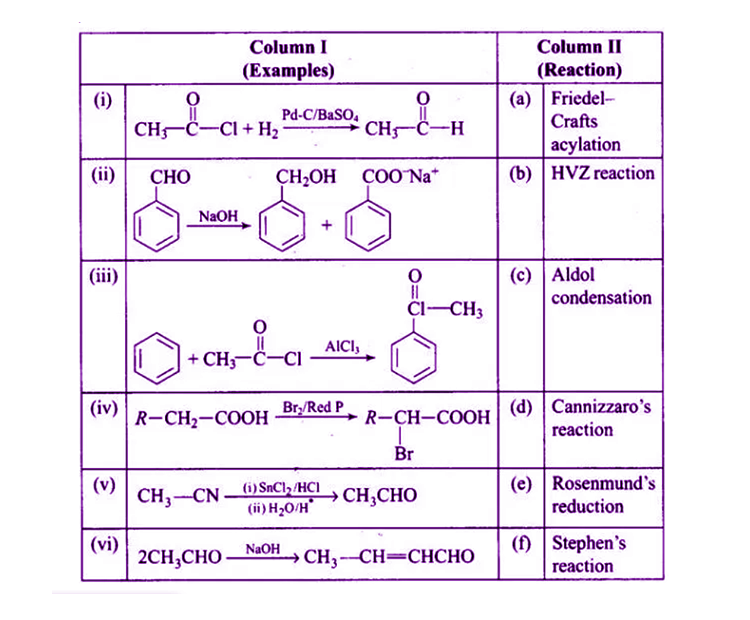
(i) is e
(ii) is d
(iii) is a
(iv) is b
(v) is f
(vi) is c
V. Assertion and Reason Type
Note: In the following questions a statement of assertion followed by a
statement of reason is given. Choose the correct answer out of the following
choices.
(i) Assertion and reason both are correct and the reason is the correct explanation
of assertion.
(ii) Assertion and reason both are wrong statements.
(iii) The assertion is a correct statement but the reason is the wrong statement.
(iv) The assertion is a wrong statement but the reason is the correct statement.
(v) Assertion and reason both are correct statements but the reason is not the correct
explanation of assertion.
Assertion: Formaldehyde is a planar molecule.
Reason: It contains sp2 hybridised carbon atom.Solution:
Option (i) is correct.
Solution coming soon.