Q23Written answer
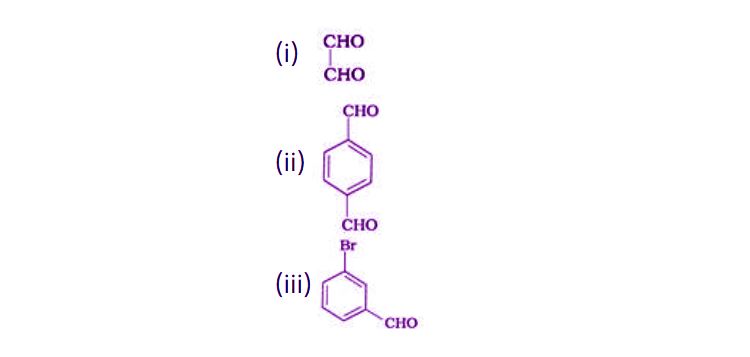
Write IUPAC names of the following structures.
Show solutionHide solution
Worked solution
(i) Ethane-1,2-dial.
(ii) Benzene-1, 4-dicarbaldehyde.
(iii) 3-Bromobenzaldehyde.
Your cart is empty.
Practice each question, then open the answer or worked solution.
Write IUPAC names of the following structures.
(i) Ethane-1,2-dial.
(ii) Benzene-1, 4-dicarbaldehyde.
(iii) 3-Bromobenzaldehyde.
Benzaldehyde can be obtained from benzal chloride. Write reactions for obtaining benzyl chloride and then benzaldehyde from it.
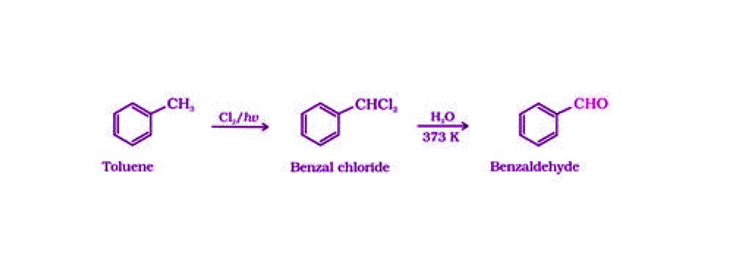
Toluene is first converted to benzal chloride by side-chain chlorination, in presence of Chlorine gas and light. Benzal chloride on hydrolysis at 373K gives benzaldehyde.
Name the electrophile produced in the reaction of benzene with benzoyl chloride in the presence of anhydrous AlCl3. Name the reaction also.
The electrophile produced in the reaction of benzene with benzoyl chloride in the presence of anhydrous AlCl3 is benzoylinium cation. The product formed in this reaction is benzophenone. This reaction is called Friedel Craft’s acylation reaction.
Oxidation of ketones involves carbon-carbon bond cleavage. Name the products formed on oxidation of 2, 5-dimethylhexan-3-one.
The products formed on oxidation of 2, 5-dimethylhexan-3-one are the mixtures of ketone and carboxylic acids. Ketone is then further oxidized to carboxylic acids. Overall the products formed in this reaction are 2-Methylpropanoic acid, 3-Methylbutanoic acid, ethanoic acid and methanoic acid.
Arrange the following in decreasing order of their acidic strength and give the reason for your answer.
CH3CH2OH, CH3COOH, ClCH2COOH, FCH2COOH, C6H5CH2COOH
FCH2COOH > ClCH2COOH > C6H5CH2COOH > CH3COOH > CH3CH2OH.
CH3CH2OH is least acidic among the given compounds. C6H5CH2COOH is more acidic than CH3COOH due to the resonance in C6H5CH2COOH. FCH2COOH and ClCH2COOH are highly acidic due to the –I effect of halogen.
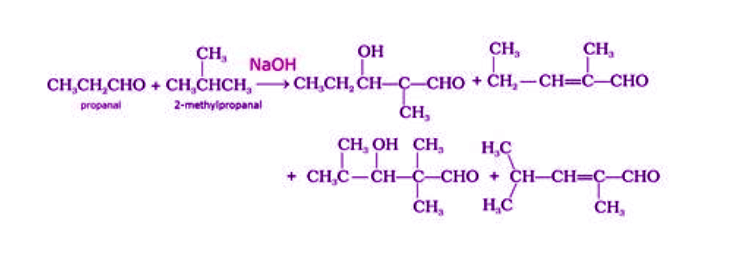
What product will be formed on reaction of propanal with 2-methyl propanal in the presence of NaOH? What products will be formed? Write the name of the reaction also.
When propanal reacts with 2-methyl propanal in the presence of NaOH, the mixture of aldehydes are formed. Both the reactants have an alpha-hydrogen and hence, can undergo cross aldol reaction in the presence of NaOH.
Compound ‘A’ was prepared by oxidation of compound ‘B’ with alkaline KMnO4. Compound ‘A’ on reduction with lithium aluminium hydride gets converted back to compound ‘B’. When compound ‘A’ is heated with compound B in the presence of H2SO4 it produces the
fruity smell of compound C to which family the compounds ‘A’, ‘B’ and ‘C’ belong to?
Compound ‘A’ belongs to the carboxylic acid.
Compound ‘B’ belongs to alcohol.
Compound ‘C’ belongs to an ester group.
Arrange the following in decreasing order of their acidic strength. Explain the arrangement.
C6H5COOH, FCH2COOH, NO2CH2COOH
NO2CH2COOH > FCH2COOH > C6H5COOH.
NO2CH2COOH is most acidic among the given three compounds. Electron withdrawing groups like -NO2, increases the acidity of carboxylic acids by stabilizing the conjugate base through resonance effects
Alkenes and carbonyl compounds both contain a π bond but alkenes show electrophilic addition reactions whereas carbonyl compounds show nucleophilic addition reactions. Explain.


Both the compounds carbon atom is attached to the electronegative atom oxygen. Thus the oxygen pulls more shared pair of electron towards them and a partial positive charge will be acquired by carbon and a partial negative charge by oxygen. So carbonyl atom is attacked by a nucleophile.
Carboxylic acids contain carbonyl group but do not show the nucleophilic addition reaction like aldehydes or ketones. Why?
The oxygen atom in carbonyl compound pull more shared pair of electron towards itself and so, carbon acquires partial positive charge and oxygen acquires partial negative charge in carbonyl compounds. So, the carbon in the carbonyl atom is attacked by a nucleophile. Due to the resonance, carboxylic acids contain carbonyl group do not show the nucleophilic addition reaction like aldehydes or ketones