Q13Written answer
Which of the following compounds do not undergo aldol condensation?
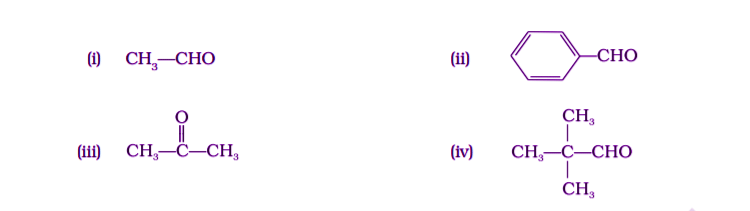
Show solutionHide solution
Worked solution
Option (ii) and (iv) are the answers.
Your cart is empty.
Practice each question, then open the answer or worked solution.
Which of the following compounds do not undergo aldol condensation?
Option (ii) and (iv) are the answers.
Treatment of compound with NaOH solution yields
(i) Phenol
(ii) Sodium phenoxide
(iii) Sodium benzoate
(iv) Benzophenone
Option (ii) and (iii) are the answers.
Which of the following conversions can be carried out by Clemmensen
Reduction?
(i) Benzaldehyde into benzyl alcohol
(ii) Cyclohexanone into cyclohexane
(iii) Benzoyl chloride into benzaldehyde
(iv) Benzophenone into diphenylmethane
Option (ii) and (iv) are the answers.
Through which of the number of the following reactions of carbon atoms can be
increased in the chain?
(i) Grignard reaction
(ii) Cannizaro’s reaction
(iii) Aldol condensation
(iv) HVZ reaction
Option (i) and (iii) are the answers.
Benzophenone can be obtained by ____________.
(i) Benzoyl chloride + Benzene + AlCl3
(ii) Benzoyl chloride + Diphenyl cadmium
(iii) Benzoyl chloride + Phenyl magnesium chloride
(iv) Benzene + Carbon monoxide + ZnCl2
Option (i) and (ii) are the answers
Which of the following is the correct representation for intermediate of nucleophilic addition reaction to the given carbonyl compound (A) :
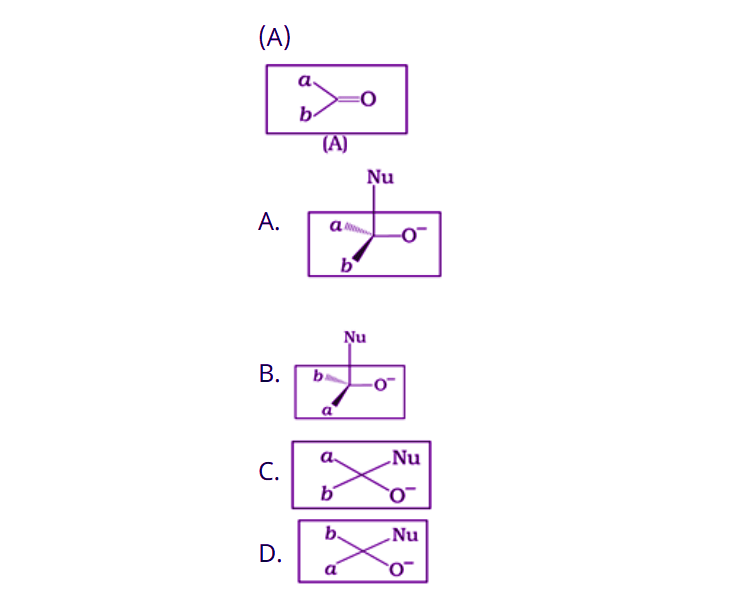
Option (A) and (B) are the answers.
III. Short Answer Type
Why is there a large difference in the boiling points of butanal and butane-1-ol?
Butanal has no intermolecular hydrogen bonding but butan-1-ol has intermolecular hydrogen bonding. This bonding in butan-1-ol makes it more stable at a higher temperature than butanal.
Write a test to differentiate between pentan-2-one and pentan-3-one.
One can differentiate between pentan-2-one and pentan-3-one by iodoform test. Pentan-2-one have a –CO-CH3 group and therefore forms a yellow precipitate of Iodoform. Pentan-2-one gives a positive iodoform test, whereas, and pentan-3-one does not give a positive iodoform test because they don’t have a –CO-CH3 group.
Give the IUPAC names of the following compounds
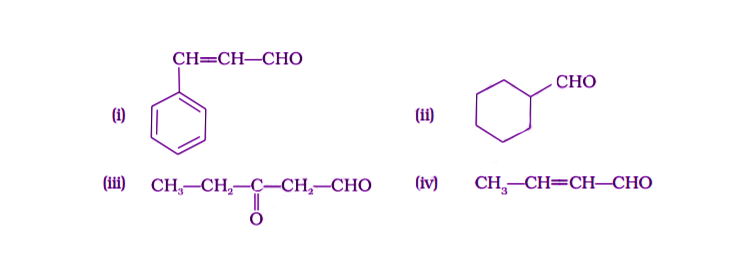
(i) 3-Phenylprop-2-ene-1-al.
(ii) Cyclohexanecarbaldehyde
(iii) 3-Oxopentan-1-al
(iv) IUPAC name: But-2-enal
Give the structure of the following compounds.
(i) 4-Nitropropiophenone
(ii) 2-Hydroxycyclopentanecarbaldehyde
(iii) Phenyl acetaldehyde
(i)

(ii)