My Cart
Your Cart 0

    Your cart is empty.

  • Total (Amount) ₹0.00
NCERT Exemplar · Class 12 · Chemistry

Chapter 11: Alcohols, Phenols and Ethers

Practice each question, then open the answer or worked solution.

Questions

56 questions
Q31Written answer

Out of o-nitrophenol and p-nitrophenol, which is more volatile? Explain.

Show solutionHide solution
Worked solution

Due to the presence of intramolecular hydrogen bonding between the NO2 and OH group, the o-nitrophenol is more volatile.

Q32Written answer

Out of o-nitrophenol and o-cresol, which is more acidic?

Show solutionHide solution
Worked solution

There is an electron-withdrawing group NO2 that is present in the ortho position in ortho-nitrophenol, which enhances the acidic strength and makes it more acidic. In o-cresol, there is an electron-releasing group that decreases acidic strength.

Q33Written answer

When phenol is treated with bromine water, a white precipitate is obtained. Give the structure and the name of the compound formed.

Show solutionHide solution
Worked solution

The name of the compound formed in this reaction is 2,4,6-tribromophenol. The structure of the compound formed is:

NCERT Exemplar Solutions of Class 12 Chemistry Chapter 11 Alcohol, Phenols and Ethers-13

Q34Written answer

Arrange the following compounds in increasing order of acidity and give a suitable explanation. Phenol, o-nitrophenol, o-cresol

Show solutionHide solution
Worked solution

Increasing order of the acidity of the given compounds: o-cresol < Phenol < o-nitrophenol.

Due to the presence of the electron-withdrawing group, NO2 o-nitrophenol becomes more acidic. The remaining has an electron-releasing group which decreases the acidic strength.

Q35Written answer

Alcohols react with active metals e.g. Na, K etc., to give corresponding alkoxides.

Write down the decreasing order of reactivity of sodium metal towards primary, secondary and tertiary alcohols

Show solutionHide solution
Worked solution

The decreasing order of reactivity of sodium metal towards alcohols: Primary alcohols > secondary alcohols > tertiary alcohols

The reactivity of sodium metal towards tertiary alcohols is lowest mainly due to two reasons. First, steric hindrance of the alkyl groups. Second, an increase in the electron density of the Oxygen atom in the hydroxyl bond.

Q36Written answer

What happens when benzene diazonium chloride is heated with water?

Show solutionHide solution
Worked solution

When benzene diazonium chloride is heated with water, Phenol is formed along with the by-products, Nitrogen gas and Hydrochloric acid.

Q37Written answer

Arrange the following compounds in decreasing order of acidity.

H2O, ROH, HC ≡ CH

Show solutionHide solution
Worked solution

The decreasing order of the acidity of the given compounds:

H2O > ROH > HC ≡ CH

HC ≡ CH is less acidic because the carbon atoms here are sp hybridised, so the electron density is higher on the carbon atom.

Q38Written answer

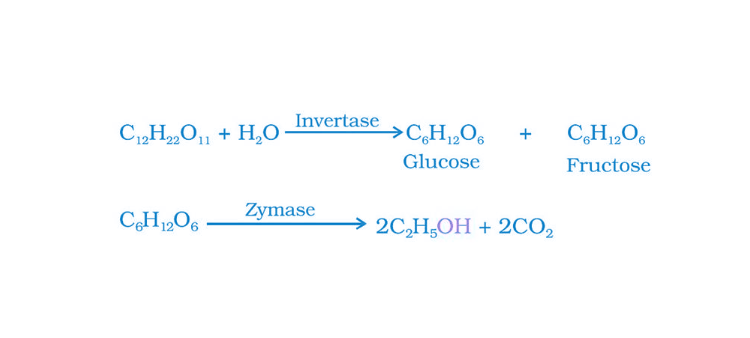
Name the enzymes and write the reactions involved in the preparation of ethanol from sucrose by fermentation.

Show solutionHide solution
Worked solution

The names of the enzymes involved in the preparation of ethanol from sucrose by fermentation are invertase and zymase.

Invertase converts sucrose into glucose and fructose. Then, glucose and fructose undergo fermentation in the presence of zymase, and ethanol is produced.

NCERT Exemplar Solutions of Class 12 Chemistry Chapter 11 Alcohol, Phenols and Ethers-14

Q39Written answer

How can propane-2-one be converted into tert- butyl alcohol?

Show solutionHide solution
Worked solution

Propane-2-one is treated with CH3MgBr in the presence of dry ether (Grignard reagent), followed by hydrolysis to yield tert- butyl alcohol.

Q40Written answer

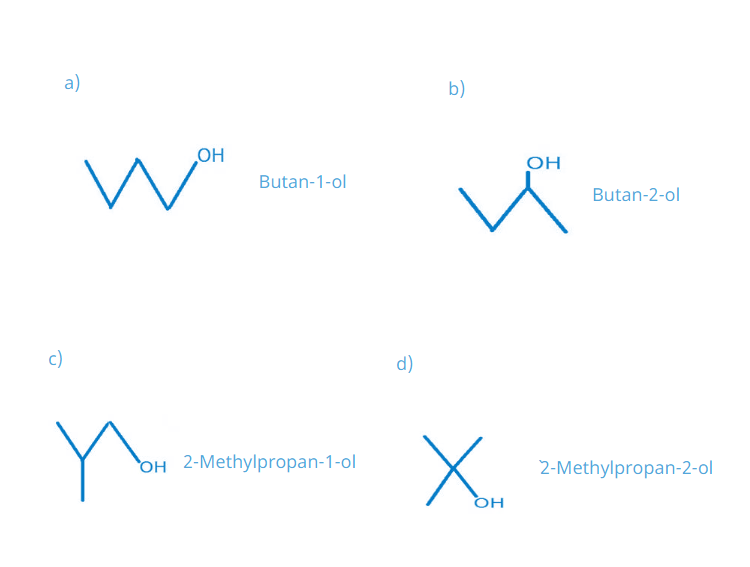
Write the structures of the isomers of alcohols with molecular formula C4H10O. Which of these exhibits optical activity?

Show solutionHide solution
Worked solution

NCERT Exemplar Solutions of Class 12 Chemistry Chapter 11 Alcohol, Phenols and Ethers-15

Here, only Butan-2-ol exhibits optical activity because it has a chiral carbon atom.